Local broadcasters keep you connected and informed. Learn about how we serve Americans every day, the economic impact we have on local communities, read stories of broadcasters' public service and more.
In 2025, local broadcasters came together to advance our shared mission of informing communities, strengthening local journalism, providing the best entertainment and keeping audiences safe. This Year in Review highlights the milestones we achieved together through advocacy, education and innovation leadership.
Join our team of broadcast advocates. When legislative issues arise that could impact your station and career, we'll reach out and give you simple steps to contact your legislators.
The NAB Leadership Foundation works with current and aspiring leaders in broadcasting to build a more diverse, innovative and vibrant future for the industry by investing in our greatest resource: our people.
The premier destination for innovation – an unrivaled marketplace of bleeding-edge products, services and ideas – NAB Show drives the future of our industry across the entire workflow of creation, distribution, management and monetization.
NAB's SmartBrief is a daily snapshot of broadcast industry news pulled from numerous leading media sources. SmartBrief contains summaries of the news that matters to you, written by expert editors to save you time and keep you informed and prepared.
My NAB is a platform designed to create a more personalized and enhanced experience for our members to interact with NAB, access members-only content and easily register for programs and awards.
The Broadcast Resource Hub, powered by the National Association of Broadcasters and the NAB Leadership Foundation is a comprehensive one-stop shop for resources, tools and information on the most relevant issues impacting local television and radio stations.
NAB Member Services provides members with tools and resources to support their professional needs and interests. It's our mission to deliver benefits that positively impact members' business operations and career progression, as well as strengthen the future of broadcasting.
Allow Broadcasters to Continue Negotiating in the Free Market
ISSUE SUMMARY
For decades, the Department of Justice's (DOJ) Antitrust Division has maintained that local broadcast television stations compete only against one another when analyzing mergers and other competition issues. This view is out of sync with today’s media marketplace.
With the explosive growth of online video and digital content along with the proliferation of cable and satellite television channels, broadcasters face intense competition for audiences and local advertising dollars.
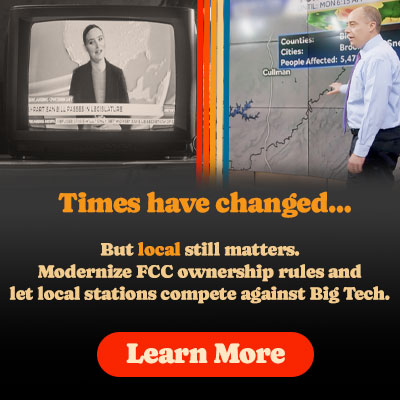
Yet, the DOJ’s outdated viewpoint stifles broadcasters' ability to achieve efficiencies to allow them to best serve audiences with the high-quality entertainment and locally-focused news, weather and sports they have come to expect. It is well past time for the DOJ to update its regulatory policies to reflect the realities of the 21st century media market.
As a direct result of the DOJ's narrow view of the media marketplace, broadcasters face strict limitations in acquiring stations and taking advantage of important economies of scale.
This skews the competitive playing field because giant tech companies such as Facebook and Google, large pay-TV and broadband providers such as Charter Spectrum and Verizon, and online video providers like Netflix and Amazon are not subject to comparable limitations.
Yet, broadcasters compete with them for local viewers and advertising dollars. Neither consumers nor advertisers believe that local TV stations are their only options for accessing video content or placing advertisements:
Broadcast TV stations have lost and continue to lose advertising dollars to digital platforms, which dominate the local advertising market. According to Borrell Associates, digital advertising accounts for close to three-quarters of all advertising by local businesses, and about 84 percent of this “local” digital advertising goes out of market, spent mostly with providers such as Google and Meta. Only about 16 percent of local businesses' digital advertising dollars are spent with local media companies, including broadcast TV and radio stations and newspapers.
According to estimates from eMarketer and BIA Advisory Services (BIA), the U.S. advertising revenues of Google alone were far more than double the combined ad revenues of all local TV and radio stations in the country in 2025.
Surveys and studies conducted by industry analysts and economists, including Borrell, BIA and NERA Economic Consulting, have found that advertisers who utilize broadcast stations also use a wide range of other platforms, especially digital, and that advertisers view digital platforms as substitutes for local broadcast advertising. Competition to TV broadcasters from digital video platforms continues to expand, with rapid growth of advertising on free ad-supported streaming TV and ad-supported subscription video on demand services and via internet-connected TV devices.
Broadcast TV stations have lost and continue to lose audiences to online options. Nielsen's monthly TV and streaming snapshot called “The Gauge” has documented the rapid increase of consumers’ total time spent viewing streaming, at the direct expense of traditional linear television. Streaming far exceeds - indeed doubles - broadcast TV viewing, with YouTube alone routinely garnering more than 12 percent of total TV viewing each month.
The DOJ should recognize what broadcasters, cable and satellite providers, online content providers, advertisers and consumers already know: technological advances have transformed the media landscape.
In light of these vast changes, the DOJ should reevaluate its approach for defining the relevant market and analyzing competition when reviewing broadcast TV station mergers.