|
NAB
Encouraging Broadcaster Participation
in the FCC’s Disaster Information
Reporting System (DIRS)
NAB is encouraging
broadcasters to participate in the FCC’s Disaster Information
Reporting System (DIRS). A free 30-minute webinar will be held
on Tuesday, July 14, 2009 starting at 3:30 p.m. EDT, to explain
the benefits for broadcasters that participate in DIRS, and provide
step-by-step instructions for obtaining a DIRS account and reporting
a station's situation during a major disaster. Additional information
on this webinar including how to sign up is available on the Internet
at www.tvworldwide.com/events/nab/dirs/090714/.
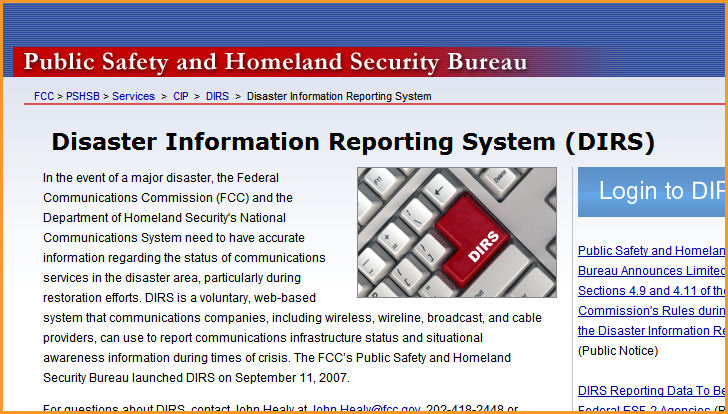
DIRS was launched
on September 11, 2007 to help the FCC and the Department of Homeland
Security's National Communications System (NCS) obtain accurate
information regarding the status of communications services during
a major disaster, particularly during restoration efforts. DIRS
is a voluntary, web-based system that communications companies,
including wireless, wireline, broadcast, and cable providers,
can use to report communications infrastructure status and situational
awareness information during times of crisis. The FCC, Federal
Emergency Management Agency (FEMA) and local public safety officials
rely on the information in DIRS to identify and help broadcast
stations in need of fuel, generators and other needed equipment
during times of emergencies.
Data entry
into DIRS is facilitated by the use of templates that are tailored
for different communications sectors (i.e., wireless, wireline,
broadcast, and cable). Participating communications providers
initially log onto the system to provide emergency contact information.
When DIRS is activated (during a major disaster), participating
communications providers that serve areas affected by the disaster
will be able to voluntarily submit information regarding the status
of their communications equipment, restoration efforts, power
(i.e., whether they are using commercial power, generator or battery),
and access to fuel. During an activation, participants need only
to update their DIRS information once a day, and this may be done
remotely by anyone with access to the Internet and with knowledge
of the username and password for the facility (chosen during initial
login). Since its inception, DIRS has been activated three times
– during hurricanes Gustav (August 2008) and Ike (September
2008), and during the Kentucky Ice storms in February, 2009.
Because the information that communications companies input to
DIRS is sensitive, for national security and/or commercial reasons,
DIRS filings are treated as confidential, however, information
submitted to DIRS may be shared with the NCS on a confidential
basis.
Participants
in the webinar will hear from the following experts from the FCC
and NAB, and will have the opportunity to engage in live Q&A
throughout the session:
John Healy,
Communications Systems Analysis Division, Public Safety and Homeland
Security Bureau, FCC
Larry Walke, associate general counsel, NAB
David Layer, senior director, advanced engineering, NAB
Additional
information on DIRS including information on how to participate
can be found on the FCC’s Web page at www.fcc.gov/pshs/services/cip/dirs/dirs.html.
2009
NAB Radio Show Engineering Program
 This
year’s three-day Radio Show Engineering Program focuses on
planning, building and maintaining an IP-based radio facility,
operating under emergency conditions, computerized antenna modeling,
preventing tower failures, datacasting opportunities and much
more. Our engineering sessions are presented in a workshop-type
environment where you have ample time to ask questions and interact
with experts and your industry peers. This
year’s three-day Radio Show Engineering Program focuses on
planning, building and maintaining an IP-based radio facility,
operating under emergency conditions, computerized antenna modeling,
preventing tower failures, datacasting opportunities and much
more. Our engineering sessions are presented in a workshop-type
environment where you have ample time to ask questions and interact
with experts and your industry peers.
The relaxed
atmosphere of the Radio Show means you always have plenty of time
to network with exhibitors. You’ll learn about their latest
products while enjoying lunch and snacks on the show floor. For
busy radio engineers, the NAB Radio Show is an excellent way to
advance your technical education and maintain your edge in an
increasingly competitive business.


The July 6, 2009 Radio TechCheck is also available
in an Adobe Acrobat file.
Please
click
here to read the Adobe Acrobat version of Radio TechCheck
|