|
 |
 |

|
CALM
Best Practices
The FCC Regulations to implement the CALM Act begin to take effect
December 12, 2012. The requirements these regulations place on stations
were summarized in the December
19, 2011 issue of TV TechCheck. To provide additional
guidance to stations, the NAB TV Technology Committee, with NAB
Labs support, has developed the following "Best Practices"
document. Commercial Advertisement Loudness
Mitigation (CALM) Act Introduction The purpose of this document is to assist in establishing and
maintaining consistent loudness across programs and commercials
throughout the broadcast day for all audio services. There are FCC
Regulations that apply, but this document is intended to be the
practical guidance and a quick reference to the key issues for managing
audio program loudness at various points in the broadcast chain.
It is not intended to supplant ATSC A/851, but to remind those responsible
for the control of audio loudness of important aspects of measuring
and monitoring loudness as outlined in ATSC A/85. It is the responsibility
of the reader to become familiar with A/85 in order to most effectively
manage audio loudness and understand the methods of loudness measurement
and correction. 1. Loudness Monitoring Using ITU-R BS.1770 versus
PPM or VU Metering The most significant change for those involved in the management
of audio loudness is the new paradigm of utilizing a time averaged
loudness measurement. As described in A/85, ITU-R BS.1770 defines
the loudness algorithms used to measure the perceived loudness of
program material. Although many are familiar with using PPM and
VU meters, these meters provide poor correlation to what a listener
perceives as loudness. These meters were primarily intended to protect
downstream equipment from overload and clipping. BS.1770 provides
a frequency weighted, sliding window, time averaged measurement
intended to model human loudness perception and is not intended
as an instantaneous measurement such as provided by a PPM or VU
meter. BS.1770 also provides a true peak reading to monitor and
prevent downstream overload. BS.1770 meters report the measurement
of loudness in terms of units of LKFS, which is a decibel scale. Loudness must be measured for all forms of a program's audio
delivery to listeners, e.g., 5.1-channel surround, stereo downmix,
and monaural sum.3 The loudness of ancillary audio services such
as video description or alternative language versions must also
be measured. 2. Measuring the Loudness of Commercials, Promos, or Programs For short-form content, A/85 recommends that the average loudness
of the full mix be measured over the entire length of the item. Large loudness changes from the segment average should be avoided
near program boundaries when possible. Short-form content within
acceptable limits may have the perception of being loud, when contrasted
with quiet content entering or exiting programs. 3. The AC-3 Metadata Parameter, Dialnorm The simplest method for dealing with the dialnorm parameter (and
the method least likely to cause additional loudness problems) is
to set all audio at a fixed target loudness and with a single encoder
setting (so-called fixed dialnorm). . A/85 recommends a target loudness
of -24 LKFS for stations wishing to use a fixed dialnorm value.
(Note stations can choose to operate at a different fixed target.)
To operate at the -24 fixed loudness, the dialnorm parameter must
be set to 24 in the AC-3 encoder and the audio input managed to
match the average loudness of -24 LKFS. For stations that do not adopt a fixed target loudness (which is
not recommended) the dialnorm value must always match the actual
average audio loudness of each program and each commercial. As each
program (or short form item) changes in average loudness over its
total length, the corresponding dialnorm setting in the AC-3 encoder
must be changed to match. Failure to do so will aggravate audio
loudness problems. Most major networks have chosen to operate with a fixed target
loudness of -24 LKFS, as recommended by A/85. If the station adopts
a fixed loudness of -24 LKFS, dialnorm can be fixed at 24 without
change for all the content that is delivered at -24 LKFS. For stations
that choose to operate without a fixed target loudness (and therefore
choose an agile dialnorm setting), workflow is considerably more
complex. In this case, audio loudness still needs to be determined
and dialnorm metadata must also be managed to match loudness of
all content. Refer to A/85 for guidance before attempting an agile
dialnorm operation. 4. Guidance on Loudness Certification, Program/Commercial
Delivery Specifications and Loudness Correction If the average loudness of any short form content item is measured
with a difference of more than +/- 2dB from the specified target
loudness value of the station, the average loudness of this content
should be adjusted to match the target value by the difference,
in units of dB. If the station measures a difference of more than +/- 2dB from
the target loudness for long form programming, it is recommended
that the program provider re-issue the content or be consulted prior
to correction by the station, if time-to-air permits. 5. Loudness Control via Inline Automatic Controllers 6. Loudness Control via File Delivery Methods It is recommended that files be checked after receipt using a commercially
available product such as a file-based transcoder incorporating
the ITU-R BS.1770 measurement algorithm. Care should be exercised
when using one of these products as most are limited to measurement
and adjustment of the duration of the content's full program mix
only, and therefore, per A/85, limited to use on short-form content.
Once measured, should any loudness offset from the entered target
value be identified, these products make a one-time loudness shift
to all elements of the content to match the desired target. There
is no alteration to dynamic range and quality of the content. Excellent
loudness matching of short-form content loudness can be expected
with this technique. Note: Using one of these products for long form content should
be avoided. Automated checking of the entire file after delivery
might not result in a close match to an anchor element value, especially
when using the 'gated' measurement mode on long form content. Isolation
of the anchor element, ideally used for long form creation and loudness
measurement, may not be available in these commercial products.
When an apparent variance is found in long form content, it
is recommended that the content be rejected and reissued. This document is brought to you by NAB Labs. It was developed under
the auspices of the NAB TV Technology Committee. This document can also be found on the NAB Technology page under
the "Additional Resources" heading
http://www.nab.org/resources/technology.asp
as CALM
Act Summary of Best Practices. NAB
Satellite Uplink Operators Seminar
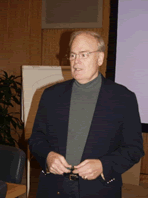
The class is taught by Sidney Skjei, M.S.E.E., P. E. of Skjei Telecom. Mr. Skjei has over 30 years experience in engineering, operating and developing a wide range of hardware and software satellite communications systems and services. He is highly knowledgeable in all major satellite communications operational areas: global, U.S. domestic and military. An article on Mr. Skjei and the seminar appears in the latest issue of TV Technology. The four-day seminar provides the operational training which minimize the risk of satellite transmission interference. This is an important seminar since the FCC rules require that "a trained operator be present at all times during transmissions, at either an earth station site or designated remote control point" [Section 25.271 (b)].
The seminar fee is $1,250 (NAB members) and $1,550 (all others). The seminar fee includes a Satellite Uplink Handbook, continental breakfast and lunch. Space is limited so if you don't want to miss this opportunity, go to the Satellite Seminar Web page or call Cheryl Coleridge at (202) 429-5346. If you are interested in sponsorship opportunities for this event contact NAB Advertising at (800) 521-8624 or advertising@nab.org.
Registration is now open for the Los Angeles Audio Loudness Management Seminar, scheduled for September 27, 2012 at Universal Studio's Hitchcock Theater. More information, including the day's program and registration link, is available online: http://www.atsc.org/cms/index.php/communications/seminars/299-2012-atsc-audio-seminars Additionally, we are looking for lunch sponsors for this event. Please contact Lindsay Shelton-Gross for a detailed description of sponsorship benefits! Registration
Open for 2012 IEEE Broadcast Symposium In addition to technical presentations and tutorial sessions, this year's program features a panel discussion on broadcast towers and an update on the government's broadband plan, spectrum usage, and broadcast audio issues. The Symposium also offers attendees the opportunity to network and socialize with their peers at evening receptions and luncheon programs. This year's luncheon keynote speakers are Kevin Gage, NAB's executive vice president and chief technology officer, and Sam Matheny, Capitol Broadcasting's vice president of policy and innovation. For those unable to attend in person, all Symposium sessions will be made available globally via live and archived streaming on the Internet. Also, up to 2.5 Continuing Education units (CEUs) are available to on-site attendees. Complete information is available on the Symposium website. The three-day event will be held at The Westin Alexandria hotel in Alexandria, Va. Early registration is encouraged in order to take advantage of special rates which expire after Oct. 1, 2012. Special early bird hotel room rates are also available. For complete registration information, visit the organization's website at http://bts.ieee.org/broadcastsymposium. |

 Join
fellow satellite uplink operators, engineers and technicians for
NAB's Satellite Uplink Operators Training Seminar on September
24- 27 at NAB headquarters in Washington, D.C. In this comprehensive
four-day class, you'll learn how to set up an interference-free
uplink every time. This seminar provides in-depth information on
the theory of satellite communications and all operational aspects
of the ground equipment for uplink and downlink facilities and is
applicable to distributing signals for both analog and digital television
and radio.
Join
fellow satellite uplink operators, engineers and technicians for
NAB's Satellite Uplink Operators Training Seminar on September
24- 27 at NAB headquarters in Washington, D.C. In this comprehensive
four-day class, you'll learn how to set up an interference-free
uplink every time. This seminar provides in-depth information on
the theory of satellite communications and all operational aspects
of the ground equipment for uplink and downlink facilities and is
applicable to distributing signals for both analog and digital television
and radio.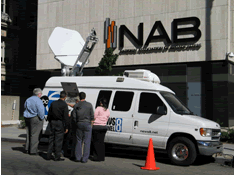 In
addition to classroom instruction, students will receive hands-on
training in a satellite newsgathering (SNG) truck as well as an
all-day field trip to a nearby, large satellite teleport and operations
center.
In
addition to classroom instruction, students will receive hands-on
training in a satellite newsgathering (SNG) truck as well as an
all-day field trip to a nearby, large satellite teleport and operations
center.  Registration
for the
Registration
for the|
|




ADVERTISEMENTS