|
 |
 |

|
New
Report on Lab Testing of FM IBOC
There have been a number of technical studies conducted on so-called asymmetric sideband technology, and last month a report was released on a laboratory test effort conducted by iBiquity Digital Corporation with funding provided by the NAB FASTROAD technology advocacy program (see the February 28, 2011 issue of Radio TechCheck for information on an earlier companion field test report). This latest report was also submitted to the FCC by iBiquity in December 2011 along with comments on an FCC Public Notice proposing to authorize use of asymmetric sideband technology. 
In the lab test report, iBiquity discusses the improvements in the peak-to-average power ratio reduction (PAPR) algorithms needed to implement the asymmetric sideband waveform, and then summarizes the results of a laboratory evaluation of the expected improvement in digital signal-to-noise ratio (SNR) that may be realized by FM stations using asymmetric sidebands. The laboratory tests were performed using three typical automotive HD Radio receivers, each with a different HD Radio chipset (either the ST Micro STA-680, the NXP SAF 3560 or the Texas Instruments Jacinto). 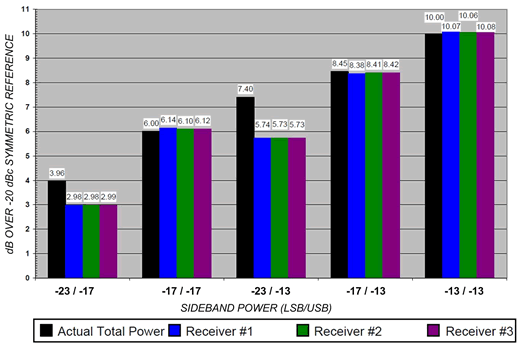
Briefly, these tests established the bit error rate (BER) performance of the receivers under test as a function of digital SNR for various digital sideband configurations, both symmetric and asymmetric. Shown in the table is the increase in total digital power for various sideband configurations compared to the legacy configuration (equal power sidebands, total digital power of -20 dBc). Ideally, the improvement in digital SNR should track this increase in digital power so that, for example, in the case where the LSB and USB powers are set to -23 and -17 dBc, respectively (first row in table), and the total increased digital power is 3.96 dB, the expected improvement in digital SNR would also be 3.96 dB. An example of the lab test results is shown in the figure, for a case where there is no interfering adjacent channel present. Each group of columns in the figure corresponds to one of the configurations shown in the table. The measured values indicate the improvement in digital SNR (in dB above the -20 dBc symmetric reference case) at which a BER of 5x10e5 was achieved. Note that in the symmetric cases (-17/-17 and -13/-13), the expected performance (black columns) and the observed performance is virtually identical, as is also true for the case with a 4 dB asymmetry (-17/-13). However, the cases with greater asymmetry demonstrate a shortfall over the expected performance. For the first case (-23 /-17), the expected digital SNR improvement is 3.96 dB, however the measured improvement for each receiver was only about 3 dB (a 1 dB shortfall), and similarly for the third case (-23 / -13) where a 2 dB shortfall is measured. iBiquity believes that this shortfall is due to coding losses that are brought about by the extreme asymmetry in these received signals. The full text of this report and information on the NAB FASTROAD technology advocacy program are available at www.nabfastroad.org. Inquiries on these results are encouraged – please contact NAB Technology Senior Director, Advanced Engineering David Layer at dlayer@nab.org. NAB’s filed comments with the FCC on the asymmetric sideband public notice are available here. |
 FM
broadcasters using the HD Radio digital radio system have, since
early 2010, been allowed to increase the power in the digital sidebands
of their IBOC signals by 6 to 10 dB, resulting in a much improved
coverage area, better signal penetration into buildings, better
multicast channel reception and enhanced performance into portable
consumer devices. For some stations, the amount of power increase
allowed is limited by the presence of a close upper- or lower-first
adjacent signal, and in these cases it would be helpful if broadcasters
were allowed to operate the upper and lower digital sidebands at
different (unequal) power levels (currently, FCC rules require equal-power
sidebands).
FM
broadcasters using the HD Radio digital radio system have, since
early 2010, been allowed to increase the power in the digital sidebands
of their IBOC signals by 6 to 10 dB, resulting in a much improved
coverage area, better signal penetration into buildings, better
multicast channel reception and enhanced performance into portable
consumer devices. For some stations, the amount of power increase
allowed is limited by the presence of a close upper- or lower-first
adjacent signal, and in these cases it would be helpful if broadcasters
were allowed to operate the upper and lower digital sidebands at
different (unequal) power levels (currently, FCC rules require equal-power
sidebands). |
NAB
Accepting Nominations for 2012 NAB Engineering Achievement Awards Additional information and a nomination form are available on NAB's website. The deadline for nominations is January 23, 2012.
The January 9, 2012Radio TechCheck is also available in an Adobe Acrobat file. Please click here to read the Adobe Acrobat version of Radio TechCheck. |


ADVERTISEMENTS