|  |  |

|
New Report on Field Testing of FM IBOC with Asymmetric Sidebands Many FM digital radio broadcasters have taken advantage of the FCC’s rule change allowing for increased power in the digital sidebands, to improve coverage area, enhance reception for portable devices and allow for better signal penetration into buildings. For some stations, the amount of power increase allowed is limited by the presence of a close upper- or lower-first adjacent signal, and in these cases it would be helpful if broadcasters were allowed to operate the upper and lower digital sidebands at different (unequal) power levels (currently, FCC rules require equal-power sidebands). To that end, significant work is being done on the design and test of technology allowing for use of unequal sidebands, typically referred to as asymmetric sidebands (see the October 11, 2010 issue of Radio TechCheck for additional information). NAB FASTROAD today announced the release of a report on field testing of HD Radio asymmetric (unequal) sidebands undertaken by iBiquity Digital Corporation (Columbia, Md), developers of the HD Radio IBOC system used by U.S. broadcasters to transition to digital radio. This work was co-funded by iBiquity and NAB FASTROAD, with technical support provided by Greater Media station WKLB-FM (Ch. 273B, 102.5 MHz, Waltham, Mass.). The report, entitled “FM HD Radio Field Performance With Unequal Digital Sideband Carrier Levels (Preliminary),” characterizes the digital coverage improvement that may be realized by a typical FM class B station using asymmetric digital sidebands. This transmission method affords broadcasters the ability to mitigate potential first-adjacent digital-to-analog interference by allowing independent adjustment of upper and lower IBOC digital sideband levels, maximizing the allowable power in the digital sidebands as a result. WKLB, located in the Boston, Mass. market, was used to host these tests. Under experimental authorization from the FCC, a number of asymmetric sideband scenarios were established and then digital coverage measurements were made using a test vehicle on two different test routes, with one route to the north of the WKLB transmitter (on I-93, starting at I-495 then progressing north through Derry, Manchester and Hooksett, N.H.), and a southerly route on I-95, starting at I-495 and heading south through Pawtucket and Providence, R.I. Shown in the maps below is a sample of the results obtained from this testing. These maps compare the digital coverage obtained on the northerly route using symmetric then asymmetric digital sidebands. The test route is shown as the green and yellow line, which indicates for any location along the route whether the receive mode was digital (green) or had blended to analog (yellow) because of some RF signal impairment (e.g., blockage, interference, weak signal, etc.). 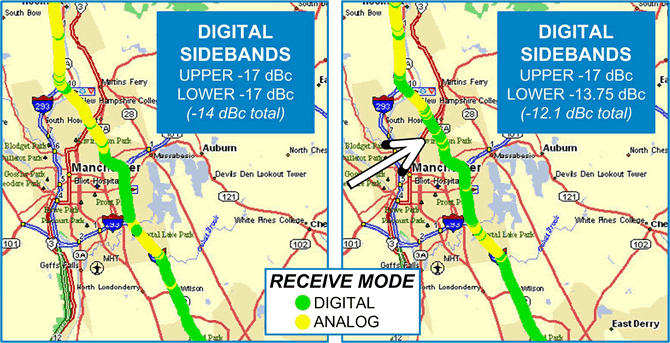
The symmetric case is shown in the map at left; this case is representative of a station that is operating at a total digital power level of -14 dBc which is the FCC’s “blanket” authorization level for higher power FM IBOC operation. In the asymmetric case shown at right, the upper digital sideband level is unchanged, but the lower digital sideband level is now increased by 3.25 dB resulting in a total digital power level of -12.1 dBc. This case is representative of the situation where a station has a closely-spaced upper first-adjacent signal, but no closely-spaced lower first-adjacent signal. The increased digital coverage due to the asymmetric sideband operation is apparent in the region pointed to by the white arrow (in the map at right). iBiquity is in the process of conducting additional laboratory tests on asymmetric operation, the results of which will be released soon. While broadcasters are not yet allowed to use this new technique under existing FCC rules (except by experimental authorization), these test results (and others, notably the tests done by NPR Labs discussed in the October 11, 2010 issue of Radio TechCheck) will provide a basis for requesting a rules modification allowing for use of this digital coverage-improving technology. The full text
of this report and information on the NAB FASTROAD technology advocacy
program are available online.
Inquiries on these results are encouraged – please contact
NAB Science and Technology Senior Director, Advanced Engineering
David Layer at dlayer@nab.org.
iBiquity field test and implementation manager Russ Mundschenk will be discussing this work at the 2011 NAB Broadcast Engineering Conference (Las Vegas, Nev., April 10-14, 2011on Sunday, April 10, 2011 starting at 1 p.m. in room S228 of the Las Vegas Convention Center. Immediately following at 1:20 p.m. in the same room will be a presentation entitled “PAPR and Asymmetrical Sidebands Field Results: HD Radio Coverage Technologies” which will focus on a similar test effort conducted by Nautel, NPR Labs and WAMU (Ch. 203B, 88.5 MHz, Washington, D.C.). Presenters for this second paper include John Holt, director of engineering and operations, WAMU, John Kean, senior technologist, National Public Radio, and Hal Kneller, market development manager, Nautel. |

|
Upcoming EAS Webinar – How to Implement the Common Alerting Protocol (CAP) On March 10, 2011 at 4:00 p.m. (ET), the National Alliance of State Broadcasters Associations will hold the second in a series of webinar presentations on the Emergency Alert System (EAS). This webinar will present three case studies designed to provide helpful information on how broadcasters and state governments can work together to implement the next generation of CAP-based EAS systems. The discussion will also address potential funding sources, as well as how to identify new technologies that will make the transition easy. Please visit http://www.easalert.org/ for more information and instructions on how to register. Last
Call for Nominations for the NAB is currently accepting nominations for the 2011 NAB Technology Innovation Awards. First presented at the 2009 NAB Show, NAB presents the award to organizations that bring advanced technology exhibits and demonstrations of significant merit to the NAB Show. The nominated exhibit should present advanced research and development projects in communications technologies that have not yet been commercialized. Candidates for the Technology Innovation Awards must be organizations who are currently exhibiting at the NAB Show. The size of the organization is not a determining factor. Nominated projects may not be commercial products that have been offered for sale prior to or at the NAB Show. The merit of the technology exhibit is the sole factor to be taken into account. The entry deadline is March 4, 2011. The awards will be presented at the NAB Technology Luncheon on April 13, 2011 at the NAB Show in Las Vegas. IEEE Broadcast Technology Society Issues Call for Papers 
A Call for Papers has been issued for the 2011 IEEE Broadcast Symposium, to be held October 19-21, 2011, in Alexandria, Va. The Symposium Committee seeks timely and relevant technical papers relating to all aspects of broadcast technology, in particular on the following topics:
The February 28, 2011 Radio TechCheck is also available in an Adobe Acrobat file. Please click here to read the Adobe Acrobat version of Radio TechCheck. |