|
FCC
Announces Start of Telcordia Database Trial
The FCC
took another step forward in implementing TV White Spaces (TVWS)
with the initiation of the 45-day public trial of Telcordia Technologies
Inc.'s TV database system on December 7, 2011. (See http://hraunfoss.fcc.gov/edocs_public/attachmatch/DA-11-1956A1.pdf.)
Telcordia is one of ten entities that the FCC has tentatively approved
to be TV White Space Database Administrators, and is the second
to receive FCC approval to begin a 45-day public test period for
its database. (The other operators include Airity Inc. [formerly
WSdb LLC], Comsearch, Frequency Finder Inc., Google, Key Bridge
Global LLC, LS Telcom AG [formerly KB Enterprises LLC and LS Telcom],
Microsoft Corporation, Neustar Inc., and Spectrum Bridge Inc.)
The first database tested was Spectrum Bridge's, which was completed
on November 2, 2011. It is now expected that the FCC may soon move
forward with some approval of Spectrum Bridge's database for public
use, along with authorization of one or more TV band devices. Meanwhile,
the FCC's Office of Engineering and Technology (OET) has stated
that it has examined Telcordia's database system and found it ready
for its turn at testing by the public.
By way of background, the FCC's Part 15 TV White Space rules (47
C.F.R. § 15.701 et seq.) require that unlicensed TV band devices
contact an FCC-authorized database system to obtain a list of channels
that are available for its operation (i.e., channels not occupied
by authorized radio services and that conform to interference protection
criteria stated in the White Space rules) at its specific geographic
location. The database will then return a list of the channels available
to the device in its reported location. As part of its authorization
process for TV band database systems, the FCC stated that each database
will be subject to a public trial period of not less than 45 days,
to ensure that the database is providing accurate results before
it is allowed to be made available for regular public use.
The current 45-day limited trial is intended to allow the public
to access and test Telcordia's database system, to ensure that the
database correctly identifies channels that are available for unlicensed
devices that operate in the TV band. The testing process is also
intended to verify that the database properly registers all facilities
that are entitled to protection, such as licensed wireless microphones
and other low power auxiliary operations, and that all such authorized
services and registered facilities are provided the appropriate
protection as specified in the rules.
Protected services include broadcast television stations (including
full power, Class A and LPTV stations and translators), fixed broadcast
auxiliary service (BAS) links (regular licensed and temporary),
receive sites (and received channels) of TV translators, LPTV, Class
A TV and multichannel video programming distributors (MVPDs), private
land mobile radio service and commercial mobile radio service operations,
offshore radio telephone service operations, radio astronomy operations
at specific sites, and low power auxiliary service operations (principally,
licensed and certain approved unlicensed wireless microphone venue
sites).
For
most of these services, the necessary protection data will either
be extracted by Telcordia from the Commission's databases or is
specified in the rules. Operators of such services or channels do
not need to take any action to obtain protection from TV band devices.
Database operators are obliged to permanently enter this data into
their databases themselves. The major exceptions, however, are MVPD
receive sites, translator receive sites, sites where licensed wireless
microphones and other low power auxiliary devices are used, and
approved unlicensed wireless microphone venues. Operators of these
facilities must register their sites and the expected time period
of use in one of the approved databases in order to obtain protection
from interference by unlicensed TVWS devices. Long-term temporary
registrations, such as those for wireless microphones at a studio
or remote site, need to be renewed and re-entered annually.
Each database operator will in turn share registration data it receives
with all other approved database operators
Note that because licensed wireless microphones are included in
this process, all broadcasters (i.e., both TV and radio stations)
should be aware of and take part in this process. (See Radio
TechCheck, June 20, 2011 here.)
Initial Review
The Telcordia system uses Google maps and allows the user to scroll
to any location on the map, as well as enter specific locations
or coordinates. The system also provides a contour-mapping view
of protected services, and allows a user to view only the contours
of selected channels.
The following is an example view from the Telcordia system, showing
channel availability for the Baltimore, MD area:
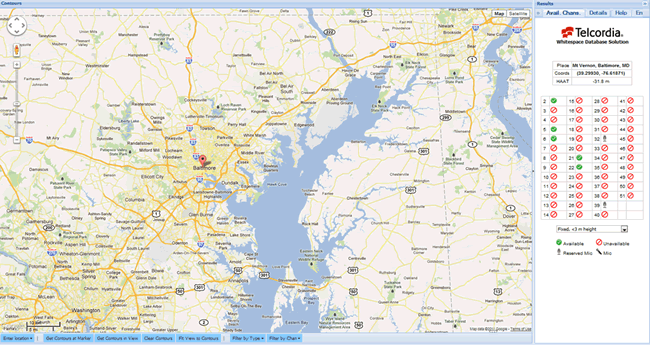
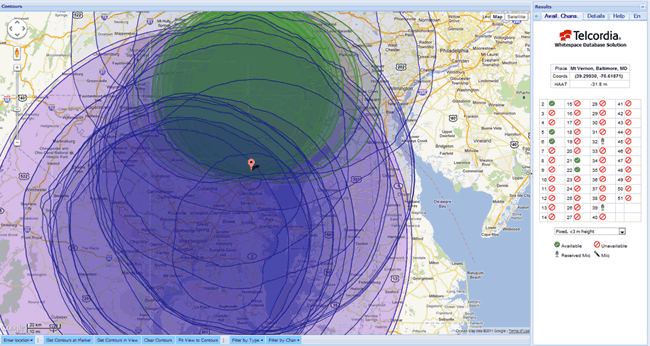
The contour
view for that same location looks like this, with green indicating
channel availability:
Clicking on the Details tab provides information on why channels
are not available for unlicensed operations:
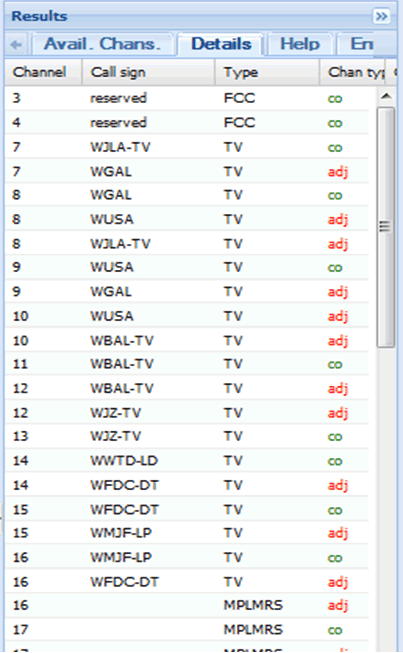
For example, channel 8 above is not available at the selected location
(Baltimore, MD) because of co-channel restrictions from WGAL (Lancaster,
PA), and adjacent channel restrictions from WJLA-TV on channel 7
and WUSA on channel 9 (both Washington, DC).
Try It Yourself
The FCC encourages all interested parties to test the database and
provide appropriate feedback to Telcordia. The database can be accessed
at https://prism.telcordia.com/tvws/home/trial.
Users
are encouraged to report any inaccuracies or other issues with any
aspect of the database system to Telcordia through the response
facility on the trial's website. Telcordia will respond to such
reports with an explanation and notification of any responsive actions
it may take, as appropriate. During the trial, Telcordia may apply
any corrective measures it determines are needed, and will advise
participants of any such changes through the trial's website.
NAB Technology also encourages all broadcasters to test the database,
and if any problems are encountered to report them to Bruce Franca
(bfranca@nab.org) or other
NAB Technology Staff (in addition to sending that information to
Telcordia, as noted above). This will enable NAB to better prepare
an industry response to Telcordia's trial and required final report.
The FCC
is encouraging participants to test the following elements of the
database's user interface:
- the channel
availability calculator
- the MVPD
receive site (cable headend and satellite receive site) registration
utility
- the broadcast
auxiliary temporary receive site registration utility
- the fixed
TVWS device registration utility
- the wireless
microphone registration utility
Users are encouraged
to report any inaccuracies or other issues with any aspect of the
database system to Telcordia through the response facility on the
trial's website. Telcordia will respond to such reports with an explanation
and notification of any responsive actions it may take, as appropriate.
During the trial, Telcordia may apply any corrective measures it determines
are needed, and will advise participants of any such changes through
the trial's website.
NAB Technology also encourages all broadcasters to test the database,
and if any problems are encountered to report them to Bruce Franca
(bfranca@nab.org) or other
NAB Technology Staff (in addition to sending that information to Telcordia,
as noted above). This will enable NAB to better prepare an industry
response to Telcordia's trial and required final report
|