| |
What
Will Replace The CRT for Professional Video Monitors?
The cathode
ray tube (CRT), once the mainstay of the television display industry,
has all but disappeared from the marketplace, and new display
technologies are rushing in to take its place. A session at the
upcoming NAB Broadcast Engineering Conference (BEC, April 18-23,
2009, Las Vegas, NV - see below for additional information) titled
"Quality Control for Television" includes a paper,
excerpted here, discussing the suitability of new display technologies,
in particular LCD and plasma, as replacements for the venerable
CRT in evaluation-grade monitor applications.
THE CHANGE
- it's been apparent for some time that CRT technology is
doomed to extinction, not just for professional monitor applications,
but also for consumer television sets. While CRTs have done an
excellent job for several decades, several developments in the
1990s and the first part of this century have clearly provided
the epitaph. First, we are moving from a world of low-resolution
standard-definition television to high-definition acquisition,
production, and viewing. This means the link between resolution
and brightness-long the weakness of CRTs-must be broken. Second,
our picture shapes are changing, with a 1.77:1 (16:9) aspect ratio
becoming the preferred display format over the older 1.33:1 (4:3)
aspect ratio we've come to know and love for 60 years. Further,
TV and monitor manufacturing has evolved into a high-volume business
with highly competitive pricing. This makes it difficult for manufacturers
to devote substantial resources to the development and manufacture
of professional-grade monitors. Rather, any new monitors are usually
derivatives of existing consumer television technologies.
THE CHALLENGERS
- LIQUID CRYSTAL DISPLAYS (LCDs) - today, LCD imaging is a
mature technology and is found in both direct-view and projection
applications. Direct-view LCD monitors and TVs have been made
with screen sizes measuring as much as 108 inches diagonally,
although commercially-available sizes are limited to about 65
diagonal inches. Because LCDs are transmissive imaging devices,
they are unable to completely block light when shut off. As a
result, LCDs have a difficult time displaying "black"
and very low shades of gray. This, of course, limits their dynamic
range. LC transit (alignment) speeds are also hard-pressed to
keep up with fast motion, resulting in blurred images. The most
common illumination source for LCDs is the cold cathode fluorescent
lamp, or CCFL. CCFLs are very bright, but have uneven spectral
radiation characteristics and are also difficult to calibrate
to a consistent white point. A new generation of LCD displays
is now coming to market, equipped with light-emitting diode (LED)
backlights. LEDs promise more accurate color control and improved
contrast. A technique known as local area dimming, when combined
with pulse-modulated LEDs, results in very high contrast and deeper
black levels.
THE CHALLENGERS
- PLASMA DISPLAY PANELS (PDPs) - Plasma display panels were
first developed in the 1960s and were commercialized for consumer
and professional use in the early 1990s. They are similar in function
to CRTs, as both are 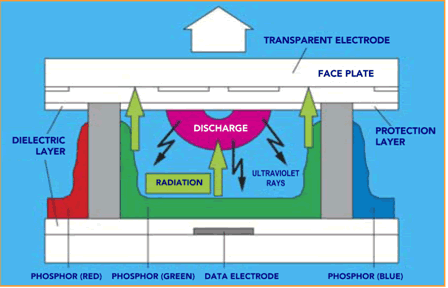 classified
as emissive devices. Plasma panels are made up of thousands of
red, green, and blue pixels. Each pixel contains a mix of xenon
and neon gases. A priming charge of several hundred volts is applied
to the pixel electrodes, and when the voltage reaches a high enough
level, there is a brief, but intense electrical discharge through
the pixel (see figure). This causes the gas mixture to ionize
and emit a broad spectrum of energy, including ultraviolet light.
It is this UV light that causes the color phosphors within each
pixel to glow brightly. A sustaining charge, roughly one-half
the priming charge, maintains pixel activity, until a clearing
charge resets the pixel to its off state. Plasma panels, unlike
LCDs, are switching displays. They have only two states-"on"
and "off." Therefore, PDPs must employ pulse-width modulation
techniques to digitally create different luminance values. This
is accomplished with switching speeds as fast as 600 Hz. classified
as emissive devices. Plasma panels are made up of thousands of
red, green, and blue pixels. Each pixel contains a mix of xenon
and neon gases. A priming charge of several hundred volts is applied
to the pixel electrodes, and when the voltage reaches a high enough
level, there is a brief, but intense electrical discharge through
the pixel (see figure). This causes the gas mixture to ionize
and emit a broad spectrum of energy, including ultraviolet light.
It is this UV light that causes the color phosphors within each
pixel to glow brightly. A sustaining charge, roughly one-half
the priming charge, maintains pixel activity, until a clearing
charge resets the pixel to its off state. Plasma panels, unlike
LCDs, are switching displays. They have only two states-"on"
and "off." Therefore, PDPs must employ pulse-width modulation
techniques to digitally create different luminance values. This
is accomplished with switching speeds as fast as 600 Hz.
COLOR GAMUTS
- Another area of concern is color gamut performance. An evaluation
monitor can't cover just the SMPTE-C or ITU BT.709 color standard
color spaces. It must instead display a wider range of color shades
that are needed for encoding 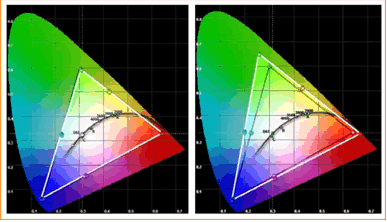 video
and film content into extended color spaces, such as xvYCC or
the DCI P3 color space. All professional LCD and plasma monitors
I have tested to date are capable of showing 100% of the SMPTE-C
and BT.709 standard color gamuts. However, only emissive displays
and LED-equipped LCD monitors have shown the potential to cover
xvYCC and P3 color shades. Shown in the figure are plotted color
gamuts (white triangles) for commercial LCD/CCFL (left) and plasma
monitors (right). While both cover 100% of BT.709 (represented
by the black triangle in the figure), the plasma monitor is capable
of a much wider gamut, particularly in the green channel. video
and film content into extended color spaces, such as xvYCC or
the DCI P3 color space. All professional LCD and plasma monitors
I have tested to date are capable of showing 100% of the SMPTE-C
and BT.709 standard color gamuts. However, only emissive displays
and LED-equipped LCD monitors have shown the potential to cover
xvYCC and P3 color shades. Shown in the figure are plotted color
gamuts (white triangles) for commercial LCD/CCFL (left) and plasma
monitors (right). While both cover 100% of BT.709 (represented
by the black triangle in the figure), the plasma monitor is capable
of a much wider gamut, particularly in the green channel.
This paper
is authored by Peter H. Putman, ROAM Consulting L.L.C. It will
be presented on Monday, April 20, 2009 starting at 2:00 p.m. in
room S226 of the Las Vegas Convention Center. It will also be
included in its entirety in the 2009 NAB Broadcast Engineering
Conference Proceedings, on sale at the 2009 NAB Show Store
and available on-line from the NAB Store (www.nabstore.com)
after the convention.For a complete list and summaries of each
paper that will be presented at the 63rd NAB Broadcast Engineering
Conference, April 18 – 23 in Las Vegas
click here. For additional conference, housing and registration
information visit the NAB Show Web page at www.nabshow.com.


The
February 23, 2009TV TechCheck is also available
in an Adobe Acrobat file.
Please click
here to read the Adobe Acrobat version of TV TechCheck.
|
|

