|
WiNRADiO
Programmable Receivers Show Flexibility
of Software Defined Radio
 Broadcast
engineers looking for a new way to monitor the RF spectrum might
want to consider a software-defined radio (SDR) from Australian
receiver manufacturer WiNRADiO (Oakleigh, Australia, www.winradio.com).
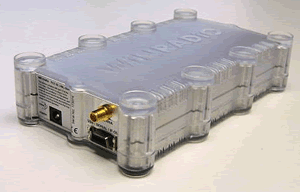
The WR-G33WSM Receiver (see photo, MSRP of $999.95), which requires
a personal computer for the user interface, can easily be configured
for specific tasks using the “RBASIC” application development
environment available free-of-charge from WiNRADiO. Broadcast
engineers looking for a new way to monitor the RF spectrum might
want to consider a software-defined radio (SDR) from Australian
receiver manufacturer WiNRADiO (Oakleigh, Australia, www.winradio.com).
The WR-G33WSM Receiver (see photo, MSRP of $999.95), which requires
a personal computer for the user interface, can easily be configured
for specific tasks using the “RBASIC” application development
environment available free-of-charge from WiNRADiO.
An
SDR is a radio for which most of the radio signal processing is
performed in software, using digital signal processing methods,
rather than with traditional discrete hardware components such
as resistors, capacitors, diodes, etc. In the WR-G33WSM, the received
RF signal is digitized early in the signal processing chain and
all further processing, demodulation and decoding of the digitized
signal is performed entirely in software. Some of the advantages
to this approach include flexibility of demodulation modes (new
modes can be added easily by simply upgrading software); improved
performance over a conventional receiver since digital techniques
make it possible to implement sharper selectivity filters and
more accurate (i.e. mathematically precise) demodulators and decoders;
and, improved consistency and stability because component tolerances
and aging do not play as important a role compared to conventional
receivers.
Some of the technical specifications for the WR-G33WSM are provided
in the table below. While the WiNRADiO company makes a broad array
of programmable receiver devices, this unit was developed especially
for sound engineers and performers who work with wireless microphones
and other wireless audio devices. Using the WR-G33WSM an engineer
can map the radio spectrum environment of a particular location,
determine available frequencies and then allocate wireless microphones
to the available channels. The entire spectrum environment of
each venue can be saved and recalled later, to save time during
the next visit.
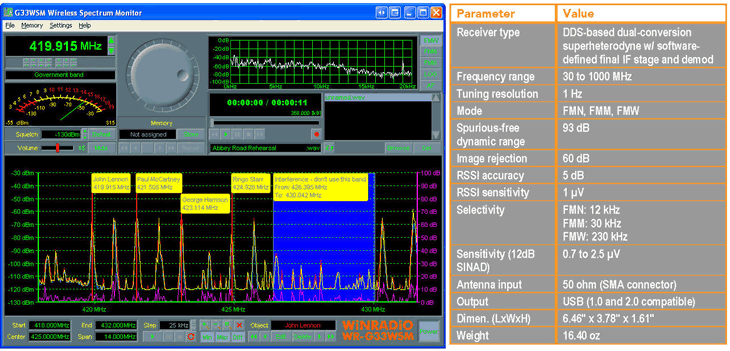
An
example of the user interface is shown above (to the right of
the specifications) which also illustrates one of the most useful
features of the WR-G33WSM, namely the real-time spectrum analyzer
(the large graph at bottom) which supports both linear and logarithmic
scales and a variable intermediate frequency (IF) filter bandwidth.
In the image, cursors and text labels have been added to the display
to assist the engineer in remembering which frequencies are assigned
to which performers (apparently this particular receiver was taken
back in time to a Beatles concert!)
WiNRADiO
receivers also support what is called the Extensible Radio Specification
(XRS), a standard-based platform for the control of radio devices
(receivers or transmitters) by a computer. The XRS standard defines
the interface between a radio control program (the “server”)
and an add-on plug-in software module (the “client”).
Over 30 different XRS plug-ins have been developed and are available
for download (free-of-charge) from the XRS Web site, xrs.winradio.com,
from the following categories:
Tuning
tools and panels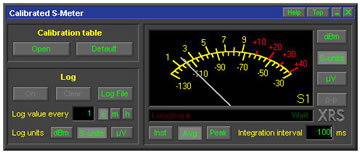
Memory
management
Scanning
and searching
Spectrum
analysis
Signal
strength and channel occupancy logging
Calibration
(including the “Calibrated S-Meter” shown at right)
Frequency
logging
Antenna
switching
Task
scheduling, miscellaneous
RBASIC
(mentioned earlier) is also an XRS plug-in which is described
in detail (and available for free download) at the Web site www.rbasic.com.
With RBASIC, users can create their own applications to control
and/or automate every aspect of receiver operation, and can create
data files containing receiver-derived data for later use. A host
of public-domain RBASIC applications is available, as well.
 NAB
AM Antenna NAB
AM Antenna
Computer Modeling Seminar
November 20-21, 2008
NAB Headquarters
Washington, DC
Don’t miss this opportunity for broadcast engineers to learn
the basics needed to utilize modeling software such as MININEC
and nodal analysis for designing performance-optimized AM directional
antenna phasing and coupling systems and proving the performance
of directional antenna patterns.
You
will learn about:
- Moment
Method Modeling Basics
- DA Proofing
Using Moment Method Modeling
- Overcoming
Limitations of Using Field Strength Measurements for DA Proofs
- State
of the Art in Phasing System Design Nodal Analysis of AM DA
Phasing and Coupling Systems
- Pattern
Design Considerations for Optimum Performance
AM
antenna experts Ron Rackley and Ben Dawson, along with antenna
modeling software specialist Jerry Westberg, will lead the seminar
demonstrating how moment method modeling makes analysis of actual
tower current distributions possible and how a model can be used
to proof an array provided the proper criteria are considered.
All instructors are well known in the radio industry as experts
in the field of directional antenna design and maintenance. Their
decades of experience offer station engineers an opportunity to
learn techniques, tips and tricks that can be immediately useful.
Seminar
fee: $395.00 (NAB members) and $495.00 (non-members). For
more information on the curriculum, how to register or housing
go to AM
Antenna Computer Modeling Seminar on the NAB Web site or call
Sharon Devine at (202)-429-5338. Register now for the NAB AM Antenna
Computer Modeling Seminar!


The August 4, 2008 Radio TechCheck is also available
in an Adobe Acrobat file.
Please
click
here to read the Adobe Acrobat version of Radio TechCheck.
|
