|  |  |

|
Lightning Protection for Communications Facilities Radio and TV broadcast towers are often the tallest objects around and as such are especially susceptible to damage from lightning (not to mention other natural phenomenon). A session at the upcoming NAB Broadcast Engineering Conference (BEC, April 9-14, 2011, Las Vegas, NV – see below for additional information) entitled “Emergency Operations – Planning and Implementation” includes a paper, excerpted here, which focuses on reviewing several case histories involving lightning damage, and highlighting the power quality infrastructure that may be adapted to benefit any facility that operates electronic equipment. This paper is entitled “Case Histories in Lightning Protection – Communications Facilities,” and was written by David Brender, P.E., Copper Development Association, Inc. WHY GROUND? – one of the primary purposes of grounding electrical systems is to provide a low impedance path for transient overvoltages, such as lightning, to flow safely to earth, bypassing the sensitive equipment. Many communications facilities have large towers for mounting of antennas. Obviously these towers can be a lightning target in many parts of the country, and should be protected to the greatest degree feasible. In the case histories that follow, towers are typically grounded beyond simple Code requirements. GOING BEYOND CODE MINIMUM – the National Electrical Code is somewhat nebulous on the requirements for low resistance grounding. The Code alludes to a desired minimum resistance to ground of 25 ohms, but does not mandate that value. The Code does mandate that certain facilities be used as grounding electrodes, if they exist, and provides rules for bonding the electrodes together. But, as for resistance, it stipulates that if 25 ohms is not achieved, an additional electrode should be installed and connected. There is no requirement for testing the resultant system, no protocol for how to test the system, or how often to repeat the testing. A more important document for power quality considerations is the IEEE Emerald Book, formally known as “IEEE Recommended Practice for Powering and Grounding Sensitive Electronic Equipment.” It has been pointed out that simply installing enhanced electrical systems and better grounding systems will prevent (or cure) many power quality problems. RETROFIT OF AN OMAHA TV STATION – KPTM-TV occupies a studio facility in downtown Omaha, Neb. Trouble started when a 365-foot tower was built adjacent to the studios to transmit the signals to their main transmitter 10 miles away (see photo below – this tower is directly adjacent to another, seen at left). Lightning events caused about $40,000 worth of equipment damage per event, plus costly downtime. Upon examination by a professional, several key retrofits were instigated that completely (as of this writing) eliminated the damage problem despite continuing lightning strikes. 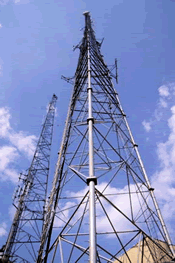
First, 100-ft deep copper-clad grounding rods, one for each tower, were installed then each was bonded to the towers with 250-kcmil stranded copper. Why so deep? Because the region’s groundwater has high resistivity because of its low dissolved mineral content. The grounding electrodes were driven using equipment capable of measuring ground resistance as a function of depth. Final depth was selected as the point where resistance dropped below two ohms. Next, each tower was surrounded with a buried 250-kcmil bare copper ring ground. More copper bonded the rings to the tower’s steel structure, to the deep electrodes and to each other. In addition, 250-kcmil pigtails were run from the rings to the station’s satellite dish antennas, the transmitter room and into the studio building. That put the entire facility at the same ground potential, eliminating ground-loop currents at their source. Mr. Brender will present this paper on Wednesday, April 13, 2011 starting at 2:00 p.m. in room S226 of the Las Vegas Convention Center. It will also be included in its entirety in the 2011 NAB Broadcast Engineering Conference Proceedings, on sale at the 2011 NAB Show Store and available on-line (after the Show) from the NAB Store (www.nabstore.com). Other papers being presented during this session include the following:
|
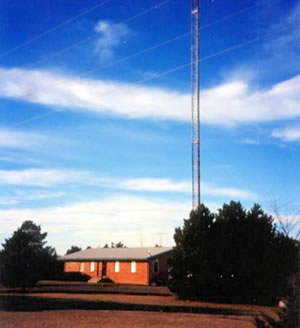 GROUNDING AT A RADIO STATION – KROA is a 100 kW FM station
in Doniphan, Neb., located adjacent to the Platte River. Its 500-foot
antenna tower (shown in the photo to the right) is a perfect lightning
rod, attracting numerous strikes in a typical summer. One such occasion
a couple of years ago resulted in lightning following the coax right
into the transmitter room, where it damaged several pieces of expensive
equipment, and took KROA off-the-air for several weeks. Close examination
by the outside professional revealed (among other things) that the
primary grounding electrode exhibited 29 ohms to ground, despite
a 5-foot deep water table. A new grounding installation was constructed
consisting of a 40-foot deep copper-plated ground rod driven near
the main service entrance; 250-kcmil copper conductor was used to
connect to the ground bus, using corrosion-resistant bronze connectors,
and three 50-foot copper-plated electrodes were driven in a triangular
pattern surrounding the antenna tower, resulting in a resistance
to ground of under 3 ohms. Despite many lightning strikes since
the installation described, there has been no equipment damage,
nor down time since 1997.
GROUNDING AT A RADIO STATION – KROA is a 100 kW FM station
in Doniphan, Neb., located adjacent to the Platte River. Its 500-foot
antenna tower (shown in the photo to the right) is a perfect lightning
rod, attracting numerous strikes in a typical summer. One such occasion
a couple of years ago resulted in lightning following the coax right
into the transmitter room, where it damaged several pieces of expensive
equipment, and took KROA off-the-air for several weeks. Close examination
by the outside professional revealed (among other things) that the
primary grounding electrode exhibited 29 ohms to ground, despite
a 5-foot deep water table. A new grounding installation was constructed
consisting of a 40-foot deep copper-plated ground rod driven near
the main service entrance; 250-kcmil copper conductor was used to
connect to the ground bus, using corrosion-resistant bronze connectors,
and three 50-foot copper-plated electrodes were driven in a triangular
pattern surrounding the antenna tower, resulting in a resistance
to ground of under 3 ohms. Despite many lightning strikes since
the installation described, there has been no equipment damage,
nor down time since 1997.|
IEEE Broadcast Technology Society Issues Call for Papers
The submission deadline for abstracts is May 1, 2011. There is additional information on the Symposium on the IEEE Broadcast Technology Society website.
The February 14, 2011 Radio TechCheck is also available in an Adobe Acrobat file. Please click here to read the Adobe Acrobat version of Radio TechCheck. |
 A Call for
Papers has been issued for the 2011 IEEE Broadcast Symposium,
to be held October 19-21, 2011, in Alexandria, Va. The Symposium
Committee seeks timely and relevant technical papers relating
to all aspects of broadcast technology, in particular on the following
topics:
A Call for
Papers has been issued for the 2011 IEEE Broadcast Symposium,
to be held October 19-21, 2011, in Alexandria, Va. The Symposium
Committee seeks timely and relevant technical papers relating
to all aspects of broadcast technology, in particular on the following
topics: