|  |  |

|
Digital-only Boosters for FM IBOC The iBiquity HD Radio In-band/on channel (IBOC) system utilizes a digital modulation technique called Orthogonal Frequency Division Multiplexing (OFDM), which has become the preferred technique for digital terrestrial radio broadcasting systems worldwide. All of the predominant systems, including Eureka-147 DAB, Digital Radio Mondiale (DRM) and Integrated Services Digital Broadcasting-Terrestrial (ISDB-T) utilize, with variations, OFDM modulation schemes. The OFDM technique involves sub-dividing a data stream into dozens or hundreds of parallel, lower-rate streams and using these to modulate an equal number of orthogonal RF carriers. 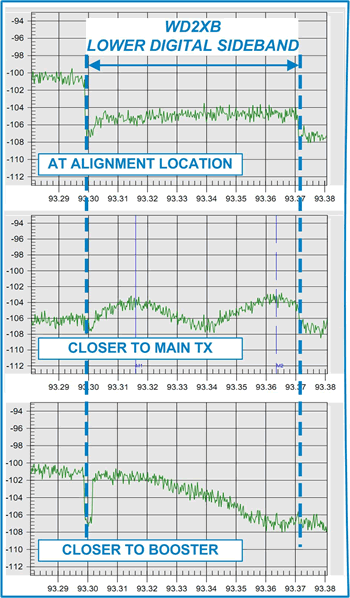
OFDM systems perform well in multipath fading environments and as such, support the use of on-channel booster transmitters which can be useful for filling in areas of limited reception due to, for example, terrain shielding of the main transmitter. At last week’s IEEE Broadcast Symposium (October 20-22, 2010, Alexandria, Va., www.ieee.org/organizations/society/bt/), a presentation on work being done by iBiquity to test the performance of FM IBOC digital-only boosters was given by Russ Mundschenk, field test and implementation manager with iBiquity Digital Corporation. Russ’ colleague at iBiquity, lead broadcast development engineer Russ Iannuzzelli, was co-author of this presentation. In his talk, Russ focused on field testing that iBiquity has been conducting of an on-channel booster in the Baltimore, Md. area, using experimental station WD2XAB (Columbia, Md., 93.5 MHz, 1.5 kW ERP analog, 150 W ERP digital, 456 ft HAAT) and booster WD2XAB-FM1 (Kingsville, Md., 50W ERP digital, 446 ft HAAT) which is located approximately 20 miles away from the main transmitter. For these tests, iBiquity is using transmission equipment modified so that, among other things, both transmission signals have identical frequency and “state synchronization” so that the transmitted signals are identical. When setting up the booster, one of the variables which needs to be set is the time delay between the signals emanating from the main and booster transmitters. Typically, for optimum performance, it is desirable to establish the zero delay point at the approximate center of the coverage overlap areas between the two transmitters. The spectrum images at right (taken from Russ’ presentation) illustrates the behavior of the lower digital sideband at this alignment location as well as what the sideband looks like both closer to the main transmitter and closer to the booster. As can be seen from these figures, in the zero delay case (at alignment location), the spectrum of the digital sideband is flat as it should be, because the main and booster signals at that point are identical. As one moves in either direction from this point, the two signals start to differ in both amplitude and delay, and the resulting spectrum exhibits the ripples and nulls that one observes when multipath fading is present. Even when this multipath distortion is present, the digital signal will still be receivable because of the OFDM system's resistance to multipath fading. iBiquity’s test program involves both performance testing, to characterize the digital coverage of the main station as well as extensions of digital coverage resulting from use of the digital booster, and analog compatibility testing to examine the potential interference from the digital sidebands on the host analog signal near the booster site. Digital coverage performance results have been very encouraging and iBiquity reported that no destructive interference of the digital signals was encountered. Tests have shown that some receivers may experience interference to the analog host (due to the digital-only booster) at digital-to-analog power ratios below 0 dBc. iBiquity intends to experiment with adding a small analog signal component to the digital booster output to see if this can mitigate the host interference in the vicinity of the booster, while at the same time not adversely affecting analog reception at greater distances. Additional testing is scheduled for later this month at Greater Media station WKLB (Waltham, Mass., 102.5 MHz, channel 273B). These tests, as well as the field tests already conducted, are being partly funded by the NAB FASTROAD technology advocacy program (www.nabfastroad.org). |
|
NAB and Others Ask the FCC to Extend the 180-Day CAP Compliance Deadline On Thursday October 21, 2010, NAB together with a number of other broadcast and cable organizations filed a petition with the FCC seeking an extension of the 180-day CAP compliance deadline. That deadline, which is currently March 29, 2011, was established under the FCC’s EAS regulations (See 47 C.F.R. § 11.56.) and was triggered because on September 30, 2010 FEMA published the technical standards and requirements for CAP-formatted EAS alerts to be used for their Integrated Public Alert Warning System (IPAWS). By that deadline all EAS participants must have acquired and installed equipment capable of receiving Common Alerting Protocol (CAP) v1.2 formatted Emergency Alert System (EAS) alerts. (See October 4, 2010 issue of Radio TechCheck). The petition asks that the FCC extend the deadline for at least an additional six months to September 30, 2011 or consider other appropriate relief, including, but not limited to, a longer extension as well as holding the deadline in abeyance until the FCC has completed its own CAP-related equipment certification process and has resolved its anticipated rulemaking proceeding concerning modifications to Part 11 of the Commission’s rules necessary to reflect the implementation of CAP. The petitioners are: NAB, a group of forty-six State Broadcasters Associations, the Society of Broadcast Engineers (SBE), National Public Radio (NPR), the Association of Public Television Stations (APTS), the Public Broadcasting Service (PBS), Association for Maximum Service Television (MSTV), the National Cable and Telecommunications Association (NCTA) and the American Cable Association (ACA). A copy of the petition is available on NAB’s website.
The October 25, 2010 Radio TechCheck is also available in an Adobe Acrobat file. Please click here to read the Adobe Acrobat version of Radio TechCheck. |