|
FCC Publishes Test Results for Coupon-Eligible Converter Boxes
The Federal Communications Commission (FCC) Laboratory conducted
a test program on behalf of the National Telecommunications and
Information Administration (NTIA) to determine if a converter
box met the criteria to be included in the program. They tested
136 models, and found that 116 of these met the minimum performance
criteria (some after resubmission). The FCC Laboratory performed
about 300 tests related to NTIA requirements on each of the models.
In addition to the pass/fail tests; the FCC Laboratory performed
measurements of paired-interferer rejection performance on each
converter box model to contribute to knowledge of interference
vulnerabilities caused by third-order intermodulation (IM3) in
the DTV tuners.
The FCC determined that there were 13 different brands of demodulator
chips used.
The report asserts that:
"The tested RF reception performance characteristics were: Sensitivity
(i.e., minimum RF input signal at the threshold at which
the TV picture begins to degrade);
Ability to tolerate phase noise and burst noise;
Ability to reject interference from;
- a single NTSC signal on co-and adjacent-channels
- a single DTV signal on adjacent and taboo channels, and
- a pair of DTV signals at channel offsets that place third-order
intermodulation (IM2) products in the channel to which the converter
box is tuned
Multipath rejection performance (single static echo and field
ensembles);
RF pass-through performance on converter boxes that were equipped
with RF pass-through capability.
The other functionalities that were tested included the following:
Image decoding (ability to decode 36 combinations of digital
picture resolutions, interlacing, and frame rates);
Ability to process and display certain Program and System Information
Protocol (PSIP) data;
Parental control (V-chip) functions, including ability to adapt
to changes in the rating system through downloadable ratings tables;
Caption pass-through to the connected analog television (on
line 21)."
The report is organized into chapters. Chapter 1 has the introduction.
Chapters 2 through 6 present performance data for the 116 converter
box models that were approved. The chapter titles in the report
are:
"Chapter 2 - RF performance test results including dynamic range,
susceptibility to phase noise and burst noise, interference susceptibility
(including paired DTV interferers), and RF pass-through performance;
Chapter 3 - Multipath performance test results including receiver
performance against laboratory-generated single static echoes
and performance with the 50 ATSC-recommended field ensembles;
Chapter 4 - variations in RF performance as a function of tuner
implementation (single or double conversion);
Chapter 5 - variations in RF performance as a function of RF
pass-through implementation (no pass through, switched/unamplified
pass through, and amplified pass through); and
Chapter 6 - power-consumption.
The report also provided other chapters as follows:
Chapter 7 describes the failures of 92 converter box models
that initially failed one or more tests; in cases where requirements
or standards were unclear, the test criteria that were applied
in the converter box program are identified.
Chapter 8 lists characteristics that were judged to be functional
deficiencies in some converter boxes, but for which available
rules and standards documents provided no specific basis for pass/fail
thresholds; these are provided for possible consideration by standards
committees when relevant standards are being revised.
Chapter 9 discusses lessons learned regarding DTV receiver testing.
Chapter 10 summarizes the findings of the report."
This 202-page report contains a significant quantity of data,
showing performance is generally improved over earlier models.
Many plots are provided with the assessment of the state of the
art that the results indicate. The ability to handle the RF captures
is perhaps the most meaningful finding; however, one of the more
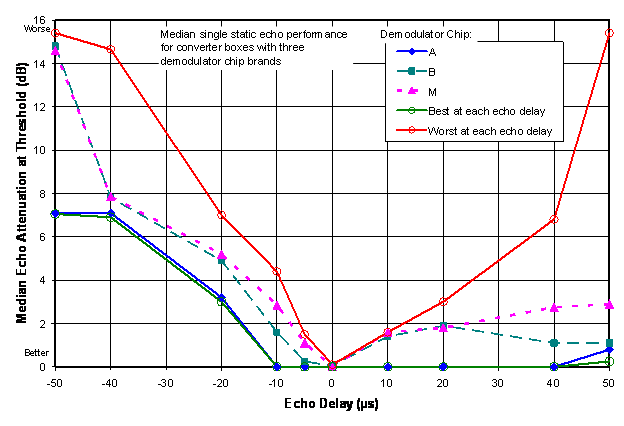
interesting findings was the much increased echo range as compared
to the initial range of some early receivers. The results show
the limits of range were not found for all devices as the testing
was only from -50 µs to +50 µs; so some chips have
even more range/level capability. Another finding was that dynamic
range has generally increased by raising the maximum power level
while reducing minimum power needed for detection. The multipath
figure below is one of many graphical presentations in the report.
The full report
is at: http://www.fcc.gov/oet/info/documents/reports/9TR1003-ConverterBoxTestReport.pdf.

NAB's Graham Jones Receives SMPTE Award
Graham Jones, Director of Communications Engineering in the NAB
Science and Technology Department, received the "2009 Citation
of Outstanding Service to the Society" from the Society of Motion
Picture and Television Engineers (SMPTE) at their Conference in
Los Angeles last week. He was recognized for his exceptional service
to the Society most particularly for his support of the activities
and membership of the Washington, D.C. section of SMPTE. Graham
also serves on the SMPTE Board of Governors as Governor of the
Eastern region.Graham is shown in the photo to the left receiving
his award from Kenneth Fuller, President of SMPTE

2009 ATSC Seminar on Audio Loudness
Wednesday, November 4, 2009
Wiley Rein Conference Center
1776 K St, NW
Washington, DC 20006
http://www.atsc.org/seminars/loudness09.php
Cost for ATSC members is $50.00 for pre-registrants, $75.00 on-site.
ADVERTISEMENT

|
The November 2, 2009 TV TechCheck is also available
in an Adobe Acrobat file.
Please click
here to read the Adobe Acrobat version of TV TechCheck
|

