
|
Broadcasting’s
Neighbor – Radio Astronomy

The International Year of Astronomy 2009 (IYA2009) is an event
initiated by the International Astronomical Union (IAU) and UNESCO
to celebrate astronomy and its contributions to society and culture.
Not coincidentally, 2009 also marks the 400th anniversary of the
first use of an astronomical telescope by Galileo Galilei, the
famous 17th century Italian philosopher and scientist. While it
was 400 years ago that Galileo first pointed a telescope at the
heavens, it wasn’t until the mid-1930’s that the science
of radio astronomy was born.
Radio astronomy involves searching the heavens for objects which
radiate electromagnetic radiation in the radio frequency bands
as opposed to the optical frequency bands seen by telescopes such
as those used by Galileo. An interesting talk on the relationship
between radio astronomy and broadcasting was given at the recently-held
IEEE Broadcast Symposium (Alexandria, Va., October 14-16, 2009,
www.ieee.org/bts) by Dr.
Andrew Clegg of the National Science Foundation entitled “The
Co-existence of Broadcast and Radio Astronomy Services or What
Ever Happened to TV Channel 37?” Portions of Dr. Clegg’s
presentation are excerpted below.
As can be seen in the table at right, a significant number of
frequencies have been allocated for radio astronomy in the VHF
and UHF bands. Shown here (in gray shading) are all of the radio
astronomy frequencies allocated in these bands along with the
other services that share these frequencies with the radio astronomers.
Also shown (in orange shading) are the TV and FM radio frequency
allocations in the VHF and UHF bands. Looking in the UHF band,
the radio astronomy allocation from 608 to 614 MHz (which is shared
with Land Mobile services) is 6 MHz wide and falls precisely between
TV channels 36 and 38. In fact, these frequencies were originally
allocated as TV channel 37 until 1963, when the FCC instituted
a 10-year moratorium on use of this channel, to make these frequencies
available instead to radio astronomers. Ultimately this ban became
permanent, both in the U.S. and Canada, and in fact no local TV
station has ever been allocated TV channel 37 in either country.
In addition, TV channel 37 is allocated for radio astronomy in
many other countries around the world.
The allocation of TV channel 37 for radio astronomy is a result
of the need by astronomers for regularly-spaced spectrum bands
in which to make observations. At the time of the initial allocation,
astronomers had access to frequencies in the 1400-1600 MHz and
150-300 MHz bands but were lacking frequencies in between; the
allocation of TV channel 37 at 608-614 MHz to radio astronomy
resolved this problem. Observations at these frequencies are made
primarily of hydrogen atoms, the most prevalent atoms in the universe.
Radio frequency emissions from hydrogen atoms fall nominally
at 1420 MHz, but because of the expansion of the universe which
creates a Doppler shift of spectral line emissions, astronomers
observe hydrogen emissions at frequencies lower than this, as
well. The farther away a hydrogen atom is, the greater the Doppler
shift of its emissions and the greater the shift towards lower
frequencies. It turns out that when astronomers look at hydrogen
emissions around 600 MHz, they are looking at a distance of about
8x10²² km, and when the speed of light is factored in, this means
that these emissions are about 9.5 billion years old.
Dr. Clegg indicated in his talk that radio astronomers 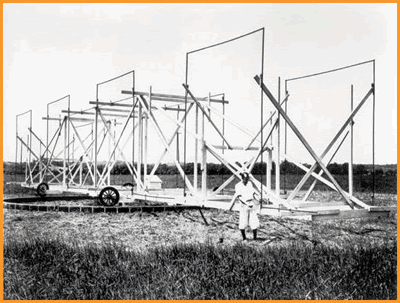
appreciate the efforts of the broadcast industry in coordinating
possible interference mitigation
due to adjacent-channel TV stations. Some other interesting facts
presented by Dr. Clegg include the following:
- The science of radio astronomy was discovered by accident
back in the 1930’s when a Bell Laboratories engineer, Karl
Jansky, was trying to identify sources of interference to long-distance
wireless telephone circuits. Using the rotatable antenna shown
at right, Jansky identified three sources of interference: local
lightning storms, the aggregate of distant lightning storms,
and a persistent but variable source that came and went on a
slightly-less-than daily rate. When Jansky plotted the direction
of this variable interference, it coincided with the plane of
our Milky Way galaxy. Observations over several months in 1932-1933
confirmed the result, and radio astronomy was born.
- While Jansky’s result was of academic interest, there
was no commercial reason to pursue further observation, and
the “science” of radio astronomy languished –
even astronomers didn’t follow up. Grote Reber, an amateur
radio operator and an employee of a radio company, had read
about Jansky’s discovery, and, beginning in 1937, took
it upon himself to further investigate the nature of cosmic
radio emissions, purely as a personal effort.
- Jansky and Reber’s observations were only the “tip
of the iceberg” as they were able to detect only the very
strongest astronomical radio emissions. The bulk of radio astronomy
observing deals with much, much weaker emissions. In honor of
Karl Jansky, the basic unit of radio astronomy signal strength
is the jansky (Jy) = 10-26W/m2/Hz. A 1 Jy signal is equivalent
to -176 dBm received signal strength for a 6 MHz bandwidth TV
channel, using a 0 dBi receive antenna (-46 dBµV/m). Signals
a million times weaker (1 µJy) are routinely observed
and studied, corresponding to a -236 dBm TV signal. As a result,
radio telescopes are extremely sensitive to RF interference
(RFI) from adjacent channels.
- Radio telescopes measure the amount of radio power coming from
a source by using very careful differential noise measurements
(on-source vs. off-source). This is necessary because system noise,
even when using cryogenically cooled receivers, often dominates
the total noise power. The accuracy of differential noise measurements
(assuming Gaussian statistics) improves with the square root of
the product of the observing bandwidth and the averaging time.
Therefore, most radio astronomical observing makes use of the
widest bandwidth and longest possible observing time. Bandwidth
is often limited only by RFI, feed horn response, or other fundamental
limitations.
Additional information on the International Year of Astronomy
is available on the Internet at www.astronomy2009.org.

2009 ATSC Seminar on Audio Loudness
Wednesday, November 4, 2009
Wiley Rein Conference Center
1776 K St, NW
Washington, DC 20006
http://www.atsc.org/seminars/loudness09.php
Cost for ATSC members is $50.00 for pre-registrants, $75.00 on-site.
ADVERTISEMENT

|
The October 26, 2009 TV TechCheck is also
available in an Adobe Acrobat file.
Please click
here to read the Adobe Acrobat version of TV TechCheck
|
| |
|
|
