|
Open
Mobile Video Coalition Releases Use Cases for ATSC Mobile DTV
 An
assessment of desirable use cases for ATSC Mobile Digital Television
(Mobile DTV) has been created by the Open Mobile Video Coalition
(OMVC) and is now publicly available. The Use Case document is
intended to guide product deployment decisions about the market
possibilities for mobile digital television. The document was
created by two working groups of the OMVC–the Business Advisory
Group (OBAG) and the Technical Advisory Group (OTAG). It represents
their analysis of various activities that a customer may undertake
through mobile DTV, as well as a description of mobile device
capabilities that would enable such activities. An
assessment of desirable use cases for ATSC Mobile Digital Television
(Mobile DTV) has been created by the Open Mobile Video Coalition
(OMVC) and is now publicly available. The Use Case document is
intended to guide product deployment decisions about the market
possibilities for mobile digital television. The document was
created by two working groups of the OMVC–the Business Advisory
Group (OBAG) and the Technical Advisory Group (OTAG). It represents
their analysis of various activities that a customer may undertake
through mobile DTV, as well as a description of mobile device
capabilities that would enable such activities.
The OMVC said
“…the document is intended to help device and infrastructure
manufacturers understand the possibilities and requirements for
a robust mobile DTV market. It also includes features that the
broadcast industry feels would be necessary to create a profitable
business.”
As
the ATSC Mobile DTV Standard only provides for wide aspect ratio
video, all mobile devices are expected to have a video “look”
somewhat like the photo below.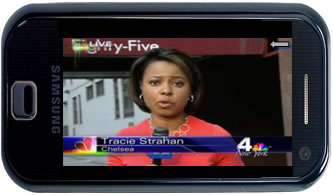
The document describes the use cases and then prioritizes
them by need and time-to-market expectations. It also identifies
the key technology needed to support each case. The time to market
is assessed as Device Launch, Medium Term or Long Term.
Industry experts
recognize that to include the complete set of desirable functions
at the time services are launched would involve including many
technical capabilities. Some initial product offerings might not
be able to support all of these capabilities. Priorities were
placed on the use cases within the timing categories in order
to provide guidance about which functions are deemed necessary
when manufacturers introduce the new devices into their product
lines. The matrix of timing, priority and associated technologies
are shown in Annex A of the document.
The highest
priority/device launch use case involves use of an Electronic
Service Guide (ESG) allowing consumers to locate and select which
TV programs to watch. Basic TV program watching should be considered
to include closed captioning support (as that is explicitly noted
as the same “highest” priority) and audio (but a separate
audio service had a lower priority). A high priority is also assigned
to devices that support a return channel which would be used to
get permission to watch that service from that broadcaster.
The next higher
priority cases add enhancements to the viewing experience through
the addition of Interactive Overlays. The overlays are described
as a means to provide “popup” data related to the program,
selected from a set of transmitted data. Purchase of a subscription
to a service has this priority as well. One potential option,
which appears to enhance the advertiser supported business model,
is described for passive audience measurement with a user Opt-Out
that is linked to availability of content.
The report
contains graphics to illustrate the cases, such as the following
showing one type of user interaction – the viewer would get
access to a video clip in return for providing demographic information.
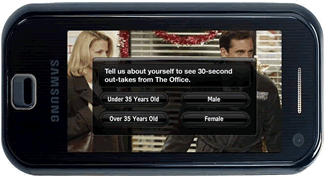
Many more use cases can be found in the full report which is available
at: http://www.omvc.org/_assets/docs/reports/Mobile-DTV-Use-Cases.pdf. The OMVC invites feedback and comments online at http://www.omvc.org/contact/.
2010
NAB Show Call for Speakers
Call
for Technical Papers – NAB Broadcast Engineering Conference
 The
2010 NAB Show will host the 64th Broadcast Engineering Conference. This world-class conference addresses the most recent developments
in broadcast technology and focuses on the opportunities and challenges
that face broadcast engineering professionals. Each year hundreds
of broadcast professionals from around the world attend the conference. They include practicing broadcast engineers and technicians, engineering
consultants, contract engineers, broadcast equipment manufacturers,
distributors, R&D engineers plus anyone specifically interested
in the latest broadcast technologies. The
2010 NAB Show will host the 64th Broadcast Engineering Conference. This world-class conference addresses the most recent developments
in broadcast technology and focuses on the opportunities and challenges
that face broadcast engineering professionals. Each year hundreds
of broadcast professionals from around the world attend the conference. They include practicing broadcast engineers and technicians, engineering
consultants, contract engineers, broadcast equipment manufacturers,
distributors, R&D engineers plus anyone specifically interested
in the latest broadcast technologies.
Do you have something to share?
If you feel qualified to speak at the NAB Broadcast Engineering
Conference, we invite you to submit
a technical paper proposal. Not all acceptable submissions can
be included in the conference, due to the large number of submissions
that are received and the limited number of available time slots.
PLAN TO ATTEND!
The IEEE Broadcast Technology Society
59th ANNUAL BROADCAST SYMPOSIUM
October 14-16, 2009
The Westin Alexandria
Alexandria, VA, USA
www.ieee.org/bts/symposium
2009 ATSC Seminar on Audio Loudness
Wednesday, November 4, 2009
Wiley Rein Conference Center
1776 K St, NW
Washington, DC 20006
http://www.atsc.org/seminars/loudness09.php
Cost for ATSC members is $50.00 for pre-registrants, $75.00 on-site.

ADVERTISEMENT

|
The
September 28, 2009 TV TechCheck is also available
in an Adobe Acrobat file.
Please
click here to read the Adobe Acrobat version of TV
TechCheck.
|
