|
EBU/SMPTE
Task Force on Timing and Synchronization Report Published
  In
late 2007, the Society of Motion Picture and Television Engineers
(SMPTE) and the European Broadcasting Union (EBU) formed a Joint
Task Force on Timing and Synchronization to investigate a potentially
major change in one of the key aspects of the broadcasting infrastructure
system timing and synchronization see TV
TechCheck of October 1, 2007. The task force, chaired jointly
by Dr. Hans Hoffmann of the EBU Technical Department, and Peter
Symes, SMPTE Director of Standards & Engineering, included
some 170 experts from all sectors of the industry and, after numerous
meetings and considerable analysis and discussion on contributions
received, published its report last week. In
late 2007, the Society of Motion Picture and Television Engineers
(SMPTE) and the European Broadcasting Union (EBU) formed a Joint
Task Force on Timing and Synchronization to investigate a potentially
major change in one of the key aspects of the broadcasting infrastructure
system timing and synchronization see TV
TechCheck of October 1, 2007. The task force, chaired jointly
by Dr. Hans Hoffmann of the EBU Technical Department, and Peter
Symes, SMPTE Director of Standards & Engineering, included
some 170 experts from all sectors of the industry and, after numerous
meetings and considerable analysis and discussion on contributions
received, published its report last week.
The report
notes that existing solutions, principally color black distribution
and SMPTE 12M Time-code, both date from analog-only systems and
tape recorders. Both solutions are still viable today but there
have been major changes in technology and requirements since their
development. The Task Force was charged with identifying user
requirements for the digital age, and suggesting technologies
for standardization that would provide cost-effective solutions.
The report
takes the form of a Request for Standardization (RFS), intended
as a reference document for the SMPTE technology committee that
is expected to develop the recommended standards. It comprises
two main sections, on Synchronization and Time-Related Labeling
(TRL), which describe the basis of the technologies needed to
meet the user requirements and the standardization work required.
These are followed by various annexes with information on audio
applications, time labels for standards conversion, IEEE 1588
Precision Time Protocol, and contributions from several major
manufacturers. The extracts below are taken from the report, with
permission from SMPTE.
Introduction
"This document describes the consensus of the joint EBU/SMPTE
Task Force on Timing and Synchronization in light of the responses
received to its Request
for Technology (issued 03/2008). The Task Force requests that
the Society of Motion Pictures and Television Engineers (SMPTE)
undertake standardization efforts with reference to this document."
Motivation
"The current methods of synchronization for television, audio
and other moving picture signals rely on standards that have been
in place for over 30 years. These standards are becoming increasingly
inappropriate for the digital age with, for example, networked
content sharing and the higher frame rates appropriate to HDTV,
UHDTV and other image formats. This document is intended to provide
a foundation to standardize a new synchronization and time labeling
system."
"The
Task Force has focused on a conceptual solution first proposed
to SMPTE several years ago. Fundamentally, if any periodic signal
has its state defined at a given point in time (the 'Epoch') its
state can be calculated at any future time, provided the time
is known with sufficient accuracy. The problem, therefore becomes
one of distributing time to slave devices."
Scope
"The intention of this document is to give guidelines on
what the SMPTE is requested to standardize based on the initial
user requirements defined by the Task Force in its first report,
the 'Request for Technology' (RFT), together with the 'Requests
For Standardization' (RFS) presented within this document.
Broadly speaking,
the standardization work concerns Time-Related Labeling (TRL)
and a new A/V synchronization system. The Task Force suggests
that the standardization activities in these fields are continuously
reviewed against the user requirements and proposals outlined
in this document. Each member of the Task Force who wished to
give additional or more specific input to the Task Force work
was permitted to add this in an appendix to this document.
The Task Force
is well aware that the techniques that are outlined in this document
may need reassessing and further in-depth investigation when proof-of-concept
and interoperability tests are conducted, for instance. New findings
at this stage may therefore impact the standardization activities
of SMPTE."
Synchronization
The following diagram is taken from the section describing the
synchronization system concept, and illustrates the intention
to define a single interface for so-called Common Synchronization
Interface (CSI).

Conceptual
diagram for the synchronization system
The CSI is
an internal interface layer within products using this type of
synchronization. It provides a uniform method for designers to
connect their implementation to the synchronization system.
The rest of
this section describes the requirements, format, mechanism, and
scenarios for the synchronization system proposed.
Time-Related
Labeling (TRL)
"Originally, the Task Force considered that only a timestamp
would be required both for acquisition and for use in post-production.
It was eventually realized that a timestamp alone is not sufficient
to guarantee unambiguous conversion. To take account of the particular
needs for video, it was decided to propose two types of TRL. TRL
Type 1 includes only the timestamp, while TRL Type 2 includes
a Media Unit (MU) count in conjunction with a Start TRL timestamp.
With the correct choice of TRL Type 1 and TRL Type 2 according
to the application, conversion from a timestamp to MU number for
video production is no longer needed. Special applications such
as over/under cranking can be supported in the same way as fixed
frame rates."
"The
figure shows a typical simple independent audio/video acquisition
and postproduction process and illustrates the basic principles
of the two types of TRL."
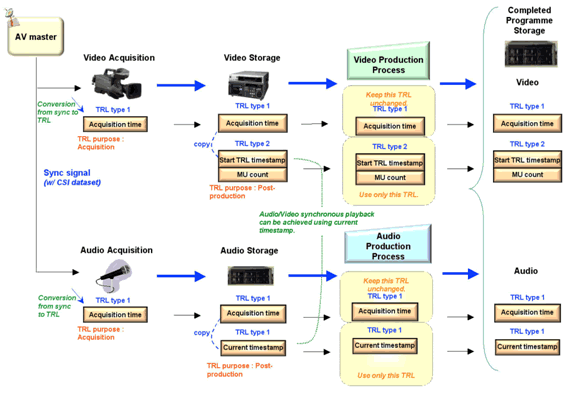
TRL
Workflow Example: Independent Audio/Video
acquisition and postproduction
The rest of
this section includes detailed information on the components of
the TRLs, their representation and use cases, and states that:
"standards that describe the representation of the TRL in
binary, as XML and as human readable formats are required. The
human readable variants need to consider current industry practice
to simplify the transition from SMPTE 12M to the TRL."
The full report
comprises 115 pages, including appendices, and is recommended
for anyone wishing to stay current on developments in this area
of television engineering. It is available for purchase for $25
at the SMPTE Booth at the IBC Convention this week and for download
from the online SMPTE Store (https://store.smpte.org).
2010
NAB Show Call for Speakers
Call
for Technical Papers – NAB Broadcast Engineering Conference
 The
2010 NAB Show will host the 64th Broadcast Engineering Conference.
This world-class conference addresses the most recent developments
in broadcast technology and focuses on the opportunities and challenges
that face broadcast engineering professionals. Each year hundreds
of broadcast professionals from around the world attend the conference.
They include practicing broadcast engineers and technicians, engineering
consultants, contract engineers, broadcast equipment manufacturers,
distributors, R&D engineers plus anyone specifically interested
in the latest broadcast technologies. The
2010 NAB Show will host the 64th Broadcast Engineering Conference.
This world-class conference addresses the most recent developments
in broadcast technology and focuses on the opportunities and challenges
that face broadcast engineering professionals. Each year hundreds
of broadcast professionals from around the world attend the conference.
They include practicing broadcast engineers and technicians, engineering
consultants, contract engineers, broadcast equipment manufacturers,
distributors, R&D engineers plus anyone specifically interested
in the latest broadcast technologies.
Do you have something to share?
If you feel qualified to speak at the NAB Broadcast Engineering
Conference, we invite you to submit
a technical paper proposal. Not all acceptable submissions can
be included in the conference, due to the large number of submissions
that are received and the limited number of available time slots.
NAB Broadcast Engineering Conference Committee
Meets to Begin Planning for 2010
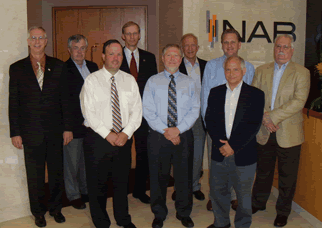 The
NAB Broadcast Engineering Conference (BEC) Committee met at NAB
headquarters on September 9 to begin planning for the 2010 NAB
Broadcast Engineering Conference. (Pictured left to right front
row): Joe Snelson, BEC Committee Chairman, Meredith Broadcasting
Group; Jeff Smith, Clear Channel Radio – NYC; Jim Kutzner,
PBS; Dom Bordonaro, Cox Radio.; Thomas Hankinson, ABC; (back row);
David Folsom, Raycom Media, Inc.; SBE Representative, John Poray;
Andy Laird, Journal Broadcast Group; Michael Cooney, Beasley Broadcast
Group, Inc. BEC Committee member not pictured is Glenn Reitmeier,
NBC Universal and SBE Ennnes representative Fred Baumgartner. The
NAB Broadcast Engineering Conference (BEC) Committee met at NAB
headquarters on September 9 to begin planning for the 2010 NAB
Broadcast Engineering Conference. (Pictured left to right front
row): Joe Snelson, BEC Committee Chairman, Meredith Broadcasting
Group; Jeff Smith, Clear Channel Radio – NYC; Jim Kutzner,
PBS; Dom Bordonaro, Cox Radio.; Thomas Hankinson, ABC; (back row);
David Folsom, Raycom Media, Inc.; SBE Representative, John Poray;
Andy Laird, Journal Broadcast Group; Michael Cooney, Beasley Broadcast
Group, Inc. BEC Committee member not pictured is Glenn Reitmeier,
NBC Universal and SBE Ennnes representative Fred Baumgartner.
PLAN TO ATTEND!
The IEEE Broadcast Technology Society
59th ANNUAL BROADCAST SYMPOSIUM
14 -16 October 2009
The Westin Alexandria
Alexandria, VA, USA
www.ieee.org/bts/symposium
Reduced
Price on NAB Engineering Handbook, 10th Edition
Now Through September 15
For a limited
time, you can purchase The NAB Engineering Handbook from
the NAB
Store for only $159 (Book & CD) with the promo code: TechCheck
(applied at checkout). The offer expires September 15, 2009.

The
September 14, 2009 TV TechCheck is also available
in an Adobe Acrobat file.
Please
click here to read the Adobe Acrobat version of TV
TechCheck.
|
