|
Diversity
Technology for Helicopter IFB and Fade Resistant
Terrestrial Reception
News helicopters
need off-air pictures and IFB - both nearly impossible in the
post-analog era. Brief fades below the "cliff effect"
threshold result in pixelation and frozen screens. Most often,
these fades are weather-related, but aircraft and even truck traffic
can cause destructive reflections. These hits can pose serious
problems for signals feeding cable systems or broadcast repeaters
at some locations.
Cell phones
could offer a solution in helicopters, but the use of cell phones
in an airborne helicopter is illegal. Most cell systems can detect
operation in the air and will turn off communications within a
few seconds. Although your area may afford you the opportunity
to use cell phones now, you run the risk of having your cell signal
dropped, leaving you without any means of IFB while airborne.
While solutions
for IFB for 'live' trucks using the ATSC broadcast stream are
not new, porting such solutions to helicopters has been reported
to be a real challenge. ATSC signal reception has been inconsistent
in helicopters.
The search
for a solution led Modulation Sciences, Inc. (MSI) to an old,
but powerful, technology - diversity. Diversity has been used
extensively since the 1950s, with voluminous technical literature
to support it.
To solve both
the helicopter and rebroadcast challenges, MSI adopted an approach
using four LG sixth generation tuners. The diversity selection
takes place on the transport stream.
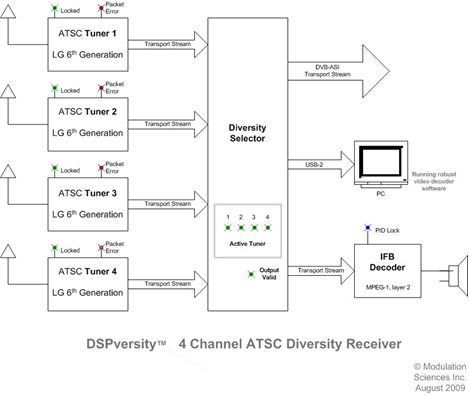 The
heart of the receiver is the DSP Diversity Processor, which selects
portions of the transport stream from each of the four tuners
to assemble into valid ATSC packets. It does this by analyzing
the Transport Error Indicator flag in the TS packets in the transport
stream, while the data is held in a short buffer. The buffer must
be short to minimize latency - a critical parameter for effective
IFB. The
heart of the receiver is the DSP Diversity Processor, which selects
portions of the transport stream from each of the four tuners
to assemble into valid ATSC packets. It does this by analyzing
the Transport Error Indicator flag in the TS packets in the transport
stream, while the data is held in a short buffer. The buffer must
be short to minimize latency - a critical parameter for effective
IFB.
The Diversity
Processor can output a reconstructed Transport Stream in a variety
of formats: DVB ASI, SMPTE 310M, DVB SPI and USB 2.0. The USB
2.0 format is especially important for helicopter use. A USB Transport
Stream makes it easy to connect the DSPversity™ to any PC,
allowing decoding of the Transport Stream to video in software.
MSI reported that tests showed software decoding of ATSC signals
to be far more robust than doing so in available hardware subsystems.
In helicopter operations, the breaking up of pictures from non-robust
decoding to video can render all the advantages of diversity nil.
Reliable IFB
is a critical requirement for helicopter ENG. By employing MPEG-1,
layer 2 audio for IFB, a virtually unlimited number of high-quality
IFB audio channels can be implemented, using encoding facilities
easily available to the station (this implementation uses two
channels per "ghost" PID).
The antenna
system is critical for both helicopter and ground applications
of diversity reception. For helicopters there are no commercially-available
TV antennas. At best, an avionics antenna designed for another
frequency and application may work on your channel. If it doesn't,
the process of trial and error can get very expensive, and, more
often than not, especially for UHF, nothing will be found that
works. FAA requirements and the cost of airframe work on a helicopter
make experimenting with different antennas a costly option. MSI
has developed a proprietary diversity antenna system that requires
no penetration of the fuselage.
The antenna
array was flight tested at two locations, each over several days,
with similar results. The placement of three antennas, one looking
forward and one on each side of the helicopter, yielded 360º
coverage on channel 9 - good coverage based on wavelength of the
signal compared to the width of the helicopter. This same configuration
for a channel 39 station using the same model helicopter produced
about 300º of coverage with a 60º null off the tail.
This null was only noticeable when flying toward a story (tail
toward the tower). Once the aircraft was orbiting, the null was
not apparent in either picture or IFB audio. In high speed runs
(up to 150 knots) toward the station, there was no loss of lock
unless the pilot jogged the aircraft. In either instance, VHF
or UHF, there was no interference from rotor blade modulation
of the signal.
Ground applications
of diversity not only offer vastly increased reliability of reception
within the radio horizon but also increased coverage beyond the
radio horizon. Over-the-horizon, or troposcatter, reception was
perfected by the military before the era of communications satellites.
For extended-coverage ground applications of diversity for feeding
cable and repeaters, the ideal antenna system has four antennas,
each with as much gain as possible. High gain is imperative in
over-the-horizon applications. MSI suggests that the four antennas
form a box 50 to 100 wavelengths on a side. For mid-UHF channels,
this is only 75 to 150 feet. Many variations on this arrangement
are possible. If a tall tower is available, one can try stacking
the four antennas at different heights and have no horizontal
spacing. Generally a box arrangement is the best but polarization
diversity is a viable alternative in some instances. While requiring
a good antenna installation, a Net Present Value calculation for
the system (that is factoring in the annual cost of either a satellite
or fiber link for comparison) can show which to be more cost effective,
with long hauls favoring use of antennas.
The DSPversity
ATSC four-channel diversity receiver appears to offer an innovative
solution to both program video and IFB in the air. This diversity
receiver subsystem also may offer another alternative for reliable
terrestrial reception to feed multiple service operators' redistribution
systems.
2010 NAB
Show Call for Speakers
Call
for Technical Papers – NAB Broadcast Engineering Conference
 The
2010 NAB Show will host the 64th Broadcast Engineering Conference.
This world-class conference addresses the most recent developments
in broadcast technology and focuses on the opportunities and challenges
that face broadcast engineering professionals. Each year hundreds
of broadcast professionals from around the world attend the conference.
They include practicing broadcast engineers and technicians, engineering
consultants, contract engineers, broadcast equipment manufacturers,
distributors, R&D engineers plus anyone specifically interested
in the latest broadcast technologies. The
2010 NAB Show will host the 64th Broadcast Engineering Conference.
This world-class conference addresses the most recent developments
in broadcast technology and focuses on the opportunities and challenges
that face broadcast engineering professionals. Each year hundreds
of broadcast professionals from around the world attend the conference.
They include practicing broadcast engineers and technicians, engineering
consultants, contract engineers, broadcast equipment manufacturers,
distributors, R&D engineers plus anyone specifically interested
in the latest broadcast technologies.
Do you have something to share?
If you feel qualified to speak at the NAB Broadcast Engineering
Conference, we invite you to submit
a technical paper proposal. Not all acceptable submissions can
be included in the conference, due to the large number of submissions
that are received and the limited number of available time slots.
PLAN
TO ATTEND!
The IEEE Broadcast Technology Society
59th ANNUAL BROADCAST SYMPOSIUM
14 -16 October 2009
The Westin Alexandria
Alexandria, VA, USA
www.ieee.org/bts/symposium
 Sign
Up for NAB Satellite Uplink Operators Training Seminar Sign
Up for NAB Satellite Uplink Operators Training Seminar
October 5 - 8, 2009
Washington, DC
Satellite
interference costs your station time and money. If you or your
operations staff has not received formal training for operating
your uplink facilities, sign up for NAB's Satellite Uplink Operators
Training Seminar. The course will be offered Oct. 5 to 8, 2009,
at NAB's headquarters in Washington D.C.
This four-day
course is designed to instruct about uplink operational practices,
which minimize the risk of satellite transmission interference.
This is an important course since the FCC rules require that a
trained operator be present at all times during transmissions,
either an earth station site or designated remote control point.
Go to http://www.nab.org/satelliteSeminar/
or contact NAB Science & Technology Department at (202) 429-5346
or ccolerid@nab.org for
information about the NAB Satellite Uplink Operators Training
Seminar. If you are interested in sponsorship opportunities for
this event contact NAB Advertising at (800) 521-8624 or advertising@nab.org.
Reduced Price on
NAB Engineering Handbook, 10th Edition
Now Through September 15
For a limited
time, you can purchase The NAB Engineering Handbook from
the NAB
Store for only $159 (Book & CD) with the promo code: TechCheck
(applied at checkout). The offer expires September 15, 2009.
ADVERTISEMENT

|
TV
TechCheck will
not be published on September 7
but will return on September 14. |
The
August 31, 2009 TV TechCheck is also available
in an Adobe Acrobat file.
Please
click here to read the Adobe Acrobat version of TV
TechCheck.
|
