|
CEA
Publishes Recommended Practice on A/V Synchronization Implementation
in Receivers
The Consumer
Electronics Association recently published a Recommended Practice
on A/V Synchronization Implementation in receivers, CEA-CEB20.
This document was developed by CEA R4WG15, a working group of
the R4 Video Systems Committee, under the chairmanship of Adam
Goldberg. Adam has written the following contribution for TV
TechCheck, covering the purpose of the RP and its main recommendations.
"Since
the launch of over-the-air digital television (DTV) in the U.S.,
there has been some difficulty in maintaining accurate audio and
video synchronization in television programming delivered to viewers.
There have been (and still are) many reasons for this, including
production, distribution and reception equipment each contributing
to the varying delays of audio and video rendering. In mid-2008,
there was growing concern that some DTV receivers were not using
the MPEG-2 audio/video synchronization mechanisms properly. In
response, the R4 standards committee in CEA began work on a document
which sets out to explain to receiver designers who are familiar
with but perhaps not expert on how synchronization provided for
in the MPEG-2 Systems standard should be implemented.
There are
some receivers/decoders which yield poor A/V synchronization,
even in the presence of perfect streams. There are many reasons
for this, among them poor or naive design choices, an imperfect
understanding of how the synchronization mechanisms should work,
or merely buggy implementations. Unfortunately, it is often the
endpoint which gets blamed for problems which may be at the endpoint
or may be upstream.
|
In order
to provide direction for receiver engineers, as well as
attempt to limit the synchronization errors and allow better
debugging of upstream problems, CEB20 was written to recommend
the proper MPEG tools and how to use them to achieve A/V
 synchronization
correctly. synchronization
correctly.
The document is aimed at receiver implementers who have
some knowledge of MPEG-2 synchronization tools, but aren't
expert on the subject. Internally, we described this as
"AV Sync 401" (an upper-division undergraduate
course).
|
|
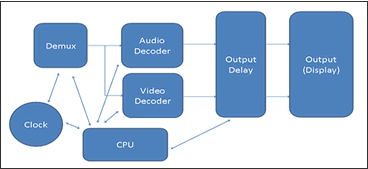
Hardware
Components Discussed In CEB20
|
The document
recommends specific hardware and software processing and explains
how the MPEG timestamps (PCR and PTS) should be used. One of the
specific industry concerns was that some receivers were only comparing
PTS and system time once (at channel acquisition time), which
yields A/V synchronization that drifts over time.
The hardware
recommendations include specific functionality for the demultiplexer,
and that receivers should include both a variable-rate oscillator
driven hardware 27MHz clock and output delay hardware (buffers).
The software recommendations include specific recommendation on
how the encoder's 27MHz clock (the 'system time clock') should
be recovered and maintained (using the PCRs in the stream) and
that processing should continue over time (not just at acquisition
time).
Finally, the
document recommends against an overzealous reading of the MPEG-2
standard. Receiver designers should be aware of the theoretical
operation of a receiver that is receiving perfect streams with
idealized perfect hardware, but also should be aware of the practical
considerations of a real-world system. Among other things, receivers
should not attempt to detect every possible error and fail if
any of them is received."
CEA-CEB20
is available for purchase on-line from the IHS Standards Store
at this link.
Adam Goldberg
has more than a 15 years experience in various facets of digital
television, including the over-the-air digital transition, cable
television, digital telecommunications activities, and home entertainment
in general. He has been intimately involved with many aspects
of DTV receivers, receiver silicon and broadcast equipment. He
has held engineering, project management, strategic planning,
standards and government relations roles for software vendors,
decoder and silicon manufacturers, network and head-end vendors
and consumer electronics companies. Now an independent consultant,
he can be reached at adam@agp-llc.com
or via www.agp-llc.com.
 NAB
Satellite Uplink Operators Training Seminar NAB
Satellite Uplink Operators Training Seminar
October 5 - 8, 2009 Washington, DC
Satellite interference costs your station time and money. If
you or your operations staff has not received formal training
for operating your uplink facilities, sign up for NAB's Satellite
Uplink Operators Training Seminar. The course will be offered
Oct. 5 to 8, 2009, at NAB's headquarters in Washington D.C.
This four-day
course is designed to instruct about uplink operational practices,
which minimize the risk of satellite transmission interference.
This is an important course since the FCC rules require that
a trained operator be present at all times during transmissions,
either an earth station site or designated remote control point.
Go to http://www.nab.org/satelliteSeminar/
or Contact NAB Science & Technology Department at (202)
429-5346 or ccolerid@nab.org
for information about the NAB Satellite Uplink Operators Training
Seminar. If you are interested in sponsorship opportunities
for this event contact NAB Advertising at (800) 521-8624 or
advertising@nab.org.
Broadcast
Equipment Auction Benefiting Bayliss Foundation Scholarship and
Internship Programs
 The
first-ever online Bayliss Foundation auction benefiting the Foundation's
scholarship and internship programs is underway until Wednesday,
August 12, 2009. The auction includes donated new and previously
owned radio and broadcast equipment including transmitters, studio,
editing, remote and production equipment for radio, TV, video
and other broadcast applications. The
first-ever online Bayliss Foundation auction benefiting the Foundation's
scholarship and internship programs is underway until Wednesday,
August 12, 2009. The auction includes donated new and previously
owned radio and broadcast equipment including transmitters, studio,
editing, remote and production equipment for radio, TV, video
and other broadcast applications.
For complete
details visit The Bayliss Online Auction on the Internet at http://rasmus.com/auction_detail.php?ID=401658.
Note that there are no minimum bids or reserves for this auction.
The top priority
at the Bayliss Foundation is to encourage aspiring young talent
in radio and help develop them into tomorrow's industry leaders.
Winning bids will provide critical funding for the Foundation's
scholarship and internship programs. For additional information
on the Bayliss Foundation visit their Web site at www.baylissfoundation.org.

The August 3, 2009 TV TechCheck is also available
in an Adobe Acrobat file.
Please click
here to read the Adobe Acrobat version of TV TechCheck.
|