| |
New
Satellite Phones on the Horizon
Cell phone
technology has provided broadcasters with a ubiquitous news gathering
tool as cellular networks now offer nearly seamless coverage across
the U.S. News stories sometimes break in remote locations lacking
cellular service, however, and in those situations broadcasters
can turn to satellite-based solutions for relaying critical and
timely news information to the studio (see, for example, the April
30, 2007 issue of Radio TechCheck discussing broadcaster
use of remote satellite terminals).
Two Internet
Protocol (IP)-based satellite phone systems will soon be available
to broadcasters offering new options for satellite-based remotes.
TerreStar Networks (Reston, Va., www.terrestar.com)
launched its first satellite, the geostationary TerreStar-1, earlier
this month, and last week announced the successful completion
of an end-to-end phone call over that satellite which they claim
is "the world's largest, most advanced commercial communications
satellite."
 TerreStar-1
will provide coverage to the continental U.S., Canada, Puerto
Rico, U.S. Virgin Islands, Hawaii and Alaska. The TerreStar network
will operate in two 10 MHz blocks of contiguous Mobile Satellite
Service (MSS) spectrum in the S-band and will accommodate voice,
data and content delivery. TerreStar-1 will offer approximately
500 dynamically configurable spot beams allowing for spectrum
allocation using ground-based beam forming (GBBF). This allows
for great efficiency during day-to-day operations and capacity
as needed in a situational crisis. A second satellite, TerreStar-2,
is currently under construction. TerreStar-1
will provide coverage to the continental U.S., Canada, Puerto
Rico, U.S. Virgin Islands, Hawaii and Alaska. The TerreStar network
will operate in two 10 MHz blocks of contiguous Mobile Satellite
Service (MSS) spectrum in the S-band and will accommodate voice,
data and content delivery. TerreStar-1 will offer approximately
500 dynamically configurable spot beams allowing for spectrum
allocation using ground-based beam forming (GBBF). This allows
for great efficiency during day-to-day operations and capacity
as needed in a situational crisis. A second satellite, TerreStar-2,
is currently under construction.
TerreStar's
network will be IP-based and as such will support converged voice
and multimedia communication (mobile and fixed) with flexible,
packet-based technologies. This network also makes use of an ancillary
terrestrial component (ATC) which utilizes high capacity land-based
mobile cellular coverage in areas of dense population, in and
around urban centers.
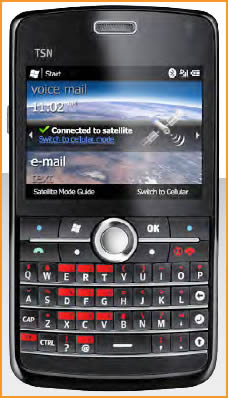
One of the first
devices to be offered for use with the TerreStar system is shown
in the photo and according to TerreStar is "the world's first
quad-band global system for mobile communications (GSM) and tri-band
wideband code-division multiple access (WCDMA)/high-speed packet
access (HSPA) smartphone with integrated all-IP satellite-terrestrial
voice and data capabilities." This phone will support connectivity
to TerreStar's satellite and terrestrial network components and
will offer:
High-speed
packet data
Touch screen
and full QWERTY keyboard
Windows Mobile
OS
Service offerings
that include short message service (SMS), multimedia message service
(MMS), instant messaging (IM), email, push-to-talk (PTT) and location-based
services (LBS).
The first-ever call mentioned above was completed between two
of these smartphones. TerreStar anticipates commercial service
of its satellite system by the end of 2009.
As reported in TV
TechCheck
of June 22, 2009, the 2 GHz spectrum for TerreStar's MSS service
is currently allocated to the Broadcast Auxiliary Service (BAS),
which is being relocated to a new part of the band. During the
period up to the BAS transition deadline of February 2010, in
which both MSS and BAS may operate in the same part of the 2 GHz
band, MSS entrants may conduct operations where the BAS incumbents
have not been relocated only if they successfully coordinate with
the BAS incumbents.
Mobile satellite
communications service provider SkyTerra Communications (Reston,
Va., www.skyterra.com)
currently operates an L-band satellite network but is planning
to transition to a next-generation system (also L-band) which
will utilize "conventional handsets" and, like the
TerreStar system, will be IP-based. SkyTerra's current network
is comprised of two geostationary satellites, MSAT-1 and MSAT-2,
which utilize spot beams to cover all of North America, Central
America, northern South America, the Caribbean, Hawaii, and
up to 250 miles offshore.
SkyTerra's
next-generation system will be a hybrid communications network
integrating mobile satellite service with an ATC (as with TerreStar).
Covering the landmasses of North and South America with hundreds
of spot beams, the satellites will use SkyTerra's patented ATC
technology, which will be made up of an ensemble of land-based
cell sites, to deliver service to wireless devices that are
virtually identical to cell phone handsets in terms of aesthetics,
cost and functionality.
 The
launch window for the first of SkyTerra's two satellites, SkyTerra
1, is scheduled for the spring 2010, and for the second, SkyTerra
2, in late 2010/early 2011. According to information on the
SkyTerra Web site, SkyTerra has developed technology to allow
current subscribers to continue to operate their existing devices
on the SkyTerra next-generation satellites during an "Emulation
Period" which is expected to run through 2012. A "Customer
Transition Incentive Program" was announce in June - SkyTerra
customers who own an active MSAT-G2 radio (shown in photo),
or customers who purchase MSAT-G2 radios and are active SkyTerra
customers prior to the company's transition to its next-generation
network, will be eligible to receive a new next-generation device
for each active radio at the time when SkyTerra formally announces
the transition (at the conclusion of the emulation period).
Additional information about the customer transition incentive
program is available on the SkyTerra Web site at www.skyterra.com/about/transition-incentive-plan.cfm. The
launch window for the first of SkyTerra's two satellites, SkyTerra
1, is scheduled for the spring 2010, and for the second, SkyTerra
2, in late 2010/early 2011. According to information on the
SkyTerra Web site, SkyTerra has developed technology to allow
current subscribers to continue to operate their existing devices
on the SkyTerra next-generation satellites during an "Emulation
Period" which is expected to run through 2012. A "Customer
Transition Incentive Program" was announce in June - SkyTerra
customers who own an active MSAT-G2 radio (shown in photo),
or customers who purchase MSAT-G2 radios and are active SkyTerra
customers prior to the company's transition to its next-generation
network, will be eligible to receive a new next-generation device
for each active radio at the time when SkyTerra formally announces
the transition (at the conclusion of the emulation period).
Additional information about the customer transition incentive
program is available on the SkyTerra Web site at www.skyterra.com/about/transition-incentive-plan.cfm.
 NAB
Satellite Uplink Operators Training Seminar NAB
Satellite Uplink Operators Training Seminar
October 5 - 8, 2009 Washington, DC
Satellite interference costs your station time and money. If
you or your operations staff has not received formal training
for operating your uplink facilities, sign up for NAB's Satellite
Uplink Operators Training Seminar. The course will be offered
Oct. 5 to 8, 2009, at NAB's headquarters in Washington D.C.
This four-day
course is designed to instruct about uplink operational practices,
which minimize the risk of satellite transmission interference.
This is an important course since the FCC rules require that
a trained operator be present at all times during transmissions,
either an earth station site or designated remote control point.
Go to http://www.nab.org/satelliteSeminar/
or Contact NAB Science & Technology Department at (202)
429-5346 or ccolerid@nab.org
for information about the NAB Satellite Uplink Operators Training
Seminar. If you are interested in sponsorship opportunities
for this event contact NAB Advertising at (800) 521-8624 or
advertising@nab.org.
What's
Working for You?
It's time for broadcasters to accentuate the positive, eliminate
the negative and latch on to the affirmative. Progress is made
every day and good deeds should not go unnoticed. Have you come
up with innovative ways of bringing in new revenue? Found a
way to prevent layoffs? Are you finding new opportunities using
the power of technology? We would like to highlight your station
or company's great work in our newsletters, conferences and
programs. Tell us "What's Working for You?" and be
entered into a drawing for two registrations to the NAB Show,
April 10-15, 2010, along with a hotel room for two nights at
a sanctioned NAB Show hotel. Click
here to tell us "What's Working for You?"

The July 27, 2009 TV TechCheck is also available
in an Adobe Acrobat file.
Please click
here to read the Adobe Acrobat version of TV TechCheck.
|