|
ADVANCED TECHNOLOGY FROM NICT AT THE 2009 NAB SHOW
Some of the
most advanced imaging and sound technologies on display at the
2009 NAB Show last week could be found at the NICT Pavilion in
the North Hall of the Las Vegas Convention Center. The National
Institute of Information and Communications Technology (www.nict.go.jp/index.html)
is a Japanese government-funded telecommunications research organization,
which was exhibiting at NAB for the first time. Several technologies
developed in the NICT labs, including those for holographic 3D
television, 3D sound, and an advanced multi-sensory interaction
system, were being shown and are described below. Other demonstrations
included a glasses-free 72-inch 3D display using 50 rear-screen
projectors and an IPTV 3D HD transmission system showing a connection
from Japan to the Las Vegas Convention Center via broadband network.
Holographic
3D Television
Holographic imaging has long been regarded as the ultimate method
for capturing and recreating 3D images, with advantages that include
no special glasses, no visual fatigue, and display of images corresponding
to eye-position. In most holography, due to the challenges of
capturing and reproducing holographic images of moving objects
in real time, a still image is reconstructed using photographic
plates. NICT has, however, developed a prototype system that is
able to capture and reconstruct real, moving objects using electronic
holography. To produce holograms under natural light, the holograms
are calculated from multi-view video captured in real time by
an integral photography (IP) camera using a lens array composed
of many micro lenses and the 3D image is reconstructed using red,
green and blue lasers. A much-simplified diagram of the overall
system is shown below.

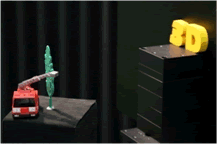
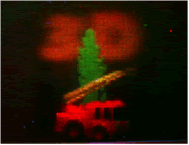
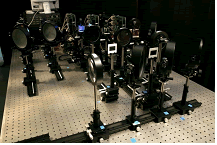
The
demonstration uses a small rotating model truck and other background
items. The small display area for the 3D reconstructed image is
just a couple of inches wide and the resolution and brightness
of the image is very low but, as can be seen from the photographs
below, all the objects are visible. It is also apparent from the
picture of the demonstration display system that more development
will be required before this becomes a system for commercial implementation.
|
|
|
|
|
Captured
Objects
|
Reconstructed
Holographic Image
|
Display
System
|
3D
Sound
 Separate
from the 3D holographic display, but related in its concept of
creating virtual reality, was a demonstration of NICT research
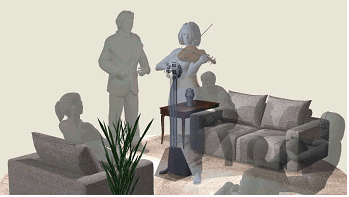
with ultra-realistic 3D sound. In this demonstration, a small
musical group was accurately reproduced as though the musicians
were in the room with the listener. Separate
from the 3D holographic display, but related in its concept of
creating virtual reality, was a demonstration of NICT research
with ultra-realistic 3D sound. In this demonstration, a small
musical group was accurately reproduced as though the musicians
were in the room with the listener.
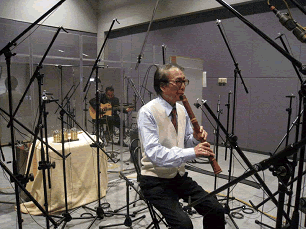
Musical instruments
generate sound in various directions and the photo below show
the arrangement used for picking up the sound with 26 microphones,
recorded to 26 separate audio channels, with the arrangement repeated
for each of three musicians. The sound is reproduced through a
special array of 26 loudspeakers for each of three locations,
radiating sound in accordance with the original sound source,
actualizing the frequency directivity dependence, and giving the
illusion of the musicians being present in the room.
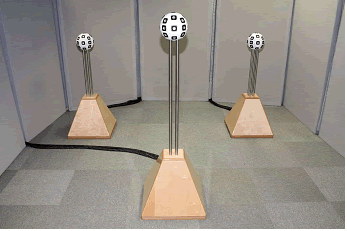
Each
specially-designed spherical radiator loudspeaker assembly, developed
by NICT, is made of ABS and houses 26 one-inch diameter loudspeaker
units. The polar coordinate origin is the center of the spherical
enclosure.
Multi-Sensory
Interaction System
In
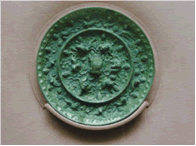
this technology demonstration, a system re-creates the 3D image,
tactile sense, and contact sounds of an ancient copper mirror
(see picture) with a textured metal back, allowing users to interact
naturally with a virtual object.
As
seen in the photo, the user wears 3D glasses to view the reflected
image from a panel display, headphones and a pen-like stylus mounted
on a retractable arm which provides positional and force-feedback
information.
The
rusty condition of the piece can be felt and heard as the stylus
is used to scrape over the metal, with tactile information revealing
the hills and valleys of the ornamental design. The stylus can
also be used to rotate the virtual mirror, with feedback to the
user giving a sense of the weight of the piece.
To produce
this realistic virtual experience, a virtual object model is constructed,
including the 3D structure, texture, and contact sound parameters
of the real object. The position sensor attached to the stylus
makes judgments about contact with the virtual object, and the
system then generates appropriate multi-sensory information to
the user.
Potential
applications for this technology noted might include cultural
and scientific education, remote medicine or medical training,
product design or even realistic online shopping. More information
about this technology is available from the NICT Multimodal Communication
Group in the Universal Media Research Center (email: info_mmc@ml.nict.go.jp).
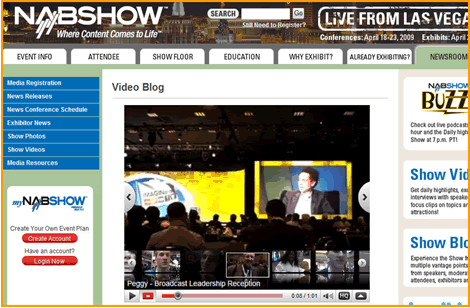 NAB
Video Blog - NAB employed "video blogging" technology
to capture the experience of attending an NAB Show. This video
blog (see screen capture) is available on the NAB Show Web page
at http://www.nabshow.com/2009/newsroom/ NAB
Video Blog - NAB employed "video blogging" technology
to capture the experience of attending an NAB Show. This video
blog (see screen capture) is available on the NAB Show Web page
at http://www.nabshow.com/2009/newsroom/
videoBlog.asp and has been compiled by a group of select "bloggers"
including:
|