|
An
FAQ on TSID, PSIP and DTV Channel Moves
Do
I need to change my TSID when I change RF channels?
No. The original
assignment table does list the then-planned DTV RF channel with
the DTV TSID number. The table that can be found at http://www.mstv.org/docs/TSID.pdf
has not been updated to show current RF emission plans; but the
number is actually for the broadcast station, not for the particular
RF channel used. So a new number should not be requested when
changing RF channels.
How
do I find out what my TSID is?
The most official
source is via an email to ntam@fcc.gov
as the FCC maintains the list. However, for most stations the
list found at http://www.mstv.org/docs/TSID.pdf
should suffice. A TSID, once assigned to a station, does not change,
but the RF channel can.
When
one or more stations are changing frequency, is there a PSIP change
we can make to existing channels just before the changeover day
so that when viewers rescan, they only "see" the new
channels?
Not really.
Each station can put the major-minor channel for another station
(along with that station's TSID) in the list of major-minor channels
in the VCT. Then a typical receiver would get the channel number
and, if that channel is selected, use the TSID to attempt to tune
to the frequency it got on the last forced scan or manual add.
If the receiver has not found a RF channel with that TSID, behavior
is not predictable, but some receivers may scan for it if a consumer
has selected it. In general, the "tell consumers to re-scan"
approach is what can be expected to work best.
What
should be done with the PSIP data if I have two DTV transmissions
on the air for some overlap period?
Just send
the exact same DTV transport stream on both RF channels. Receivers
that were built according to the CEA PSIP Recommended Practice
will detect the new station, and then when the old one goes off
the air, offer the option to delete it. Unfortunately the vast
majority of DTV receivers do not conform to the Recommended Practice
and were not designed to automatically detect new stations, ignoring
the specific process that was documented to enable this transition
to be automatic. Those sets will typically not detect the existence
of both stations, and then when the old one is turned off, will
not find the new one unless they are "rescanned" or
a new station is manually added. Those stations that are changing
DTV channels may wish to provide more than the minimum required
on-air announcements to re-scan to minimize the service disruption
and calls to the station.
I have
a duopoly, what do I do about PSIP?
Each station
can have the other station's major-minor channel number in their
VCTs in addition to their major-minor channel numbers. So in the
two channel case, there would be two TSIDs in the VCT, one with
the emitting station's major-minor channel number and one with
the other stations' major minor channel numbers.
Where
do I find the document that states which PSIP tables are required
by the FCC for over - the - air broadcast?
FCC 73.682(d)
is the section that places the ATSC standards into the rules,
legally making their contents the same as if they had actually
been printed in the Code of Federal Regulations. The ATSC Standard
A/65 is the document that contains the PISP rules. (See http://www.atsc.org/standards/a_65cr1_with_amend_1.pdf.)
Annex B of A/65 is where the rules for major channel number assignments
are found.
What
kinds of stations need a TSID?
All DTV signals
need to send a TSID, but not all need their own number. The ATSC
standard requires the number to be unique by transport stream
and be present in three places (the PAT, the VCT header, and for
each virtual channel, the TSID where that signal is found). The
key point is one TSID for one responsible "owner" of
the stream. The FCC has not established the formal process to
obtain this number, nor separately determined which transmitters
are to be assigned one. New numbers are assigned by the FCC when
they consider it appropriate to do so - with the only guidance
being the rules that are in the PISP standard (as that is part
of the regulations). TSID assignments to Class A stations are
appropriate and consistent with the PSIP requirements, at least
to cover those day-parts where they do not operate as translators.
The system is designed so that the same TSID would be used for
translators, so no seperate TSID should be sent from such stations.
This is to avoid the same virtual channel number appearing two
times in the receiver's channel listing. When a Class A station
is used as a translator for part of the day each virtual channel
in its VCT needs to be signaled as active for the periods when
it is so operating with the EIT contents covering the right times.
The simplest approach is to have a different major-minor channel
number for the Class A's programming, which means that at least
two major channel numbers are in the VCT. The PSIP data from the
primary station would need to be altered before transmitted from
such a Class A station. (The non-translator mode operating periods
have not been addressed by the FCC, but the ATSC standards can
and should apply.) If the Class A station and the broadcaster
desire the major-minor channel number to be common across all
day parts, the management of the PSIP data to maintain compliance
with the standards is significantly more complex.
Amateur
Radio Operators Reception - An NAB Tradition
The annual
Amateur Radio Operators Reception, more affectionately known as
the HAM Reception, is a free-of-charge event at the 2009
NAB Show which is open to all attendees. This year’s event
will be held in Ballroom B of the Las Vegas Hilton on Wednesday,
April 22, 2009 from 6 – 8 p.m.
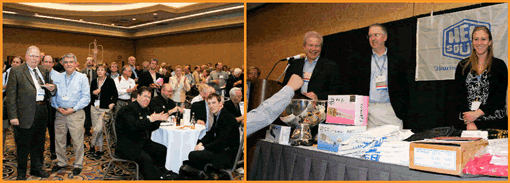 NAB’s
HAM Reception is a big draw for both amateur radio operators as
well as those who have never “pushed-to-talk” nor learned
Morse code, with hundreds lining up outside hours before the doors
open. Typically over 600 people pack the ballroom, each hoping
that they will be the lucky winner of
one of the fabulous (and sometimes very expensive) door prizes
(over $15,000 worth of prizes in all this year!). Shown in photos
above are the eager crowd (at left) and at right, John Marino
and David Layer of NAB up on the prize podium (with one of the
helpers from Baylor University who provide operational support
at the show each year for the NAB Technology Conferences). This
year the HAM Reception is co-sponsored by Heil Sound Ltd. (www.heilsound.com)
and BSW (www.bswusa.com). NAB’s
HAM Reception is a big draw for both amateur radio operators as
well as those who have never “pushed-to-talk” nor learned
Morse code, with hundreds lining up outside hours before the doors
open. Typically over 600 people pack the ballroom, each hoping
that they will be the lucky winner of
one of the fabulous (and sometimes very expensive) door prizes
(over $15,000 worth of prizes in all this year!). Shown in photos
above are the eager crowd (at left) and at right, John Marino
and David Layer of NAB up on the prize podium (with one of the
helpers from Baylor University who provide operational support
at the show each year for the NAB Technology Conferences). This
year the HAM Reception is co-sponsored by Heil Sound Ltd. (www.heilsound.com)
and BSW (www.bswusa.com).
Everyone attending
the HAM Reception is eligible to win a door prize, and is handed
a raffle ticket upon entering the ballroom. This year there are
over 100 prizes to be handed out which have been generously donated
by broadcast equipment manufacturers, engineering consulting firms,
the American Radio Relay League (ARRL), and others – many
of these prizes are listed below along with who they were donated
by (in parentheses, including a link to the donor’s Web page).
If you' re interested in becoming part of this tradition and donating
a prize, please contact David Layer at dlayer@nab.org.
Amateur
radio-related prizes:
The
ARRL Operating Manual – 9th edition (ARRL
– 3 of these)
Vertex Standard VX-110/150 VHF FM transceiver Cavell,
Mertz & Associates, Inc.)
ICOM IC-V82 handheld transceiver (Cavell,
Mertz & Associates, Inc. – 2 of these)
100’ 7977A RF-600 coax gift certificate (Belden
– 2 of these)
 The
ARRL Repeater Directory 2007/08 (ARRL
– 12 of these) The
ARRL Repeater Directory 2007/08 (ARRL
– 12 of these)
Yaesu FT-60R VHF/UHF dual band FM transceiver (Cavell,
Mertz & Associates, Inc. – 2 of these)
Dataworld
HAM contact locator map 34” x 44” (Dataworld)
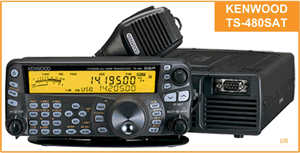
Kenwood TS-480SAT HF/50 MHz all-mode transceiver
(Harris
Broadcast Communications)
3CX1500A7 tube (Eimac
– 2 of these)
3CX800A7 tube (Eimac
– 2 of these)
The
ARRL HF Digital Handbook 4th edition (ARRL
– 10 of these)
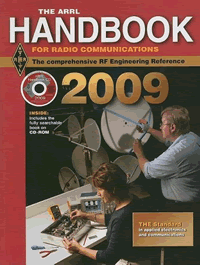
The ARRL Handbook – 2009 edition (ARRL
– 8 of these)
RFI book – 2nd edition (ARRL
– 3 of these)
The ARRL Antenna Book – 21st edition (ARRL
– 6 of these)
Jetstream JTCE1G center insulator for dipole (R&L
Electronics)
Jetstream HT antenna – 144-148, 222-225, 440-450 MHz (R&L
Electronics)
Jetstream 13.8V 25A DC power supply (R&L
Electronics)
Jetstream
9-15V 25A DC power supply w/meters (R&L
Electronics)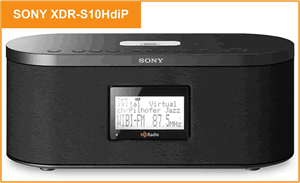
Yaesu VX-3R
handheld transceiver (Cavell,
Mertz & Associates, Inc.)
100’ 7976A RF-500 coax gift certificate (Belden
– 2 of these)
Yaesu
VX-170 VHF FM transceiver (Cavell,
Mertz & Associates, Inc.)
Yaesu Model VR-500 w/NC-60B battery charger (Hammett
& Edison, Inc.)
CQ calendars (CQ
Magazine – 10 of these)
Kenwood
TS-480SAT HF/50 MHz all-mode transceiver (Kenwood
Americas Corp.) Amateur
Electronics Supply $50 gift certificate (Wegener
Communications)
CQ Magazine subscription (CQ
Magazine – 5 of these)
100’
7810A RG8 coax gift certificate (Belden
– 2 of these)
 Broadcasting-related
prizes: Broadcasting-related
prizes:
Bird Model 43 Thruline wattmeter, plug-in
element (Bird)
SMT-1000
Mobile Tester (Kathrein,
Inc., Scala Division)
IBOC Handbook (Broadcast
Signal Lab)
SBE bookstore $40 gift certificate (SBE)Telewave
44A RF wattmeter (Telewave)
Novelty RF Sign (“Engineer at play”) (Broadcast
Signal Lab)
Combination laptop lock w/SBE logo (SBE)
Dorrough Electronics loudness meter (Dorrough
Electronics – 3 of these)
Miscellaneous:
$50
Honeybaked ham gift certificate (ATSC
– 2 of these)
Apple iPod shuffle 2 Gb (CEA
– 4 of these)
Samson Zoom-H4 Digital Audio Recorder (The
Durst Organization)
HD Car Connect radio (CBS
Radio – 2 of these)
CCRadio-SW AM/FM/shortwave radio w/ AM antenna (C.
Crane Co.)
Radio Shack digital soldering station (Larcan)
Sony XDR-S10HdiP tabletop HD Radio w/iTunes tagging (iBiquity
Digital Corp.)
 VISA
gift card - $25 (Henry Engineering
– 2 of these) VISA
gift card - $25 (Henry Engineering
– 2 of these)
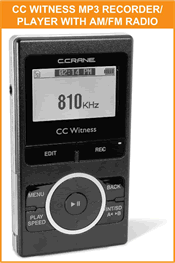
CC Witness MP3 recorder-player w/AM-FM radio (C.
Crane Co.)
256 Mbyte flash drive (IEEE
Broadcast Technology Society – 8 of these)
CC Wi-Fi Internet Radio (C. Crane
Co.)
VISA gift card - $50 (Henry
Engineering – 2 of these)
CCRadio – SWP AM/FM/shortwave pocket radio (C.
Crane Co.)
Logo shirt and 1 Mbyte flash drive (Broadcast
Electronics)
Zenith DTT901 HDTV converter box w/Silver Sensor antenna (LG
Electronics)
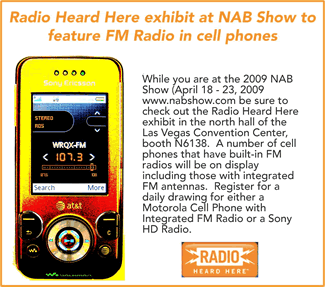
LG-VX8800 Venus cell phone for Verizon (LG
Electronics)
Media
Professionals To Recruit Job Seekers During
NAB Show Career Day
The NAB Education
Foundation, in partnership with the Broadcast Education Association
(BEA) and Radio-Television News Directors Association (RTNDA),
will host their annual Career Day at the Las Vegas Hilton on Wednesday,
April 22 during the 2009 NAB Show. Sponsored by Edge Technology
Services, Career Day will allow students and entry-level job seekers
to meet with media industry professionals.
Career Day
has expanded to include a new "Career Services" component
that will provide job seekers, both professional and entry-level,
with resume critiquing, one-on-one mini career coaching sessions
to help prepare prospective employees for career advancement.
For additional information visit the NABEF
Web site.


The
April 6, 2009 TV TechCheck is also available in
an Adobe Acrobat file.
Please click
here to read the Adobe Acrobat version of TV TechCheck.
 |