| |
New Proposal for Increasing FM IBOC Power Submitted to FCC
One of the important (and closely followed) recent technical
issues in radio broadcasting has been the proposal, filed with
the FCC in June, 2008, to give FM broadcasters the option to increase
the power in the digital sidebands of an FM IBOC signal by up
to 10 dB. Last week, iBiquity Digital Corporation (Columbia, Md.,
www.ibiquity.com) and National
Public Radio (NPR, Washington, D.C., www.NPR.org)
jointly filed “...a new proposal for resolution of the pending
request to allow FM stations to increase the power of their digital
signal.” Additionally, both the “Joint Parties”
(the group which filed the original request) and NAB submitted
filings voicing support for this new proposal.
Briefly, this new proposal recommends a blanket authorization
for up to a 6 dB power increase and a process whereby some stations
will be able to increase power by up to 10 dB. Specifically, this
new proposal recommends:
A blanket authorization for all FM stations to increase FM
digital power by up to 6 dB above existing authorized levels (i.e.,
from -20 dBc up to -14 dBc), subject to some additional conditions
(discussed in the iBiquity/NPR joint filing and below). Excluded
from this blanket authorization are grandfathered super-power
Class B stations, for which this new proposal recommends that
the digital power levels should be limited to the higher of: (i)
-20 dB relative to their analog carrier as is permitted by the
current rules, or (ii) at least 10 dB below the maximum analog
power authorized for this class of station as adjusted for height,
absent any grandfathered super power (note that this super-power
Class B exception is identical to the one in the original proposal).
Whether a station can increase its digital power by more than
6 dB should depend upon how close it is to its first-adjacent
channel neighbors. This new proposal recommends that stations
seeking to increase power by more than 6 dB (up to a maximum of
10 dB) should be required to file an application with the FCC,
setting out compliance with the following criteria and formula:
Between
the maximum IBOC power of -10 dBc and a blanket minimum power
of -14 dBc, the allowable digital power for the digital station,
toward any point on the 60 dBu contour of any first-adjacent
analog FM station, is:
Allowable
IBOC power = [2.27 * (60 - (IBOC station F(50,10) dBu)) - 33.6]
This formula
is derived from the recently-completed NPR Labs “Advanced
IBOC Coverage and Compatibility Study”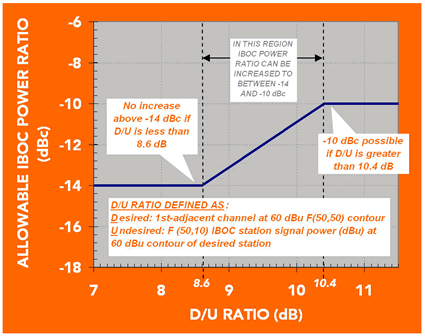 (AICCS) which was also filed with the Commission last week. The
graph helps to explain this criteria – in words, if the desired-to-undesired
(D/U) power ratio at the 60 dBu F(50,50) contour of a station
that is first-adjacent to an IBOC station is greater than
8.6 dB, then that IBOC station may be allowed to increase its
digital power above -14 dBc. The line in the graph illustrates
that, for cases where the D/U ratio falls between 8.6 and 10.4
dB D/U, a station can increase its digital power by more than
6 dB but less than 10 dB, and, for cases where the D/U is greater
than 10.4 dB, a station can increase up to the maximum allowed
-10 dBc digital power level.
(AICCS) which was also filed with the Commission last week. The
graph helps to explain this criteria – in words, if the desired-to-undesired
(D/U) power ratio at the 60 dBu F(50,50) contour of a station
that is first-adjacent to an IBOC station is greater than
8.6 dB, then that IBOC station may be allowed to increase its
digital power above -14 dBc. The line in the graph illustrates
that, for cases where the D/U ratio falls between 8.6 and 10.4
dB D/U, a station can increase its digital power by more than
6 dB but less than 10 dB, and, for cases where the D/U is greater
than 10.4 dB, a station can increase up to the maximum allowed
-10 dBc digital power level.
The FCC
should adopt the following rule, consistent with the current rule
for AM interference, to remediate harmful interference from any
stations increasing power above the existing -20 dBc power level:
In cases
in which digital operation with sideband power above the -20
dBc level results in complaints of actual interference within
another station’s protected service contour and the respective
licensees are unable to reach agreement on a voluntary power
reduction, the Commission staff may order power reductions for
the IBOC digital carriers.
In a
case in which licensees fail to reach agreement on a voluntary
power reduction, an affected station may file an interference
complaint with the Commission. In order to make out a prima
facie complaint, the station must (i) include interference reports
from a minimum of three complainants and evidence of ongoing
rather than transitory harmful interference within the station’s
protected contour, (ii) describe any test measures used to identify
IBOC-related interference and (iii) document the extent of such
interference.
The
Media Bureau shall resolve each complaint within ninety days
of filing. In the event the Bureau fails to issue a decision
within ninety days of the date on which a complaint is filed,
the interfering station shall reduce immediately its digital
subcarrier power. In the case of stations operating above -14
dBc, the station shall reduce power to -14 dBc. If there are
further complaints of continued interference at the -14 dBc
level, the station shall reduce power to -17 dBc unless continued
interference requires a further reduction to the -20 dBc level.
In the case of stations operating at -14 dBc or below, the station
shall reduce power to -17 dBc unless there are further complaints
of continued interference requiring a further reduction to the
-20 dBc level.
The FCC should include the following language in any Order authorizing
a digital power increase:
Consistent
with its previous position in this proceeding, the Commission
staff will act on unresolved complaints in cases in which interference
is shown to cause a problem. We reserve the right to revisit
in the future the appropriate power level for the digital sidebands
should the need arise due to widespread instances of harmful
interference from operation above the -20 dBc level.
In addition to these recommendations, the new proposal indicates
that NPR and iBiquity have committed to developing additional
enhancements to the HD Radio system to increase digital coverage
and minimize interference to first-adjacent analog operations
and make the system usable for the public service requirements
of radio reading services. Specifically, they have committed to
work together to finalize the design and implement single frequency
networks to fill gaps in digital coverage and asymmetrical digital
sidebands to reduce the potential for digital interference to
short spaced first adjacent analog stations, and to collaborate
on low bit rate codecs and conditional access for radio reading
services. Finally, NPR and iBiquity will periodically report to
the Commission on the progress of these efforts.
The full text of this new proposal as well as the NAB and Joint
Parties endorsements and the NPR Labs AICCS study are available
for download from the FCC’s Electronic Comment Filing System
(ECFS) Web page. To access, go to http://fjallfoss.fcc.gov/ecfs2/comment_search/input?z=38ra8
and enter “99-325” (no quotes) in the “Proceeding
Name” box, then click the “Search for comments”
button at the bottom of the page.
ADVERTISEMENT

|
The November 9, 2009 Radio TechCheck is also
available in an Adobe Acrobat file.
Please click
here to read the Adobe Acrobat version of Radio TechCheck
|

