
An
increasing number of portable consumer electronics devices are
including radio broadcast receivers, with the most exciting recent
examples being the 5th-generation iPod nano (which includes an
FM radio) and the Zune HD (with an FM-band HD Radio IBOC receiver;
see the September,
28, 2009 issue of Radio TechCheck for information on
these devices from last month’s NAB Radio Show™). Invariably
one of the biggest challenges faced by manufacturers of these
products is how to incorporate the receiver antenna into the design.
For both of
the new products just mentioned, the headphone cord is also the
FM receiver antenna, but for a variety of reasons it would be
more desirable to incorporate the antenna into the device itself.
One of the leading manufacturers of FM receiver integrated circuits
(ICs), Silicon Labs (Austin, Texas, www.silabs.com)
has published an interesting white paper which discusses some
of the technical issues surrounding how to embed FM receiver antennas
in portable devices. A good example of a device with an integrated
FM antenna is the Motorola ROKR™ EM35 cell phone (see the
March
23, 2009 issue of Radio TechCheck for more information
on cell phones with FM radios and integrated FM antennas).
Entitled “Solving
FM Antenna Design Challenges in Portable Devices,” the SiLabs
white paper focuses on the theory behind and implementation of
so-called “tuned antennas,” referring to an antenna
which incorporates tunable, resonant elements allowing for optimization
of antenna performance at a particular frequency. One of SiLabs’
FM receiver IC products, the Si4704/05, supports the use of a
short, embedded antenna. The Si4704/05 implements a self-tuned
resonant network with a patented advanced signal processing algorithm.
The antenna algorithm tunes the capacitance value of an on-chip,
tunable varactor to ensure the antenna stays at its highest efficiency
for each frequency tuned, resulting in optimum performance.
The graph
below illustrates this operation. If an FM receiver using the
SiLabs IC is tuned to station #1 in the graph (around 100 MHz),
the antenna algorithm tunes the antenna resulting in the peaked
response shown (with a high quality factor, Q, of 20). For receiving
station #2 (around 84 MHz in the graph), the algorithm would re-tune
the antenna such that the peaked response is aligned with the
new frequency.
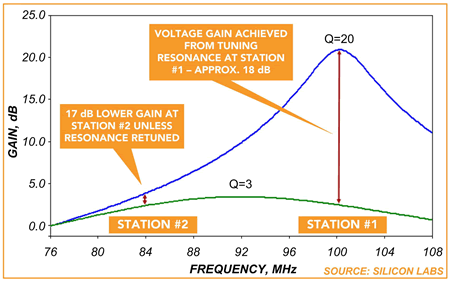
Also
shown in the graph is the response of a low-Q antenna (with a
Q=3) representing the response of an equivalent short antenna
designed to receive the entire FM band without tuning. For this
example, implementation of the tuned antenna increases the antenna
gain by approximately 18 dB compared to an equivalent untuned
short antenna. An added benefit of using a tuned antenna is improved
receiver selectivity. In addition to increasing the gain, resonating
the antenna at the desired frequency also attenuates interference
at other frequencies, significantly increasing the selectivity
of the receiver.
A copy of
the full Silicon Labs white paper is available for download from
the Silicon Labs Web site at www.silabs.com/products/audiovideo/fmreceivers/Pages/FMAntennaDesignChallengesWhitepaper.aspx.
Additional information on the iPod nano with FM receiver is available
on the Apple Web page at www.apple.com/ipodnano;
see www.zune.net/en-us/products/zunehd/default.htm
for additional information on the Zune HD. The Motorola ROKR EM35
cell phone with built-in FM radio and integrated FM antenna is
described on the Motorola Web page at www.motorola.com/motoinfo/product/details.jsp?globalObjectId=275#.

The 2010 NAB Show will host the 64th Broadcast Engineering Conference.
This world-class conference addresses the most recent developments
in broadcast technology and focuses on the opportunities and challenges
that face broadcast engineering professionals. Each year hundreds
of broadcast professionals from around the world attend the conference.
They include practicing broadcast engineers and technicians, engineering
consultants, contract engineers, broadcast equipment manufacturers,
distributors, R&D engineers plus anyone specifically interested
in the latest broadcast technologies.
Do you have something to share?
If you feel qualified to speak at the NAB Broadcast Engineering
Conference, we invite you to submit
a technical paper proposal. Not all acceptable submissions can
be included in the conference, due to the large number of submissions
that are received and the limited number of available time slots.
The deadline for submitting your proposal is October 23, 2009.
If you have any questions, contact John Marino, VP Science and
Technology, at (202) 429-5346.
PLAN
TO ATTEND!
The IEEE
Broadcast Technology Society
59th ANNUAL BROADCAST SYMPOSIUM
14 -16 October 2009
The Westin Alexandria
Alexandria, VA, USA
www.ieee.org/bts/symposium
ADVERTISEMENT

|
The October 12, 2009 Radio TechCheck is also
available in an Adobe Acrobat file.
Please click
here to read the Adobe Acrobat version of Radio TechCheck

