| |
Increasing
FM IBOC Digital Power – the Manufacturer’s Perspective
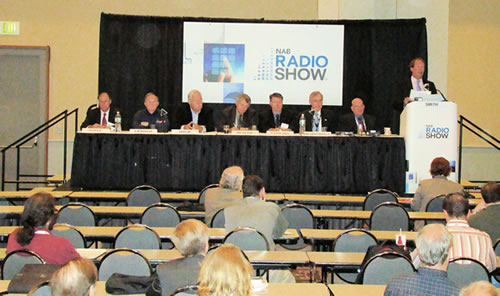 One
of the highlights of the engineering program at this year’s
NAB Radio Show (Philadelphia, September 23-25, 2009, www.nabradioshow.com)
was a session entitled “The IBOC Power Issue – You Have
Questions, We Have Answers!” This two-hour long panel discussion,
moderated by Milford Smith, vice president of Engineering for
Greater Media (and chairman of the National Radio Systems Committee,
NRSC), included presentations from iBiquity, NPR Labs, the four
principal U.S. HD Radio transmitter manufacturers (BE, Continental,
Harris and Nautel) and the FCC. While the iBiquity and NPR Labs'
presentations focused on performance and compatibility issues,
and the FCC’s comments focused on regulatory policy, the
manufacturers talked about some interesting market and equipment
issues that are summarized here. One
of the highlights of the engineering program at this year’s
NAB Radio Show (Philadelphia, September 23-25, 2009, www.nabradioshow.com)
was a session entitled “The IBOC Power Issue – You Have
Questions, We Have Answers!” This two-hour long panel discussion,
moderated by Milford Smith, vice president of Engineering for
Greater Media (and chairman of the National Radio Systems Committee,
NRSC), included presentations from iBiquity, NPR Labs, the four
principal U.S. HD Radio transmitter manufacturers (BE, Continental,
Harris and Nautel) and the FCC. While the iBiquity and NPR Labs'
presentations focused on performance and compatibility issues,
and the FCC’s comments focused on regulatory policy, the
manufacturers talked about some interesting market and equipment
issues that are summarized here.
Tim Bealor,
vice president, RF Products for Broadcast Electronics (BE) and
Mike Troje, sales manager Continental Electronics, were the first
two manufacturers’ representatives to speak and they focused
on how the possibility of higher power FM in-band/on-channel (IBOC)
digital sideband operation is impacting the marketplace. Their
separate presentations arrived at similar conclusions, namely,
that the uncertainty about whether a power increase will be authorized
(and if so, how much) is making it difficult for broadcasters
to move forward with new HD Radio installations.
Mr. Bealor
noted that to-date only about 20 percent of radio broadcasters
overall have implemented HD Radio technology and characterized
those who have yet to convert as belonging to one of the following
groups:
|
Mid-market groups
|
Smaller
stations of major groups
|
|
Small-market groups
|
Smaller
groups in major markets
|
|
Smaller public stations
|
Translators |
|
Boosters
|
Individual
stations |
|
Small ownership stations
|
|
He said that broadcasters not yet ready to build digital facilities
are looking for cost effective analog solutions now, that can
be converted to -20 dB HD Radio operation (i.e., the currently
authorized power level), then be upgraded to -10 dB or -14 dB
HD Radio power levels (i.e., the increased power levels being
contemplated) at some point in the future.
Mr. Troje
provided some additional HD Radio transition statistics, showing
that about 17 percent of non-commercial and 21 percent of commercial
broadcasters have already made the transition to HD Radio facilities.
He highlighted three specific needs of broadcasters who have not
yet made the transition:
|
Action
from the FCC on allowable higher level FM IBOC power levels
– he believes these broadcasters “...need to see
an ‘end game’ before they can be expected to get
on-board;” |
|
A realizable
business model for small to medium markets; |
|
More
automotive and portable receivers. |
The final
two manufacturer presentations were from Geoffrey Mendenhall,
vice president - Ttransmission Research and Technology, Harris
Corporation, and Gary Liebisch, regional sales manager, Nautel,
Inc. These two presentations focused more on the technical challenges
surrounding the increase in FM IBOC sideband power level. Among
other things, Mr. Mendenhall summarized the linearity challenges
faced by manufacturers in building transmission equipment to operate
at the higher IBOC sideband power levels:
|
Due
to the higher peak-to-average AM component of the increased
IBOC carrier injection, a common amplification transmitter
must be further de-rated from class ”C” saturated
FM operation; |
|
The more
the amplitude of the IBOC carriers is increased, the more
common amplification transmitters must be de-rated; |
|
For HD-only,
separate amplification without the linearizing effect of the
constant envelope analog FM signal, the maximum available
total power output (TPO) must be further reduced to improve
intermodulation distortion (IMD) suppression; |
|
At -10 dBc (10 percent) injection, the RF IMD products
need to be suppressed an additional 10 dB at the same time
the power output is increased by 10 dB. This represents
a 20 dB linearity improvement from that needed at -20 dBc
(1 percent) to maintain the original RF mask compliance.
|
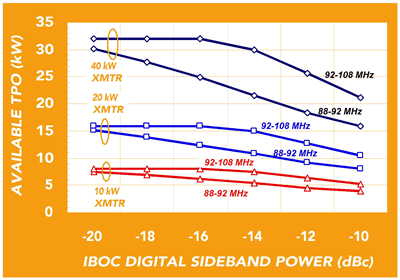 In
the Nautel presentation, Mr. Liebisch explained that Nautel has
typically used a “rule of thumb” value of 40 percent
to estimate the output power available from a Nautel transmitter
at the proposed -10 dBc power level so that, for example, Nautel
would “de-rate” a 40 kW transmitter to 16 kW for the
higher IBOC power level using this rule. Mr. Liebisch said that
recent testing has confirmed the 40 percent value for transmit
frequencies in the non-commercial educational (NCE) portion of
the FM band (88 to 92 MHz) but interestingly, in the commercial
portion of the band (92 to 108 MHz), the available power is consistently
higher (see graph at right). Consequently, for the 40 kW example
at -10 dBc, 20 kW was the available power for the commercial band
while only 16 kW (corresponding to the 40 percent rule) was available
for the NCE band. Mr. Liebisch indicated that Nautel is working
to improve the NCE performance and anticipates that it will get
closer to that being experienced in the commercial band. In
the Nautel presentation, Mr. Liebisch explained that Nautel has
typically used a “rule of thumb” value of 40 percent
to estimate the output power available from a Nautel transmitter
at the proposed -10 dBc power level so that, for example, Nautel
would “de-rate” a 40 kW transmitter to 16 kW for the
higher IBOC power level using this rule. Mr. Liebisch said that
recent testing has confirmed the 40 percent value for transmit
frequencies in the non-commercial educational (NCE) portion of
the FM band (88 to 92 MHz) but interestingly, in the commercial
portion of the band (92 to 108 MHz), the available power is consistently
higher (see graph at right). Consequently, for the 40 kW example
at -10 dBc, 20 kW was the available power for the commercial band
while only 16 kW (corresponding to the 40 percent rule) was available
for the NCE band. Mr. Liebisch indicated that Nautel is working
to improve the NCE performance and anticipates that it will get
closer to that being experienced in the commercial band.
2010
NAB Show Call for Speakers
Call for Technical Papers – NAB Broadcast
Engineering Conference
 The
2010 NAB Show will host the 64th Broadcast Engineering Conference.
This world-class conference addresses the most recent developments
in broadcast technology and focuses on the opportunities and challenges
that face broadcast engineering professionals. Each year hundreds
of broadcast professionals from around the world attend the conference.
They include practicing broadcast engineers and technicians, engineering
consultants, contract engineers, broadcast equipment manufacturers,
distributors, R&D engineers plus anyone specifically interested
in the latest broadcast technologies. The
2010 NAB Show will host the 64th Broadcast Engineering Conference.
This world-class conference addresses the most recent developments
in broadcast technology and focuses on the opportunities and challenges
that face broadcast engineering professionals. Each year hundreds
of broadcast professionals from around the world attend the conference.
They include practicing broadcast engineers and technicians, engineering
consultants, contract engineers, broadcast equipment manufacturers,
distributors, R&D engineers plus anyone specifically interested
in the latest broadcast technologies.
Do you have something to share?
If you feel qualified to speak at the NAB Broadcast Engineering
Conference, we invite you to submit
a technical paper proposal. Not all acceptable submissions can
be included in the conference, due to the large number of submissions
that are received and the limited number of available time slots.
The deadline for submitting your proposal is October 23, 2009.
If you have any questions, contact John Marino, VP Science and
Technology at 202 429 5346.
PLAN
TO ATTEND!
The IEEE Broadcast Technology Society
59th ANNUAL BROADCAST SYMPOSIUM
14 -16 October 2009
The Westin Alexandria
Alexandria, VA, USA
www.ieee.org/bts/symposium
ADVERTISEMENT

|
The October
5, 2009 Radio TechCheck is also available in an
Adobe Acrobat file.
Please
click
here to read the Adobe Acrobat version of Radio TechCheck
|

