| |
Tower
Failures and How to Prevent Them
 Having
a tower fail is one of the worst things that can happen to a broadcaster.
Tower failures put people at risk, can be enormously expensive
and take a broadcaster's life blood, the radio signal, off air.
A session which is part of the Engineering
Program at this week's NAB Radio ShowTM (Philadelphia, Pa.,
September 23-25, 2009, www.nabradioshow.com)
will cover the major causes of tower failures and offer advice
on how you can work to prevent a catastrophic Having
a tower fail is one of the worst things that can happen to a broadcaster.
Tower failures put people at risk, can be enormously expensive
and take a broadcaster's life blood, the radio signal, off air.
A session which is part of the Engineering
Program at this week's NAB Radio ShowTM (Philadelphia, Pa.,
September 23-25, 2009, www.nabradioshow.com)
will cover the major causes of tower failures and offer advice
on how you can work to prevent a catastrophic  situation.
This session will be held on Wednesday, September 23, 2009 from
9-10 a.m. in room 201B of the Pennsylvania Convention Center.
The NAB Radio Show Engineering Program is sponsored by Stainless,
LLC. situation.
This session will be held on Wednesday, September 23, 2009 from
9-10 a.m. in room 201B of the Pennsylvania Convention Center.
The NAB Radio Show Engineering Program is sponsored by Stainless,
LLC.
Hosting this
session will be David Davies, Director of Structural Products
and Services, Electronics Research, Inc. (ERI, Chandler, Ind.,
www.eriinc.com). David has
a 27-year history in the tower industry including 19 years as
an engineer with ERI. He is named in several patents including
the LAMBDA antenna mounting system and the ULTRA guy anchor design.
He has participated in projects through out the U.S. and foreign
countries, and is a member of the TIA/EIA committee responsible
for the composition of the design standards governing antenna
and antenna tower design and fabrication.
The first
part of David's presentation will focus on the five most common
causes behind tower failures, which are anchor failure (#5), aircraft
collision (#4), special wind conditions (#3), ice and wind over
ice (#2), and problems with construction (#1). This ranking is
a result of an ERI study conducted in 2009 which investigated
over 70 tower failures since 1960, and interestingly this ERI
ranking is very similar to a ranking from a study conducted by
tower manufacturer Stainless in 2006. An example of each failure
mode, taken from David's presentation follows. An interesting
list of additional failures is available on the Internet at: http://en.wikipedia.org/wiki/List_of_catastrophic_collapses_of_radio_masts_and_towers.
 Anchor
failure - picture at right shows what's left of the 528-foot
tower of WMGX (93.1) and WYNZ (100.9) in Portland, Maine, which
came crashing down on December 11, 2003. David indicates in his
presentation that the tower wasn't all that old - WMGX had built
in 1986 (17 years) - but it suffered from corrosion in the guy
wire anchor. The Anchor
failure - picture at right shows what's left of the 528-foot
tower of WMGX (93.1) and WYNZ (100.9) in Portland, Maine, which
came crashing down on December 11, 2003. David indicates in his
presentation that the tower wasn't all that old - WMGX had built
in 1986 (17 years) - but it suffered from corrosion in the guy
wire anchor. The 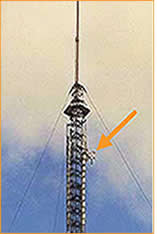 tower
plunged in the opposite direction (from where the guy wire anchor
was located), crushing a couple of cars and coming within feet
of hitting the studio and some warehouses. tower
plunged in the opposite direction (from where the guy wire anchor
was located), crushing a couple of cars and coming within feet
of hitting the studio and some warehouses.
Aircraft
collision - the CBC Tower, near Shawinigan, Quebec, Canada
was a 1,217-foot high guyed tower used for FM radio and TV transmissions.
On April 21, 2001, a Cessna 150 single-engine plane piloted by
Gilbert Paquette flew into the tower while flying in heavy fog.
Rather than plummeting to the ground, the plane became firmly
wedged into the side of the tower (see arrow in photo at left),
and a subsequent analysis determined that as a result of this
impact, the tower had been knocked several feet off-center. Apparently
a number of options were considered and ultimately it was decided
to bring the structure down in a controlled demolition. A video
of the demolition is available for viewing on You Tube at: http://www.youtube.com/watch?v=udenD7RXGg0.
This is believed to be the tallest structure ever demolished with
explosives. A detailed account of the implosion is given on the
"Implosion World" Web site at www.implosionworld.com/cbc1.htm.
Special
wind conditions - on the night of August 23, 2000, a thunderstorm
with winds in excess of 70 miles per hour went through the town
of Mexico, Mo,, taking down the 408-foot tower of KXEO which was
also home to the microwave system that 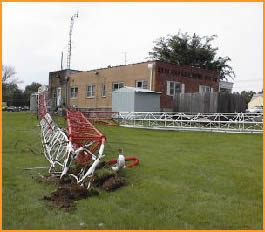 feeds
the nearby 1,203-foot KWWR tower (see photo at left). The power
lines feeding the nearby studio were knocked down, as well. As
can be seen from the photo at left, the tower just barely hit
the northeast corner of the studio building. According to reports
from the scene, there was some damage to cars in the parking lot
from breaking guy wires, but no one was injured. feeds
the nearby 1,203-foot KWWR tower (see photo at left). The power
lines feeding the nearby studio were knocked down, as well. As
can be seen from the photo at left, the tower just barely hit
the northeast corner of the studio building. According to reports
from the scene, there was some damage to cars in the parking lot
from breaking guy wires, but no one was injured.
Ice and
wind over ice - as reported in the Waterloo Cedar Falls Courier,
on February 24, 2007, the tower of FM station KHKE, just south
of Waterloo, Iowa, was felled by the combination of a 1-inch thick
coating of ice and 30- to 40-mph winds. The upper half of the
420-foot tower came crashing down when the top two 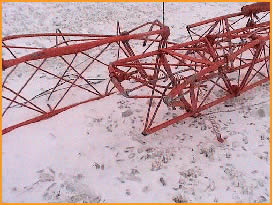 guy
wires snapped (shown in photo at right). guy
wires snapped (shown in photo at right).
Problems
with construction - this is the most common reason that towers
fail, and according to David's research is responsible for 30%
of the tower failures studied by ERI in 2009. In March of 2008,
a tower under construction in La Mirada, Ca. collapsed (see photo
at left), injuring a construction worker. While the final height
of this tower was to be 684 feet, it's height at the time of the
collapse was approximately 250 feet. David believes that although,
for example, "ice" or "storm" may be the reported
"cause of failure" in  many
tower collapses, it is likely poor design and/or installation,
tower overloading and lack of maintenance that are contributing
factors. many
tower collapses, it is likely poor design and/or installation,
tower overloading and lack of maintenance that are contributing
factors.
David explains
that hidden causes of failure, such as galvanic corrosion often
go undetected and over time will weaken and eventually destroy
a tower structure. The latter part of his presentation will focus
on important detection methods that he feels are both highly accurate
and cost effective for preventing many tower failures.
2010 NAB Show Call for Speakers
Call for Technical Papers – NAB Broadcast Engineering Conference
 The
2010 NAB Show will host the 64th Broadcast Engineering Conference.
This world-class conference addresses the most recent developments
in broadcast technology and focuses on the opportunities and challenges
that face broadcast engineering professionals. Each year hundreds
of broadcast professionals from around the world attend the conference.
They include practicing broadcast engineers and technicians, engineering
consultants, contract engineers, broadcast equipment manufacturers,
distributors, R&D engineers plus anyone specifically interested
in the latest broadcast technologies. The
2010 NAB Show will host the 64th Broadcast Engineering Conference.
This world-class conference addresses the most recent developments
in broadcast technology and focuses on the opportunities and challenges
that face broadcast engineering professionals. Each year hundreds
of broadcast professionals from around the world attend the conference.
They include practicing broadcast engineers and technicians, engineering
consultants, contract engineers, broadcast equipment manufacturers,
distributors, R&D engineers plus anyone specifically interested
in the latest broadcast technologies.
Do you have something to share?
If you feel qualified to speak at the NAB Broadcast Engineering
Conference, we invite you to submit
a technical paper proposal.
Not all acceptable submissions can be included in the conference,
due to the large number of submissions that are received and the
limited number of available time slots.
The deadline for submitting your proposal is October 23, 2009.
If you have any questions, contact John Marino, VP Science and
Technology at (202)429-5346.
PLAN
TO ATTEND!
The IEEE Broadcast Technology Society
59th ANNUAL BROADCAST SYMPOSIUM
14 -16 October 2009
The Westin Alexandria
Alexandria, VA, USA
www.ieee.org/bts/symposium
ADVERTISEMENT

|
The September
21, 2009 Radio TechCheck is also available in
an Adobe Acrobat file.
Please
click
here to read the Adobe Acrobat version of Radio TechCheck
|

