|
New
Field Test Data on FM IBOC at Elevated Power Levels Submitted
to FCC
Two new field
test reports were submitted to the FCC last week in response to
the FCC's Public Notice on operation of FM in-band/on-channel
(IBOC) digital radio at elevated power levels. These reports,
prepared by Charles River Broadcasting Company (a subsidiary of
Greater Media, Inc., Braintree, Mass. www.greatermedia.com)
and iBiquity Digital Corporation (Columbia, Md. www.ibiquity.com),
detail results from tests analyzing the digital signal performance
of station WKLB-FM (102.5 MHz, Class B, Waltham, Mass.) at various
power levels ranging from -20 dBc (the level currently permitted
under FCC rules) up to and including -10 dBc (the maximum operating
power being proposed).
In the first
report, coverage of WKLB's signal for digital power levels of
-20, -14, and -10 dBc was established along a number of test routes
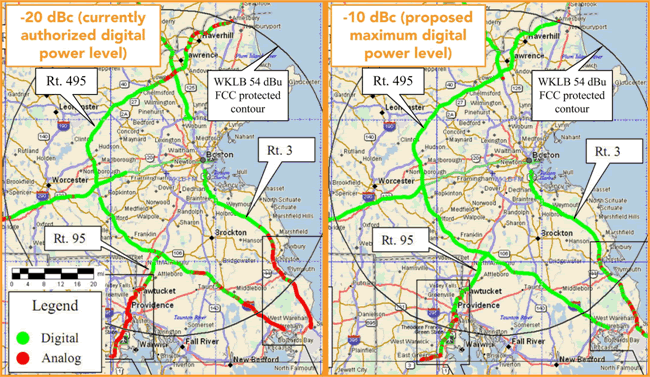
(see maps below illustrating results for -20 and -10 dBc cases)
using a mobile test platform with a JVC KD-HDR50 automotive receiver.
The first map (at left) shows how at the currently authorized
-20 dBc power level, there are significant digital coverage deficiencies
within the WKLB-FM 54 dBu protected analog contour, on all routes
measured (green represents digital reception and red represents
areas where receiver blended to analog due to deficiencies in
the digital signal).
As detailed
in the report, a close examination of each route shows multiple
instances of intermittent loss of digital service, even prior
to those areas where digital service is largely absent. In the
second map, representing service at -10 dBc, marked improvement
in digital service is shown. Other than the terrain-shadowed area
in the Providence/Pawtucket and Plymouth areas, digital reception
within the protected contour is virtually flawless over the various
routes. According to the report, other than those areas just noted,
there are virtually NO areas where even momentary digital signal
dropouts are evident.
The second
report, entitled "FM HD Radio System Performance in Building
Interiors at Elevated Digital Carrier Levels," complements
and significantly expands upon a similar report done by CBS Radio
for the Los Angeles, California area which was featured in the
November
3, 2008 issue of Radio TechCheck. In this latest study,
observations of indoor reception were made using digital signal
power levels from -20 to -10 dBc (in 2 dB increments), inside
a variety of structures representative of the majority of those
found in the greater Boston area, at six different locations.
The first three structures were all located within the urban core
of Boston, within 8-10 miles of the WKLB-FM transmission facility:
- Greater
Media studio building, Dorchester section of Boston: representative
of low rise (two story) masonry, steel and glass construction;
- The
Caning Shop, Cambridge section of Boston: a single story
structure (with an occupied
lower level) of wood and masonry construction;
- The
Prudential Tower, Back Bay section of Boston: a high rise
skyscraper of steel, aluminum and glass construction.
The other three
sites were located at approximately the edge of digital coverage
(assuming the currently authorized -20 dBc power level):
- Andover,
Mass.: a typical two story, split level residence of wood
frame construction;
- Devens,
Mass.: headquarters of the Comrex Corporation, a two story
steel framed, wood building typical of many small to medium
size commercial structures;
- North
Attleboro, Mass.: a three story apartment building of poured
concrete (with rebar) construction.
Two receiver
models were used in this testing. A Sony XDR-S10HDiP table radio
was used for evaluation at numerous fixed locations within each
structure. As many as four of these receivers, each operated with
the manufacturer-supplied antennas, were utilized simultaneously
to characterize reception at various locations within each structure.
The second receiver, a prototype KRI portable arm band radio,
was operated as it would be by a typical user, being moved about
the interior of each structure to ascertain the availability of
digital radio reception. All receivers utilized were characterized
in the iBiquity Digital Corporation laboratory to verify that
each met its published specifications.
These indoor
tests demonstrated that building penetration is a significant
challenge at the -20 dBc digital power level. While the incremental
power levels (those between -20 and -10 dBc) were shown to offer
some improvement, the report concludes that only a full 10 dB
increase will permit reliable service to portable receivers
and result in a close approximation of analog coverage.
A complete
copy of these reports can be obtained from the FCC Electronic
Comment Filing System (ECFS) webpage - to obtain, go to http://fjallfoss.fcc.gov/prod/ecfs/comsrch_v2.cgi
and enter the following information -1) Proceeding: 99-325,
4) Filed on behalf of: Charles River - then select "Retrieve
Document List" at the bottom of the page.
Additional
information on the Public Notice is provided in the June
29, 2009 issue of Radio TechCheck. Reply comments are
due to the FCC by Friday, July 17, 2009. Broadcasters interested
in filing replies in this proceeding may do so electronically
by accessing the Electronic Comment Filing System (ECFS) at http://fjallfoss.fcc.gov/prod/ecfs/upload_v2.cgi.
Filers should follow the instructions provided on the Web site
for submitting comments, and should include their full name, U.S.
Postal service mailing address, and the applicable proceeding
number (in box 1): 99-325. Parties may also submit an electronic
comment by email-to get filing instructions, send an e-mail to
ecfs@fcc.gov, and include
the words "get form" in the body of the message. A sample
form and instructions will be sent by email in response.
2009
NAB Radio Show Engineering Program
 This
year's three-day Radio Show Engineering Program focuses on planning,
building and maintaining an IP-based radio facility, operating
under emergency conditions, computerized antenna modeling, preventing
tower failures, datacasting opportunities and much more. Our engineering
sessions are presented in a workshop-type environment where you
have ample time to ask questions and interact with experts and
your industry peers. To access the details on the Engineering
Program, click here. This
year's three-day Radio Show Engineering Program focuses on planning,
building and maintaining an IP-based radio facility, operating
under emergency conditions, computerized antenna modeling, preventing
tower failures, datacasting opportunities and much more. Our engineering
sessions are presented in a workshop-type environment where you
have ample time to ask questions and interact with experts and
your industry peers. To access the details on the Engineering
Program, click here.
The relaxed
atmosphere of the Radio Show means you always have plenty of time
to network with exhibitors. You'll learn about their latest products
while enjoying lunch and snacks on the show floor. For busy radio
engineers, the NAB Radio Show is an excellent way to advance your
technical education and maintain your edge in an increasingly
competitive business.


The July 13, 2009 Radio TechCheck is also available
in an Adobe Acrobat file.
Please
click
here to read the Adobe Acrobat version of Radio TechCheck
|