|
Experimental Station’s Experiences with
FM Digital Power Increase
The FCC is
presently accepting comments on four issues relevant to the request
made by a group of broadcasters back in June of 2008 (the “Joint
Parties”) to allow for operation of the digital portion of
an FM in-band/on-channel (IBOC) signal at elevated power levels
(the full text of the FCC’s Public Notice, which was released
on May 22, 2009, is available at
http://hraunfoss.fcc.gov/edocs_public/attachmatch/DA-09-1127A1.pdf).
Comments on this matter are due Monday, July 6, 2009 and reply
comments are due Friday, July 17, 2009 (see the December
15, 2008 issue of Radio TechCheck for information about
NAB’s original comments filed in this matter).
Coincident
with the filing of the Joint Parties request, iBiquity Digital
Corporation filed a comprehensive study with the FCC detailing
their investigation of FM IBOC operation at elevated power levels,
and concluding that raising the power of the digital portion of
the hybrid FM IBOC signal by 10 dB, from the current level of
-20 dB below the analog carrier (i.e., -20 dBc) to -10 dBc, would
significantly improve digital coverage and not “meaningfully
increase” potential interference to analog (see the June
16, 2008 issue of Radio TechCheck for additional information
on the results of the iBiquity test program). These results were
based upon actual operation of FM IBOC stations at a digital power
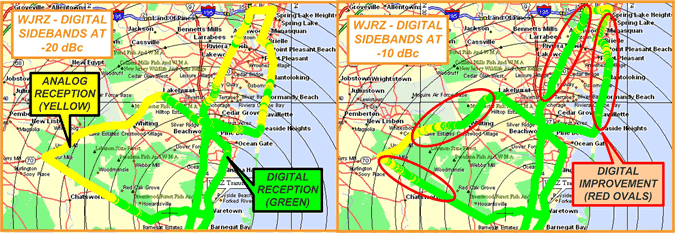
level of -10 dBc (under experimental authority); the maps below,
taken from this report, demonstrate the coverage improvement obtained
by one of these stations, WJRZ-FM (Mahahawkin, NJ, Class A, 100.1
MHz).
A number of
stations continue to operate (under experimental authority) at
the -10 dBc elevated power level, and for this week’s Radio
TechCheck, NAB asked three broadcast engineering executives
involved in these experiments to share some of there experiences
in this regard. We first spoke with Glynn Walden, Senior Vice
President Engineering with CBS Radio. Glynn told us about CBS
Radio’s experience operating station KROQ-FM (Pasadena, CA,
Class B, 106.7 MHz) at elevated digital power:
“KROQ
has been operating with a -10 dBc HD Radio digital carrier level
for over two years. As our report to the FCC indicated, the indoor
reception has been dramatically improved and the HD Radio digital
mobile coverage is consistent with the analog signal. KROQ has
two short-spaced second adjacent channels within the Los Angeles
metro and in some locations KROQ is greater than 40 dB stronger
than its second adjacent channel neighbors. Stations operating
with elevated IBOC carrier levels are required to meet a tighter
Out-of-Band Emissions (OBE) mask. The mask when applied to stations
operating with elevated digital carrier power requires an additional
10 dB of OBE suppression. Field tests and the lack of any interference
complaints demonstrate that KROQ’s sustained -10 dBc operation
has generated no second adjacent channel interference.”
Next, we spoke
with Jeff Littlejohn, Executive Vice President – Distribution
Development with Clear Channel Radio. Here’s what Jeff told
us:
“Several
Clear Channel engineers had an opportunity to participate in the
elevated (-10 dBc) digital carrier tests in New Haven, Philadelphia,
Los Angeles and Detroit. During these tests, we concentrated on
observing areas where it was predicted to most likely receive
interference. However we did not observe any interference that
could be attributed to the elevated digital carrier levels. In
New Haven and Los Angeles, Clear Channel provided the ‘host’
station (WKCI and KOST respectively) for the elevated digital
carriers. In neither case did Clear Channel receive any complaints
of interference.”
“The
coverage increase that resulted from the elevated IBOC carriers
allowed the digital coverage to more closely approach the existing
analog coverage. Given the significantly increased digital coverage
and the absence of any observed interference, it is important
that the FCC and the Radio Industry moves forward expeditiously
with broad approval of -10 dBc IBOC carrier levels.”
Finally, we
spoke with Milford “Smitty” Smith, Vice President, Radio
Engineering with Greater Media, Inc. Smitty told us about two
Greater Media stations:
WKLB-FM (Waltham,
MA, Class B, 102.5 MHz): “During December 2008, observations
were made at the -10 dBc power level. Extensive driving evaluations,
both qualitative and quantitative, showed remarkable improvement
in coverage relative to the currently authorized level of -20
dBc. In general, it was observed that the -10 dBc digital signal
level approximates or, in some cases, slightly exceeds the coverage
of WKLB-FM's full power analog signal.”
“Particular
care was taken to observe improvements in coverage in areas within
25 miles of the station's transmitter site. At the -20 dBc digital
power level, there were numerous areas where the digital signal
would routinely and predictably fade out due to terrain (referring
to gentle rolling hills and valleys in rural areas outside the
City of Boston) and man-made obstacles. During the several months
of observations, it was apparent that all of these problems disappeared
while operating at -10 dBc. There were no instances where the
signal was lost in either vehicle in any areas where the signal
loss was determined to be a problem at the -20 dBc level.”
WRAT-FM (Point
Pleasant, NJ, Class A, 95.9 MHz): “WRAT’s studio
and transmitter are located in the coastal region of New Jersey
and, as such, are largely surrounded by terrain that is generally
very flat and largely devoid of any significant obstructions,
especially north and south of the transmitter location. Therefore,
the station represents a nearly “best case” propagation
scenario for its digital signal. In spite of these optimal conditions,
the station, operating at -20 dBc since 2005, has observed a significant
abbreviation of its digital coverage as compared to that of its
analog facility.”
“It
appears that an increase in digital power to -10 dBc greatly improves
the coverage for a Class A station in relatively flat terrain,
both in terms of coverage area and the quality and robustness
of that coverage. This is critical, given the sudden and absolute
failure mode of the HD Radio signal. Listeners are not likely
to tolerate sudden drop outs more than occasionally before seeking
an alternate audio source. Further, it appears that a power level
very close to -10 dBc will be necessary to fully replicate analog
coverage with the digital signal no interference to any FM station
was reported or observed during this extended period of operation
at the elevated digital power level, including to short spaced
WBEN-FM, Philadelphia (also owned by Greater Media).”
Broadcasters
interested in filing comments in this proceeding may do so electronically
by accessing the Electronic Comment Filing System (ECFS) at http://fjallfoss.fcc.gov/prod/ecfs/upload_v2.cgi.
Filers should follow the instructions provided on the Web site
for submitting comments, and should include their full name, U.S.
Postal service mailing address, and the applicable proceeding
number (in box 1): 99-325. Parties may also submit an electronic
comment by email–to get filing instructions, send an e-mail
to ecfs@fcc.gov, and include
the words “get form” in the body of the message. A sample
form and instructions will be sent by email in response.



The June 29, 2009 Radio TechCheck is also
available in an Adobe Acrobat file.
Please
click
here to read the Adobe Acrobat version of Radio TechCheck
|