|
Skype
for Broadcasting
There are
many ways to use the Internet for transmission of audio and video,
and one of the most powerful (and popular) is to use “Skype.”
Skype (Luxembourg, www.skype.com)
is software that millions of individuals and businesses use to
make free video and voice calls, send instant messages and share
files with other Skype users. Radio broadcasters can use Skype
in a number of ways to support their on-air and Web-based offerings.
Skype was
demonstrated at this year’s NAB Broadcast Engineering Conference
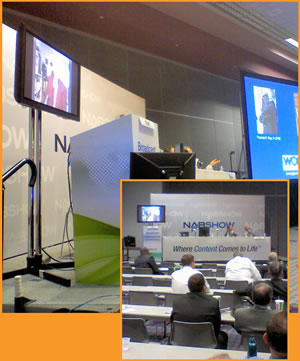
(BEC) in an interesting way. On Tuesday, April 21, in the “Antenna
Solutions and Case Studies for Radio” session, Tom Ray, Vice
President and Corporate Director of Engineering, Buckley Radio,
gave his presentation remotely using a Skype audio and video connection
(see photo). Since Skype supports a two-way connection, Tom was
able to both see and hear attendees in the conference room as
they were able to see and hear him – the video from Tom’s
location was placed on a flat-screen TV monitor behind the podium,
giving him a “virtual presence” at the show. The video
and audio quality of this Skype connection was excellent, and
was low-latency enough to nicely support real-time, two-way audio
communication.
Perhaps the
most useful application of Skype for broadcasters is for remote
news gathering. Skype’s “high quality video calling”
service provides Skype’s best video quality and offers video
images with a resolution of 640x480 pixels (i.e. VGA quality)
and up to 30 frames per second. This service offers radio broadcasters
an opportunity to obtain, at relatively low cost, audio material
for on-air use as well as companion video material suitable for
use on a station’s Web site.
 According
to information in the “Skype usage FAQ for broadcast and
other recordings,” Skype recommends the latest version of
Skype for Windows (Mac is supported, too, but not Linux-based
systems), an optimized Logitech High Quality Video webcam with
the latest webcam software, a dual core processor PC and a fast
broadband connection with at least 300 kbit/s uplink speed to
support high quality video calling. For applications requiring
only audio, a connection speed of at least 80 kbps will suffice. According
to information in the “Skype usage FAQ for broadcast and
other recordings,” Skype recommends the latest version of
Skype for Windows (Mac is supported, too, but not Linux-based
systems), an optimized Logitech High Quality Video webcam with
the latest webcam software, a dual core processor PC and a fast
broadband connection with at least 300 kbit/s uplink speed to
support high quality video calling. For applications requiring
only audio, a connection speed of at least 80 kbps will suffice.
Skype utilizes
an “in-house best-of-breed speech and audio processing software”
that allows for audio with superior speech quality and very low
latency. Skype transmits twice the audio frequency range (up to
8 kHz) compared to traditional telephony (<4 kHz) resulting
in improved audio quality over that obtained using a telephone
connection. The Skype software automatically adjusts its bandwidth
usage to the available bandwidth on the network. Quality of video
and audio will be optimized for the available bandwidth but might
vary greatly as the available bandwidth changes. Audio is prioritized
over video to ensure a fluid conversation at all times.
To reduce
latency, Skype recommends connecting to a fast broadband connection
as close to the public Internet as possible, avoiding WiFi connections,
keeping CPU utilization on the computer low, and avoiding firewalls
and virus scanners. A good first test for the connection speed
is to run www.speedtest.net
to a desired location. The numbers for up- and downlink speed
should be greater than 300 kbit/s (80 kbit/s for audio only) and
the “ping time” (indicator for latency) should be as
low as possible (typically 50-200ms).
A paper on
“High Quality Video Calling” for broadcasters using
Skype was given at the BEC and highlighted in the March 9, 2009
issue of NAB’s TV TechCheck. This paper is included in the
NAB Broadcast Engineering Conference Proceedings which
is available for purchase online from the NAB Store at www.nabstore.com.
Additional information about Skype for broadcasting is available
in the “Skype Usage FAQ for broadcasting and other recordings”
on the Skype Webpage at http://download.skype.com/share/broadcast/SkypeUsageFAQ.zip.
FCC Releases
Public Notice on FM IBOC at Elevated Power Levels
The Media
Bureau of the FCC has released a Public Notice seeking comment
on four issues relevant to the request made by a group of broadcasters
back in June of 2008 (the “Joint Parties”) to allow
for operation of the digital portion of an FM in-band/on-channel
(IBOC) signal at elevated power levels. Comments will be due 21
days after publication of this Notice in the Federal Register
and reply comments will be due 14 days after that.
This latest
Public Notice follows an earlier Notice released in October of
2008 soliciting more general comments on the Joint Parties’
request as well as on two related technical studies. The Joint
Parties have requested that the Commission increase the maximum
permissible digital operating power of FM stations from the current
level of 1 percent of a station's authorized analog power (-20
dBc) to a maximum of 10 percent of a station's authorized analog
power (-10 dBc). Filed concurrently with and in support of the
Joint Parties’ request was a technical report prepared by
iBiquity Digital Corporation (background information on the iBiquity
report is available in the June
16, 2008 issue of Radio TechCheck). In addition, National
Public Radio submitted a Corporation for Public Broadcasting-supported
research study on digital radio coverage and interference.
Four specific
questions have been asked in this Public Notice:
1) Whether the Media Bureau should defer consideration of the
Joint Parties’ requested power increase until the completion
of and comment on the further NPR studies? [NPR is presently conducting
studies related to this matter, and according to the Public Notice,
NPR expects to present the results of these studies in September
2009.]
2) Whether the record in this proceeding, the real-world experience
gained from over 1,400 FM stations operating for several years
in the hybrid mode and the record of experimental authorizations
at higher digital power levels warrant an increase in maximum
digital operating power as proposed by the Joint Parties or support
a provisional power increase of some lesser extent than that requested
by the Joint Parties?
3) If the Commission does adopt a power increase, whether it should
also establish standards to ensure the lack of interference to
the analog signals of stations operating on first adjacent channels?
Should such standards apply to, i.e., require the protection of,
LPFM stations operating on first adjacent channels?
4) Finally, if the Commission does adopt a power increase, whether
it should also establish more explicit procedures to resolve digital-into-analog
interference complaints?
The full text
of the FCC’s Public Notice, which was released on May 22,
2009, is available on the Internet at http://hraunfoss.fcc.gov/edocs_public/attachmatch/DA-09-1127A1.pdf.

The June 1, 2009 Radio TechCheck is also available
in an Adobe Acrobat file.
Please
click
here to read the Adobe Acrobat version of Radio TechCheck
|