|
Minimizing
Connectivity Loss
with a VSAT Safety Net
Disaster preparedness
is something that every broadcast engineer must deal with. A session
at the upcoming NAB Broadcast Engineering Conference (BEC, April
18-23, 2009, Las Vegas, NV – see below for additional information)
entitled “Disaster Preparedness and Public Alerting”
includes a paper, excerpted here, which focuses on what Clear
Channel Broadcasting has learned from preparing for and dealing
with the aftermath of various hurricanes and other disasters in
recent years.
INTRODUCTION
– for many years, our primary connectivity concern as radio
engineers has been getting audio from a studio site to a transmitter/tower
site without interruption. We have fairly reliable tools to accomplish
that, but even those are vulnerable to unexpected outages. In
the wake of a season of severe hurricanes, Clear Channel realized
our vulnerability to various forms of connectivity loss, and decided
it was time to address that. Our response was the installation
of very small aperture terminal (VSAT) satellite uplink/downlink
systems at every Clear Channel studio, and at key tower sites.
Because this can be used in place of the conventional/traditional
studio-transmitter link (STL), but relays data via satellite,
we affectionately nicknamed this system the “SaTL.”
But this has evolved into far more than merely a studio-to-transmitter
program link.
LESSONS
FROM KATRINA – a major disaster can test our backup systems
and our ideas about what will work and what will fail. This was
definitely the case when Hurricane Katrina hit New Orleans. The
governor of Louisiana ordered New Orleans evacuated, and our New
Orleans station staff set up shop in Baton Rouge. The now-abandoned
New Orleans studio facility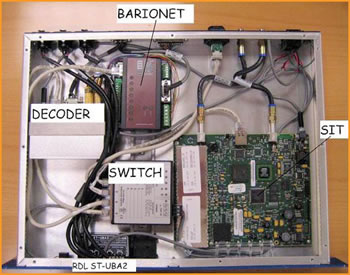 was set up as a “mid-point hop,” programming would originate
in the Baton Rouge studios, be received in the New Orleans studios
via satellite, and finally, relayed from there to the various
transmitter sites using the traditional RF STL system. We had
backup generators at the studios and all transmitter sites. Alas,
strong winds knocked STL receive dishes at various tower sites
out of alignment.
was set up as a “mid-point hop,” programming would originate
in the Baton Rouge studios, be received in the New Orleans studios
via satellite, and finally, relayed from there to the various
transmitter sites using the traditional RF STL system. We had
backup generators at the studios and all transmitter sites. Alas,
strong winds knocked STL receive dishes at various tower sites
out of alignment.
THE SaTL
IN DETAIL – the Clear Channel SaTL system (see photo)
consists of a box at Clear Channel studios and tower sites based
on the “XtremeSat™” system developed by Clear Channel’s
satellite division, CCSS. Our SaTL version contains a Satellite
Internet Terminal (SIT), a small internal IP switch, and audio
encoder (for studios) or decoder (for tower sites), and a Barionet™
remote control at tower sites only all in a 1RU chassis. Pictured
here, inside the enclosure (this one, for a typical tower site
unit), you can see the Barionet IP-based remote control, the Decoder™
audio decoder (IP – analog audio converter), a small IP switch,
and the SIT which communicates with satellite uplink/downlink
hardware. All of this connects to a dish with an integral transmitter
(block up-converter, or BUC) and low-noise block downconverter
(LNB).
BROADCAST
MODE – in widespread disasters such as earthquakes and
hurricanes, it is often desirable to broadcast a single program
feed to multiple tower sites. This was what we did in the aftermath
of Katrina, using the ad-hoc “United Radio of New Orleans”
we put together. To support this mode, any studio facility can
uplink their programming, to be turned around by the main CCSS
Denver uplink and sent back out in “broadcast mode.”
This mode enables multiple downlink sites to pull down the same
programming. So, for example, instead of the hastily constructed
hodge-podge network we used in New Orleans and Baton Rouge, we
could uplink all programming from Baton Rouge in broadcast mode,
and carry that programming at any number of sites, in New Orleans,
Baton Rouge, and/or any other markets that would benefit from
receiving the programming. We have found that in disasters it
is more common to feed a single focused news and information program
to all sites, rather than disparate programming to individual
sites.

CONCLUSION
–
the “SaTL” system is but one piece of a larger hardening/disaster
and outage readiness and response strategy. It is shown in this
photo surrounded by some of the other pieces. Our charge was to
develop a secondary connectivity support system which could be
installed and maintained  at
minimal cost. While it is impossible to foresee every possible
outage we might experience, we have found that this system has
been a valuable addition to our readiness toolkit, and has kept
us in business and operational on over 50 occasions when we have
had to fall back to it for data connectivity, audio transport,
STL replacement, and other similar needs. at
minimal cost. While it is impossible to foresee every possible
outage we might experience, we have found that this system has
been a valuable addition to our readiness toolkit, and has kept
us in business and operational on over 50 occasions when we have
had to fall back to it for data connectivity, audio transport,
STL replacement, and other similar needs.
This paper
is authored by Steve Davis, Senior Vice President, Engineering
and Capital Management, Clear Channel Radio, Tulsa, OK. It will
be presented on Wednesday, April 22, 2009 starting at 9:40AM in
rooms N231/233 of the Las Vegas Convention Center. It will also
be included in its entirety in the 2009 NAB Broadcast Engineering
Conference Proceedings, on sale at the 2009 NAB Show Store and
available on-line from the NAB Store (www.nabstore.com)
after the convention. For additional conference information visit
the NAB Show web page at www.nabshow.com;
a complete listing of the radio-related BEC conference sessions,
papers, and presenters can be found in the February 2, 2009 issue
of Radio TechCheck.


The March
30, 2009 Radio TechCheck is also available in
an Adobe Acrobat file.
Please
click
here to read the Adobe Acrobat version of Radio TechCheck
|