|
Cell
Phones with Integrated FM Antennas Introduced
One of NAB's
ongoing initiatives is to work with the cellular phone industry
to increase the number of cell phones that have FM radios in them.
An NAB FASTROAD-funded report released last year outlined the
potential benefits that could result from an increase in the penetration
of FM radios in cell phones, concluding that cell phone service
providers, radio broadcasters, and handset manufacturers all stand
to benefit from the expansion of FM-capable cell phones, a platform
that could reach 257 million American subscribers (see the June
23, 2008 issue of Radio TechCheck for additional information).
A recent advance in technology, allowing an FM radio antenna to
be integrated into the cell phone itself, may prove to be an important
breakthrough in this initiative.
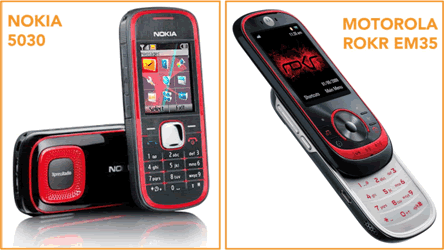
Two cell phone
products that have integrated FM antennas were recently announced.
Both the Motorola ROKR EM35 and the Nokia 5030 (see photos) include
FM radios with integrated antennas, allowing listeners to use
wireless bluetooth headsets or bluetooth-enabled speakers for
listening to the radio. Until now, virtually all cell phone-based
FM radios required listeners to use a wired headset or wired speaker
whereby this wire would serve as the antenna for the FM radio.
 Advances
in integrated circuit (IC) technology are helping to make these
new phones possible. For example, Silicon Labs, Advances
in integrated circuit (IC) technology are helping to make these
new phones possible. For example, Silicon Labs,
an innovator in the design and manufacture of "mixed signal"
ICs (those that process both analog and digital signals on a single
silicon "chip"), has introduced a family of FM receiver
ICs that support integrated antennas, digital audio out, worldwide
FM band support and Radio Data System (RDS) technology, all on
a single chip measuring 3 millimeters on a side. Silicon Labs'
ICs use a patented tuned-resonance technology which allows integrated
FM antennas constructed of printed circuit board (PCB) traces,
loops, stubs or other devices to perform as well or better than
the headset-cord wired antennas they replace. See Silicon Labs
Web site at
https://www.silabs.com/products/audiovideo/fmreceivers/Pages/Si470405.aspx
for additional information.
Other portable
devices besides cell phones also incorporate integrated FM antennas.
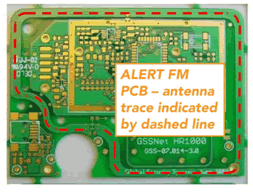
The "Alert FM" receiver–a portable, battery-powered
device the size of a pack of playing cards–is used in an
FM-subcarrier based alerting system and has an integrated antenna
which is on the PCB of the device. The photo below shows the PCB
removed from the Alert FM receiver package (and before any components
have been installed), with the integrated antenna PC trace indicated
by the dashed line (see www.alertfm.com/p-14-alert-fm-receiver.aspx
for more information). Also, so-called "smart" watches
used with Microsoft's MSN Direct FM subcarrier-based service have
integrated antennas, with some being located in the wrist band
of the watch and others implemented as a metal ring around the
face of the watch itself.
 In
addition to the convenience and freedom afforded by eliminating
the need for a wired antenna (for example, listeners can now use
a bluetooth headset when listening to the radio), the integrated
FM antenna cell phone is much better suited to deliver emergency
alert messages, since the FM radio can now function without a
headset being plugged in. Cellular carriers are currently developing
ways to eventually provide emergency alerts to their customers
through the use of broadcast SMS text messaging, a capability
which they do not currently support and which is expected to take
time and significant financial investment to develop. NAB believes
that FM radios in cell phones will provide a vehicle for cost
effective, near-term, easy and convenient access to alert messages
being sent over the Emergency Alert System (EAS). In
addition to the convenience and freedom afforded by eliminating
the need for a wired antenna (for example, listeners can now use
a bluetooth headset when listening to the radio), the integrated
FM antenna cell phone is much better suited to deliver emergency
alert messages, since the FM radio can now function without a
headset being plugged in. Cellular carriers are currently developing
ways to eventually provide emergency alerts to their customers
through the use of broadcast SMS text messaging, a capability
which they do not currently support and which is expected to take
time and significant financial investment to develop. NAB believes
that FM radios in cell phones will provide a vehicle for cost
effective, near-term, easy and convenient access to alert messages
being sent over the Emergency Alert System (EAS).
The Nokia
5030 is expected to begin shipping in the second quarter of 2009,
and will initially be only available in Europe; additional information
is available on the Internet at http://europe.nokia.com/5030.
The Motorola ROKR EM35 is available for purchase now as an "unlocked
GSM" device and is compatible with the AT&T and T-Mobile
cellular systems; additional information is on the Internet at
www.motorola.com/motoinfo/product/details.jsp?globalObjectId=275#.
In a related
development, NAB President and CEO David K. Rehr last week sent
letters to the chief executives of Verizon Wireless and AT&T
applauding the mobile phone service providers on their recent
inclusion of new FM radio-capable handset devices. Verizon Wireless
recently added the Samsung Omnia to its list of supported mobile
handsets. AT&T has added the LG Incite. Both devices include
FM radio as one of their features (however neither have integrated
FM antennas). A current list of cell phones which include FM radio
has been compiled by NAB and is available for download from the
NAB web site at www.nab.org/xert/scitech/pdfs/cellphoneswfmradio_090319.pdf.
The full text of NAB's press release discussing these letters
is available on the NAB Web page at www.nab.org/AM/Template.cfm?Section=Press_Releases1&TEMPLATE=/CM/ContentDisplay.cfm&CONTENTID=14136.
Radio Heard Here Exhibit at NAB Show to Feature
FM Radio in Cell Phones
 When
at the 2009 NAB Show (April 18-23, 2009, www.nabshow.com)
be sure to check out the Radio Heard Here exhibit in the north
hall of the Las Vegas Convention Center, booth N6138. A number
of cell phones that have built-in FM radios will be on display,
including those with integrated FM antennas. Watch for announcements
on exciting giveaways! When
at the 2009 NAB Show (April 18-23, 2009, www.nabshow.com)
be sure to check out the Radio Heard Here exhibit in the north
hall of the Las Vegas Convention Center, booth N6138. A number
of cell phones that have built-in FM radios will be on display,
including those with integrated FM antennas. Watch for announcements
on exciting giveaways!


The March
23, 2009 Radio TechCheck is also available in
an Adobe Acrobat file.
Please
click
here to read the Adobe Acrobat version of Radio TechCheck
 |