|
Common
Amplification of FM IBOC at Elevated Power Levels
The proposal
to allow broadcasters to increase the power in the digital portion
of an FM IBOC signal has been of great interest lately, and
raises a number of issues not the least of which is how this
can best be implemented. A session at the upcoming NAB Broadcast
Engineering Conference (BEC, April 18-23, 2009, Las Vegas, NV
– see below for additional information) entitled “HD
Radio Implementations and Improvements Part I” includes
a paper, excerpted here, which focuses on a new solution for
more efficient common amplification of high power digital FM
IBOC and analog signals in the 10 kW to 40 kW RF power output
range.
INTRODUCTION
– this paper traces the process of selecting the technology
and developing a new high power, VHF transmitter for the common
amplification of high power digital FM IBOC and analog signals.
This paper also explains the application of new, high power,
RF amplifier and power supply technologies to elevated HD Radio
sideband transmission. The desired transmitter solution is focused
on optimizing these key parameters: minimum purchase and operating
cost, maximum power output and operating efficiency, and environmentally
“green.” The transmitter should be capable of at least
40 kW analog FM power, 30 kW FM+HD @ -20 dBc digital sideband
level, and at least 15 kW FM+HD @ -10 dBc digital sideband level.
THE LINEARITY
CHALLENGE – the proposed 10 dB increase in HD Radio
digital sideband levels presents a significant linearity challenge
to common amplification of FM and HD Radio signals through a
single transmitter. The common amplification linearity must
be improved by 20 dB to accommodate a 10 dB increase in HD Radio
digital sidebands while still meeting the original NRSC-5-B
RF emission mask.
PURCHASE
PRICE – although solid state technology offers several
advantages, it carries significant purchase cost and 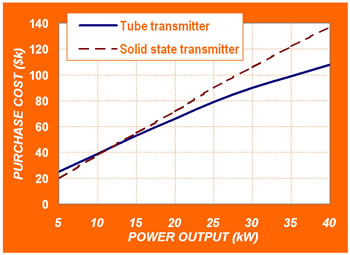 operating
efficiency penalties at RF power output levels above 20 kW using
currently available solid state device technology. The figure
illustrates typical purchase cost versus power output of solid
state and vacuum tube-type transmitters. Notice that while the
cost of solid state tracks more or less linearly with power
output, the cost of vacuum tube technology tends to flatten
out at higher power levels. The reason for the difference in
the shape of the curves is due to the differences in the transmitter
architectures. As the power of a solid state transmitter is
increased, the number of RF amplifier modules, power supplies,
cooling fans, combiners, combiner ports, and span of the control
system increases in direct proportion to the power output level.
A high power, single tube, transmitter will have some proportional
changes in the size of the vacuum tube and associated power
supplies, but they are not in direct relationship to the output
power level. For example, the cost of a 40 kW tube amplifier
cavity is not twice the cost of a 20 kW cavity and the cost
of a 5.0 ampere, high voltage power supply is not twice the
cost of a 2.5 ampere power supply. operating
efficiency penalties at RF power output levels above 20 kW using
currently available solid state device technology. The figure
illustrates typical purchase cost versus power output of solid
state and vacuum tube-type transmitters. Notice that while the
cost of solid state tracks more or less linearly with power
output, the cost of vacuum tube technology tends to flatten
out at higher power levels. The reason for the difference in
the shape of the curves is due to the differences in the transmitter
architectures. As the power of a solid state transmitter is
increased, the number of RF amplifier modules, power supplies,
cooling fans, combiners, combiner ports, and span of the control
system increases in direct proportion to the power output level.
A high power, single tube, transmitter will have some proportional
changes in the size of the vacuum tube and associated power
supplies, but they are not in direct relationship to the output
power level. For example, the cost of a 40 kW tube amplifier
cavity is not twice the cost of a 20 kW cavity and the cost
of a 5.0 ampere, high voltage power supply is not twice the
cost of a 2.5 ampere power supply.
ONGOING
ENERGY CONSUMPTION – the long term energy consumption
of a transmitter is now more important than ever not only to
save electrical power costs, but to provide a “green,”
reduced carbon footprint. Depending on the power output of a
tube-based transmitter, the broadcaster could save as much as
$6-10k/yr in energy consumption over a solid state-based transmitter.
This is due to the solid state RF combining power losses which
increase at higher power levels, as well as the lower transistor
efficiency when compared to a single tube power amplifier.
PA EFFICIENCY
– another key consideration in the selection of a high
power combined hybrid FM IBOC transmitter architecture is the
operating efficiency of the RF amplifier technology and the
ability to achieve high operating efficiency over the full range
of power output levels required. A vacuum tube amplifier can
achieve over 80% operating efficiency in FM mode and over 68%
operating efficiency in common amplification mode over the full
range of power from less than 10 kW to over 40 kW. On the other
hand, a solid state amplifier could achieve only about 60% efficiency
in common amplification mode and only at its full rated power.
As the power output is decreased, the efficiency will drop,
because the solid state amplifier, unlike the tube amplifier,
typically lacks the ability to have its load line changed for
optimum efficiency at reduced output power.
AIR COOLING
TEMPERATURE DROP – cooling efficiency is another key
consideration for a high power transmitter design. Air cooling
is most efficient when the heat sink surface being cooled has
a high temperature drop compared to the ambient air temperature.
Due to the thermal resistance from the silicon junction to the
heat sink, the maximum heat sink temperature in a solid state
transmitter is limited to about 85 degrees centigrade in order
to maintain a semiconductor junction temperature of less than
150 degrees centigrade. A high power vacuum tube anode heat
sink does not have the multiple thermal interface resistances
like a solid state amplifier and can operate at up to 225 degrees
centigrade, therefore less cooling air volume is required to
remove the same amount of heat from the tube type transmitter.
As the HD Radio digital sideband levels are raised, the amplifier
has to be biased into a more linear operating point which reduces
the PA efficiency. Ultimately, the ability to remove heat from
the amplifying device places the upper limit on power output
available at -10 dBc HD Radio digital sideband levels.
This paper
is authored by Geoff Mendenhall, vice president, Transmission
Research & Technology, Harris Broadcast Communications,
Mason, Ohio. It will be presented on Sunday, April 19, 2009
starting at 10:30 a.m. in room S226/227 of the Las Vegas Convention
Center. It will also be included in its entirety in the 2009
NAB Broadcast Engineering Conference Proceedings, on
sale at the 2009 NAB Show Store and available on-line from the
NAB Store (www.nabstore.com)
after the convention. For additional conference information
visit the NAB Show Web page at www.nabshow.com;
a complete listing of the radio-related BEC conference sessions,
papers, and presenters can be found in the February
2, 2009 issue of Radio TechCheck.
TECHNOLOGY
INNOVATION AWARDS DEBUT AT 2009 NAB SHOW


|
NAB
has selected the National Institute of Information and
Communications Technology (NICT) and the NHK Science and
Technical Research Laboratories to receive NAB Technology
Innovation Awards. This new award recognizes organizations
that bring exhibits and demonstrations of significant
merit to the NAB Show, presenting advanced research and
development projects in communications technologies. The
awards will be presented Wednesday, April 22 during the
NAB Show Technology Luncheon. |
The
Technology Luncheon will include a keynote presentation by digital
media research scientist Mimi
Ito, and will also feature the presentation of the prestigious
NAB
Engineering Achievement Awards. Since 1959, the awards have
honored individuals who have made outstanding achievements and
contributions in the broadcast engineering profession. For additional
information on the NAB Show go to www.nabshow.com.


The March
9, 2009 Radio TechCheck is also available in
an Adobe Acrobat file.
Please
click
here to read the Adobe Acrobat version of Radio TechCheck
|
