|
Data
Transmission Capabilities for FM Radio
The methods
available to broadcasters for sending data over an FM radio signal
have evolved in recent years with the advent of HD Radio™ technology
and the resurgence of the Radio Data System (RDS) FM subcarrier.
A session at the upcoming NAB Broadcast Engineering Conference (BEC,
April 18-23, 2009, Las Vegas, NV – see below for additional
information) entitled “Radio Engineering Forum Part I”
includes a paper, excerpted here, which discusses the amount of
data capacity that is available on different data channels as well
as the ability for different data (and audio) systems to coexist
on a single FM channel.
INTRODUCTION
– engineers should have an understanding of how much data capacity
is available on different FM radio-based data services as well as
the ability for different data delivery systems to coexist on a
single FM channel. To better understand these questions, several
tests were run on what could be described as a typical FM radio
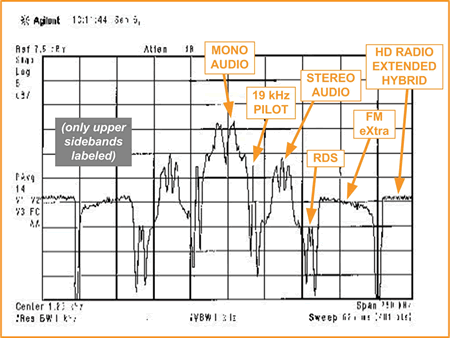
station that was running RDS and HD Radio data streams. Observations
and spectrum analysis was made during various modes of operation
(see figure for an example – the full paper includes 9 such
figures). Maximum data bandwidth was measured in each mode of operation
and cross-compatibility tests were performed. It is likely that
future advancements in existing schemes will result in future improvements
in performance, but these tests were considered to be similar to
what could be expected from a typical FM station of similar configuration
at the time of the testing.
RDS –
the RDS system utilizes a 57 kHz FM subcarrier and has an overall
data rate of 1.187 kbps. Typically, a 5% injection level is standard
for this technology. This data stream is allocated to various services
that are predefined as part of the RDS (and RBDS) standards. Stations
generally use the PS and RT fields to display information related
to the station or the content of the audio program being transmitted.
Other data services that are relayed through RDS include traffic
and emergency information for the broadcast area. These services
are capable of reasonable performance at relatively low data rates,
unlike real time digital audio delivery or large file transfers.
There weren’t any noticeable compatibility issues between RDS
and any other mode of data transmission. No additional multipath
was detected by any of the stations during tests by using RDS although
this concern has been raised in the past.
 HD
RADIO – Plain Old HD Radio (POHDR) is a single 96 kbps
channel that is used to duplicate the analog FM audio. If additional
equipment (Importer) is purchased and installed, this can be divided
into multiple data streams that will make up to 48 kbps available
for another audio stream or data channel or a mixture of both. A
minimum of 48 kbps is reserved for replicating the main channel
FM audio. Extended hybrid mode is also available which adds additional
HD carriers to the HD signal resulting in extra capacity (and requiring
extra bandwidth). HD
RADIO – Plain Old HD Radio (POHDR) is a single 96 kbps
channel that is used to duplicate the analog FM audio. If additional
equipment (Importer) is purchased and installed, this can be divided
into multiple data streams that will make up to 48 kbps available
for another audio stream or data channel or a mixture of both. A
minimum of 48 kbps is reserved for replicating the main channel
FM audio. Extended hybrid mode is also available which adds additional
HD carriers to the HD signal resulting in extra capacity (and requiring
extra bandwidth).
OTHER SCAs
– the Subsidiary Communications Authority (SCA) provisions
of the FCC’s rules allow for a variety of subcarriers to be
used. Subcarriers at 67 kHz and 92 kHz systems are typically modulated
with an analog signal for traditional SCA applications, but more
modern technology supports the use of digital subcarriers for specialized
applications. An example of this is the DirectBand system which
Microsoft uses for their Smart Personal Objects Technology (SPOT,
used with the MSN Direct service – see www.msndirect.com/
for additional information). The data rate on that system is reported
to be 12 kbps. Another readily available digital SCA system is the
FMeXtra system (see www.dreinc.com/
for additional information). If used with a stereo FM signal, this
system typically delivers 64 kbps, and if used with a mono FM signal,
the throughput increases to 128 kbps. 67 kHz-based analog SCA’s
can be employed without harm to hybrid HD Radio signals in any transmission
mode. There are cross-compatibility issues using 92 kHz analog SCA
services when the extended Hybrid HD Radio mode is activated.
This paper is
authored by Roswell Clark, Director of Technical Operations, Cox
Radio Tampa. It will be presented on Monday, April 20, 2009 starting
at 11:30 a.m. in room S228 of the Las Vegas Convention Center. It
will also be included in its entirety in the 2009 NAB Broadcast
Engineering Conference Proceedings, on sale at the 2009 NAB
Show Store and available on-line from the NAB Store (www.nabstore.com)
after the convention. For a complete list and summaries of each
paper that will be presented at the 63rd NAB BEC, April 18 –
23 in Las Vegas click
here. For additional conference, housing and registration information
visit the NAB Show Web page at www.nabshow.com.


The February
23, 2009 Radio TechCheck is also available in an
Adobe Acrobat file.
Please
click
here to read the Adobe Acrobat version of Radio TechCheck
|
