|
The
Inaugural Installation of the first “Kinstar” Antenna
AM broadcasters
who are unable (for whatever reason) to build tall antenna towers
may want to consider using the “Kinstar” low-profile AM
antenna for their facility. A session at the upcoming NAB Broadcast
Engineering Conference (BEC, April 18-23, 2009, Las Vegas, NV –
see below for additional information) entitled “Antenna Solutions
and Case Studies for Radio” includes a paper, excerpted here,
describing the application process, design, installation, final
commissioning and Kinstar versus original series-fed tower comparative
performance for the first on-air Kinstar antenna at KCST-AM Radio
in Florence, Oregon.
INTRODUCTION
– Historically any effort to produce an electrically short
AM antenna resulted in an impedance characterized with a low resistance
and high reactance yielding a commensurate narrow audio bandwidth
with a radiating efficiency that was directly related to the electrical
height of the antenna. The advent of the Kinstar AM low profile
antenna with its wide audio bandwidth and high efficiency has significantly
altered this understanding regarding short AM antennas.
FILING THE
APPLICATION – Coast Broadcasting Company President Jon
Thompson was faced with the need to replace an aging, series-fed,
base insulated tower that was unsuitable to climb. The licensed
height of this existing tower was 86.9° or 57.89 m with a daytime
operating power of 1 kW and nighttime operating power of 0.068 kW,
yielding a theoretical RMS daytime field strength of 309 mV/m at
1 km and nighttime field strength of 80.58 mV/m at 1 km. Realizing
that the maximum height for any new tower structures was limited
by local zoning regulations to 21.95 m, the KCST contract engineer,
R. Sparks Scott, recommended to Mr. Thompson the Kinstar antenna,
which would potentially result in an unencumbered zoning approval
saving considerable legal expenses that would have been required
to gain approval for a tower structure that would substantially
exceed the zoning height restrictions. Due to the concern over the
poor structural state of the existing tower and the need to replace
it sooner than later, the decision was made to file for the Kinstar
antenna.
 INSTALLATION
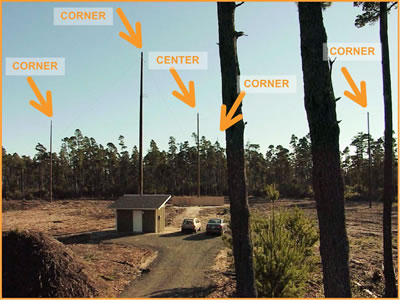
OF THE FIRST KINSTAR ANTENNA – the proposed site for the
new Kinstar antenna was a forested area that required clear cutting
of the trees followed by stump and root removal to facilitate installation
of the five 25.9 m wooden utility poles and the buried 120-radial
quarter-wave copper ground system. Following the clearing of the
site and the arrival of the utility poles and antenna kit hardware
at the site, a utility construction company from Portland, Ore.
arrived for the installation of the antenna. The antenna installation
was supervised by R. Sparks Scott, the KCST contract engineer. A
backhoe with an extendable boom was used to prepare the mounting
holes for the five poles. Screw anchors were driven into the ground
to terminate the two support guys for the four corner poles as well
as to terminate the four vertical elements symmetrically located
around the base of the center pole. The installation crew arrived
at the site at noon on the first day. The Kinstar antenna was completely
installed by the close of the following day (see photograph); hence
the total installation time was 1-1/2 days. INSTALLATION
OF THE FIRST KINSTAR ANTENNA – the proposed site for the
new Kinstar antenna was a forested area that required clear cutting
of the trees followed by stump and root removal to facilitate installation
of the five 25.9 m wooden utility poles and the buried 120-radial
quarter-wave copper ground system. Following the clearing of the
site and the arrival of the utility poles and antenna kit hardware
at the site, a utility construction company from Portland, Ore.
arrived for the installation of the antenna. The antenna installation
was supervised by R. Sparks Scott, the KCST contract engineer. A
backhoe with an extendable boom was used to prepare the mounting
holes for the five poles. Screw anchors were driven into the ground
to terminate the two support guys for the four corner poles as well
as to terminate the four vertical elements symmetrically located
around the base of the center pole. The installation crew arrived
at the site at noon on the first day. The Kinstar antenna was completely
installed by the close of the following day (see photograph); hence
the total installation time was 1-1/2 days.
OLD VS. NEW
PERFORMANCE COMPARISON – Prior to the installation of the
Kinstar antenna the KCST contract engineer conducted a series of
field intensity measurements using a Potomac Instruments FIM-41
field intensity meter for the original 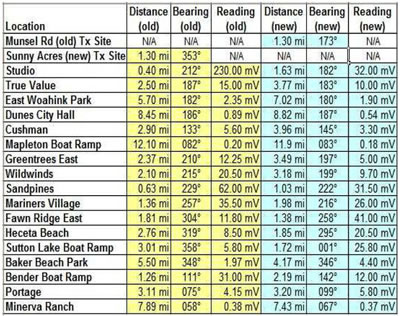 tower
site operating with a transmitter input power of 1 kW. The comparative
tabulated field intensity measurements made for the original tower
site in the June 17-19, 2008 time frame and for the Kinstar antenna
site in the January 19-22, 2009 time frame are shown in the table.
These measurements are provided as a strictly qualitative measure
of the comparative performance of the original tower site and the
low profile Kinstar antenna site. Realizing the 100 watt transmitter
input power difference, possible seasonal variations between summer
and winter that could influence these measurements, as well as the
fact that the new site is 2.09 km NW of the old site, a direct correlation
between the two sets of measurements is not possible. These measurements
do serve to confirm the relative change in the received field strength
consistent with the distance and bearing of the new site relative
to the old tower site. Based on these limited measurements we can
safely confirm that the Kinstar antenna is yielding the expected
coverage area consistent with the new location and input power level. tower
site operating with a transmitter input power of 1 kW. The comparative
tabulated field intensity measurements made for the original tower
site in the June 17-19, 2008 time frame and for the Kinstar antenna
site in the January 19-22, 2009 time frame are shown in the table.
These measurements are provided as a strictly qualitative measure
of the comparative performance of the original tower site and the
low profile Kinstar antenna site. Realizing the 100 watt transmitter
input power difference, possible seasonal variations between summer
and winter that could influence these measurements, as well as the
fact that the new site is 2.09 km NW of the old site, a direct correlation
between the two sets of measurements is not possible. These measurements
do serve to confirm the relative change in the received field strength
consistent with the distance and bearing of the new site relative
to the old tower site. Based on these limited measurements we can
safely confirm that the Kinstar antenna is yielding the expected
coverage area consistent with the new location and input power level.
This paper is
co-authored by Brian A. Herrold, Vice President of Engineering,
Star-H Corporation, Tom F. King, President, Kintronic Labs, Inc.,
Bob McClanathan, PE, Bob McClanathan and Associates, Inc., and R.
Sparks Scott, contract engineer. It will be presented on Tuesday,
April 21, 2009 starting at 4:30 p.m. in room S226 of the Las Vegas
Convention Center. It will also be included in its entirety in the
2009 NAB BEC Proceedings, on sale at the 2009 NAB Show Store and
available on-line from the NAB Store (www.nabstore.com)
after the convention. For additional conference information visit
the NAB Show Web page at www.nabshow.com;
a complete listing of the radio-related BEC conference sessions,
papers, and presenters can be found in the February
2, 2009 issue of Radio TechCheck.
Radio TechCheck
will not be published on January 16,
but will return on February 23, 2009


The February
9, 2009 Radio TechCheck is also available in an
Adobe Acrobat file.
Please
click
here to read the Adobe Acrobat version of Radio TechCheck
|
