|
Radio at the 2009 International CES
Once again the
new year began with the annual International Consumer Electronics
Show (CES) taking place in Las Vegas, Nev (www.cesweb.org).
This year’s show, which ran from January 8-11, 2009, offered
a spectacular display of new technologies and new devices spanning
two convention centers and numerous off-site venues. Some of the
radio-related highlights of this year’s show are summarized
below.
 HD
Radio Exhibit – the HD Radio exhibit was located in the
Central Hall of the Las Vegas Convention Center (LVCC; in previous
years this exhibit was in the North Hall). A display of over 40
different HD Radio receivers constituted the bulk of the exhibit,
but two of the biggest draws were the new navigation receivers (see
below) and a prototype portable MP3 player/HD Radio receiver utilizing
the latest low-power HD Radio integrated circuits. Other advanced
receiver features being demonstrated in the booth were iTunes tagging
and conditional access. HD
Radio Exhibit – the HD Radio exhibit was located in the
Central Hall of the Las Vegas Convention Center (LVCC; in previous
years this exhibit was in the North Hall). A display of over 40
different HD Radio receivers constituted the bulk of the exhibit,
but two of the biggest draws were the new navigation receivers (see
below) and a prototype portable MP3 player/HD Radio receiver utilizing
the latest low-power HD Radio integrated circuits. Other advanced
receiver features being demonstrated in the booth were iTunes tagging
and conditional access.
Shown visiting
the HD Radio booth in the photo are NAB President and CEO David
Rehr (far right) greeting Geoff Mendenhall, VP Transmission Research
and Technology, Harris Broadcast Communications, with Talmage Ball,
VP Engineering at Bonneville International Corp., and iBiquity President
and CEO Robert Struble. An online video of the HD Radio exhibit
is available at www.graveline.com/video/.
HD Radio
Navigation Devices – a number of personal navigation devices
(PNDs) which utilize real-time traffic information broadcast over
the Advanced Application Services (AAS) data channel of the HD Radio
system were at the show, including devices by Cydle, Dual (in photo,
at left), and KRI (in photo at left). The Dual receiver, model XNAV43HD,
supports reception of Clear Channel Total Traffic Network and Inrix
real-time traffic 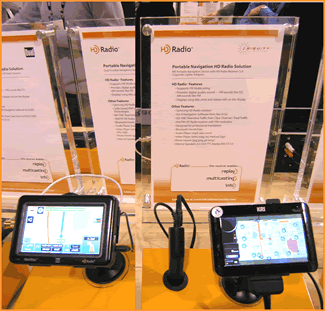 information
via Clear Channel HD Radio stations. Just prior to theCES, Clear
Channel announced that real time traffic services overHD Radio are
live and operational in 50 markets (for more information read the
Clear Channel press release available online at www.clearchannel.com/Radio/PressRelease.aspx?PressReleaseID=2352).
The Broadcaster Traffic Consortium, founded in 2008 by Beasley Broadcast
Group, Bonneville International Corporation, Cox Radio, Inc., Emmis
Communications Corp., Entercom Communications Corp, Greater Media,
NPR and Radio One, currently providing real-time traffic in 50 metropolitan
markets using Radio Data System (RDS) technology, also plans to
initiate HD Radio-based traffic information broadcasts in 2009. information
via Clear Channel HD Radio stations. Just prior to theCES, Clear
Channel announced that real time traffic services overHD Radio are
live and operational in 50 markets (for more information read the
Clear Channel press release available online at www.clearchannel.com/Radio/PressRelease.aspx?PressReleaseID=2352).
The Broadcaster Traffic Consortium, founded in 2008 by Beasley Broadcast
Group, Bonneville International Corporation, Cox Radio, Inc., Emmis
Communications Corp., Entercom Communications Corp, Greater Media,
NPR and Radio One, currently providing real-time traffic in 50 metropolitan
markets using Radio Data System (RDS) technology, also plans to
initiate HD Radio-based traffic information broadcasts in 2009.
Other highlights
of the Dual XNAV43HD include a 4.3-inch touch screen; text-to-speech
functionality; multimedia support; and a suggested retail price
of $279.99. The Dual XNAV43HD is expected to be available by summer
2009. Not shown in the photo is the Cydle T43 PND which is similar
in appearance to the Dual PND. Both the Dual and the Cydle PNDs
support reception of HD Radio audio channels, including multicast
channels. More information on the Cydle device is available on the
Cydle Web page at www.cydle.com/product_T43.asp.
 iTunes
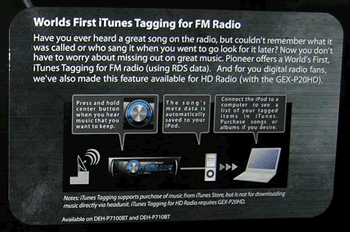
Tagging Using RDS – Pioneer Electronics introduced two
automotive receivers which are the first radios to support iTunes
tagging using both HD Radio and RDS (FM subcarrier) signals. Models
DEH-P710BT and DEH-P7100BT include built-in Bluetooth and USB direct
control for an iPod. For analog FM broadcasts which include iTunes
tagging information in the RDS data subcarrier, users can “tag”
a song from the broadcast and have its metadata saved to an iPod.
Users can then plug the iPod into a computer to see a list of tagged
items (in iTunes) for purchase. When connected to a Pioneer HD Radio
adapter, the unit can also tag songs using iTunes tagging information
transmitted in the HD Radio data channel. Expected to be available
this spring, the DEH-P710BT and DEH-P7100BT will list at $360 and
$340, respectively. For additional information, visit the Pioneer
Web site at www.pioneerelectronics.com/PUSA/Products/CarAudioVideo/Source/CD-Players/Premier/DEH-P710BT. iTunes
Tagging Using RDS – Pioneer Electronics introduced two
automotive receivers which are the first radios to support iTunes
tagging using both HD Radio and RDS (FM subcarrier) signals. Models
DEH-P710BT and DEH-P7100BT include built-in Bluetooth and USB direct
control for an iPod. For analog FM broadcasts which include iTunes
tagging information in the RDS data subcarrier, users can “tag”
a song from the broadcast and have its metadata saved to an iPod.
Users can then plug the iPod into a computer to see a list of tagged
items (in iTunes) for purchase. When connected to a Pioneer HD Radio
adapter, the unit can also tag songs using iTunes tagging information
transmitted in the HD Radio data channel. Expected to be available
this spring, the DEH-P710BT and DEH-P7100BT will list at $360 and
$340, respectively. For additional information, visit the Pioneer
Web site at www.pioneerelectronics.com/PUSA/Products/CarAudioVideo/Source/CD-Players/Premier/DEH-P710BT.
Low-power
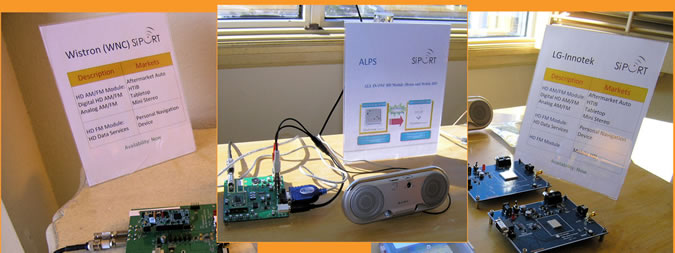
HD Radio Modules – IC developer SiPort (Santa Clara, CA,
www.siport.com) was displaying
HD Radio receiver modules from three different vendors which utilize
the SiPort HD Radio receiver chipset. These modules, by Wistron,
Alps, and LG-Innotek, were shown on hardware development circuit
boards in the SiPort suite at the Las Vegas Hilton (see photo below).
These low-power ICs (as well as those made by Samsung) are making
it possible for manufacturers to develop smaller, more portable
HD Radio receivers.
 Accessible
radio technology – for the second year in a row, efforts
at developing radio services that are more accessible for visually
and hearing impaired listeners were highlighted at the CES. The
“Wonder Vision Awards,” presented by Stevie Wonder, the
Sendero Group (a company focusing on accessible navigation products)
and the National Federation of the Blind were presented to four
organizations for their HD Radio technology-related efforts: to
National Public Radio (NPR) for their accessible digital radio broadcast
services initiative; to iBiquity Digital Corporation for support
of accessible digital radio technology; to DICE Electronics for
making the first accessible digital radio reading service receiver
(a prototype of the DICE iTR-100A is shown in the photo); and, to
NDS for the conditional access technology that supports the copyright
exemption for reading service content. The user interface of the
iTR-100A utilizes voice prompts and audible feedback to simplify
the operation and can support HD Radio-based radio reading services.
For more information about the Wonder Vision awards, visit the Vision
Free Web site at www.senderogroup.com/VisionFree/awards.htm. Accessible
radio technology – for the second year in a row, efforts
at developing radio services that are more accessible for visually
and hearing impaired listeners were highlighted at the CES. The
“Wonder Vision Awards,” presented by Stevie Wonder, the
Sendero Group (a company focusing on accessible navigation products)
and the National Federation of the Blind were presented to four
organizations for their HD Radio technology-related efforts: to
National Public Radio (NPR) for their accessible digital radio broadcast
services initiative; to iBiquity Digital Corporation for support
of accessible digital radio technology; to DICE Electronics for
making the first accessible digital radio reading service receiver
(a prototype of the DICE iTR-100A is shown in the photo); and, to
NDS for the conditional access technology that supports the copyright
exemption for reading service content. The user interface of the
iTR-100A utilizes voice prompts and audible feedback to simplify
the operation and can support HD Radio-based radio reading services.
For more information about the Wonder Vision awards, visit the Vision
Free Web site at www.senderogroup.com/VisionFree/awards.htm.
 Internet
Car Radio – Blaupunkt and miRoamer (Doncaster, Australia,
www.miroamer.com) had on display
in the North Hall of the LVCC “the world’s first Internet
car radio” (see photo). Blaupunkt plans to build OEM automotive
receivers that will connect to cell phones using Bluetooth, then
establish a connection to the Internet using the cell phone’s
data channel. Once connected to the Internet, the iRoamer software
in the receiver will access the iRoamer online portal, allowing
the user to select from thousands of audio streams, virtually any
audio stream that is available on the Internet. The user’s
favorite stations and other personal preference information are
set up using a personal computer with access to the miRoamer Internet
portal. miRoamer representatives at the show indicated that as “WiMax”
technology proliferates, new miRoamer-enabled Internet radios will
support connecting to the Internet using WiMax, as well. Internet
Car Radio – Blaupunkt and miRoamer (Doncaster, Australia,
www.miroamer.com) had on display
in the North Hall of the LVCC “the world’s first Internet
car radio” (see photo). Blaupunkt plans to build OEM automotive
receivers that will connect to cell phones using Bluetooth, then
establish a connection to the Internet using the cell phone’s
data channel. Once connected to the Internet, the iRoamer software
in the receiver will access the iRoamer online portal, allowing
the user to select from thousands of audio streams, virtually any
audio stream that is available on the Internet. The user’s
favorite stations and other personal preference information are
set up using a personal computer with access to the miRoamer Internet
portal. miRoamer representatives at the show indicated that as “WiMax”
technology proliferates, new miRoamer-enabled Internet radios will
support connecting to the Internet using WiMax, as well.


The January
26, 2009 Radio TechCheck is also available in an
Adobe Acrobat file.
Please
click
here to read the Adobe Acrobat version of Radio TechCheck.
|
