| |
FCC
Considers Rules for DTS at November 4 Meeting - NYC Broadcasters
Submit Results of DTS Field Measurements
On
November 4, 2008, having allowed interim Distributied Transmission
Systems (DTS) operations since 2004, the FCC is scheduled to adopt
rules to fully authorize DTS. On November 4, 2005, the Commission
released a Clarification Order and Notice of Proposed Rulemaking
(MB Docket No. 05-312) that clarified the guidelines for stations'
interim use of DTS and initiated a rulemaking to establish rules
for the future use of DTS by digital television stations. (See
TV
TechCheck
from November 14, 2005.)
 |
DTS
allows a DTV station to employ multiple on-channel, synchronized
transmitters distributed within a station's service area,
enabling broadcasters to fill gaps in service coverage in
order to, for example, provide coverage to areas previously
blocked by terrain.
The
current action by the FCC on this issue appears to have
been at least partially stimulated by a desire on the part
of the Commission to provide possible solutions for the
station coverage replication gaps "discovered"
during the Wilmington N.C. early DTV shut-off test, a notion
attributed to FCC Chairman Kevin Martin in announcing the
November 4 action. Also, and perhaps more importantly, on
September 15, 2008 the Metropolitan Television Alliance
(MTVA) submitted a report on the installation and testing
of three DTS systems in New York City. This project was
undertaken as an alternative solution to the reconstruction
of a large tower for NYC broadcasters.
The
MTVA retained the services of John F.X. Browne & Associates,
P.C., to design the prototype DTS network. Axcera, LLC was
selected to handle the detailed system design of the prototype
network, and to implement and support the prototype network
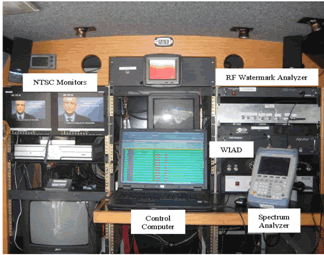
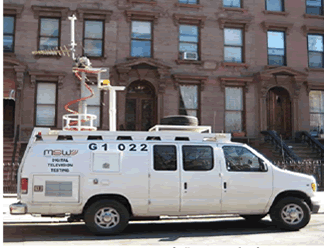
on a turnkey basis. The firm of Meintel, Sgrignoli, &
Wallace, LLC (MSW) was retained to characterize the receive
system
aspect of the project, develop a field test plan, and perform
the actual field measurements.
|
| DTX
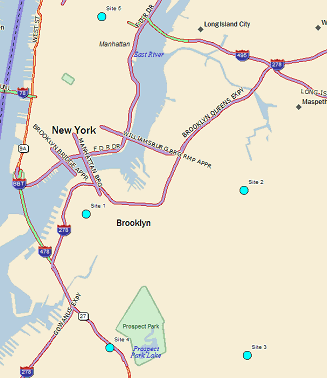
Transmitter sites (light blue dots) |
The
study sought to determine whether a DTS network consisting of
on-channel transmitters could be deployed as a system of "gap-fillers"
(i.e., filling in the discontinuities in service due to transmitting
antenna deficiencies) without receiving or causing significant
interference from/to the signals of the "main" transmitters.
An important related concern was whether the DTS network low power
transmitters would actually provide a sufficiently strong signal
to assure good service. A corollary concern was whether an off-channel
model (i.e., using a channel for the DTS other than the channel
being used by the primary transmitter) would be viable. A field
testing program was developed to evaluate these issues.
The prototype
DTS network built in Brooklyn and Queens consisted of:
- Four 1
kW ERP DTS sites with transmitters operating on ch. 12, 33,
& 65
- WPIX-DT
Channel 33 on Empire State Building (ESB)
- Channel
12 Experimental DTV station on ESB
- Both Indoor
and Outdoor measurements were taken
|
The
128 page report submitted to the FCC tabulates all of
the pertinent measurement results. Among other things,
the study showed that the average improvement with the
DTS signals complementing the main signals was 6 dB
(the equivalent of increasing the main transmitter power
by a factor of 4, e.g. from an ERP of 250 kW to 1 MW).
The report also showed that the average improvement
in indoor reception capability with the DTS enhancement
was 33% within the network's primary service area. The
conclusions of the study report are clearly positive
with respect to an on-channel DTS system deployment
and also demonstrate that a stand-alone (off-channel)
model would provide the desired indoor service capability.
The
FCC action is set to occur exactly three years from
when this proceeding was begun. Thus, on November 4,
two historic votes will take place that will set the
tone for the future, one by the American people for
the future leadership of this country, and one by the
five FCC Commissioners for the future options of television
broadcasters. Let's hope the right decisions are made
in both cases.
A copy
of the report is available on the FCC's ECFS system. All
of these documents can be obtained by going to the FCC's
Electronic Comment Filing System (ECFS) Web page (http://gullfoss2.fcc.gov/prod/ecfs/comsrch_v2.cgi)
and entering "05-312" into BOX 1 on this page,
then clicking on "Retrieve Document List" at the
bottom of the page. Look for a letter filed by Metropolitan
Television Alliance, LLC on September 11, 2008.
|
 |
 |

The
November 3, 2008 TV TechCheck is also available
in an Adobe Acrobat file.
Please click
here to read the Adobe Acrobat version of TV TechCheck.
|
|

