|
FCC
Releases Phase II White Space Device Test Report
On October
15, the FCC Office of Engineering and Technology (OET) released
a report entitled Evaluation of the Performance of Prototype
TV-Band White Space Devices. The report details the results
of tests on prototype TV band white space devices (WSDs). The
FCC conducted these laboratory and field tests as part of a rulemaking
proceeding (ET Docket No. 04-186) that considers authorizing the
operation of unlicensed low power devices on locally vacant TV
broadcast channels (TV white spaces). The FCC has already concluded
that unlicensed fixed systems (such as wireless broadband services)
would be allowed to begin operating in the TV white spaces after
the conclusion of the DTV transition on February 17, 2009. The
Commission is now considering whether to also allow "personal/portable"
WSDs to operate in the TV spectrum. The tests sought to further
investigate the viability of using "sensing" as a technology
that personal/portable WSDs could use to avoid causing interference
to TV reception and broadcaster's wireless microphone operations.
The FCC conducted
a first round of tests and issued two reports in July 2007. In
January 2008 OET announced a second round of testing and invited
interested parties to submit prototypes. Five devices were submitted
for examination in the Phase II tests. The WSDs were provided
by Adaptrum, The Institute for Infocomm Research (I2R), Microsoft
Corporation, Motorola Inc., and Philips Electronics North America
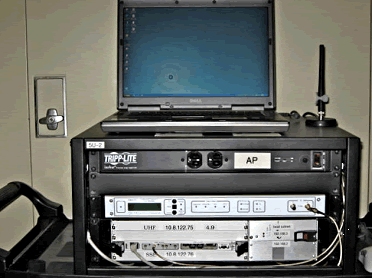
(Philips). All of the units consisted of a PC, a project box or
rack containing the radio and other electronics and an antenna,
similar to the Motorola WSD shown in the photo below. The operating
range of all the prototype devices was limited to detecting TV
broadcast signals on UHF channels 21-51.
 |
The
tests were divided into three parts with each having a lab
and field component:
Spectrum
Sensing for TV Broadcast Signals
This portion of the study examined the ability of the WSDs
to detect whether channels were occupied by ATSC (digital)
TV signals. Tests were initially performed in the laboratory
under various controlled conditions. The ability to sense
clean DTV signals in isolation and also in the presence
of TV signals on adjacent channels was measured. In addition,
tests were performed using "RF Captures" of off
air DTV signals to simulate "real world" conditions.
Field tests were conducted at nine sites in Maryland and
the District of Columbia to evaluate the DTV sensing performance.
|
| Motorola
Prototype WSD |
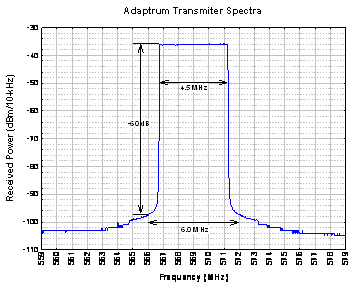 Transmitter
Characterization and Interference Testing Transmitter
Characterization and Interference Testing
The Adaptrum device included transmitting capability. Laboratory
tests were performed to characterize the transmitter's signal and
field measurements were performed to evaluate potential interference
from the Adaptrum transmitter. Further tests were also done in the
field to assess the interference of the WSD's signal on cable reception.
Spectrum
Sensing for Wireless Microphones
This testing looked at the ability of the WSDs to detect wireless
microphones authorized under Part 74 of the FCC rules. Microsoft,
Philips and I2R indicated that their devices were capable of sensing
wireless microphones. Tests of this capability were initially
performed in a controlled environment in the laboratory. Those
tests were followed by field tests at two sites, one in Maryland
and one in New York City.
The
OET report stated that the prototype WSDs have met the burden
of "proof of concept." It stated that, in the lab tests,
the WSDs were able to sense DTV signals down to levels of between
-106 dBm to -128 dBm when recorded off-air DTV signals, which
included multi-path fading and other "real-world" distortion,
were used. However, in the presence of first adjacent DTV signals,
the sensing capabilities of the WSDs diminished as much as 60-70
dB. For the field tests, the report said "In most cases,
the devices correctly reported channels as occupied when the device
was operated within the service contour of the stations broadcasting
on those channels and viewable signals were observed on the channels."
The transmitter characterization and interference tests revealed
that a WSD has the potential to create co-channel interference
at distances up to 1.2 km. While the laboratory testing showed
that the WSDs could detect wireless microphone signals down to
threshold levels ranging from -103 dBm to -129 dBm, in the field
tests one device reported all the channels on which the microphones
were transmitting as occupied whether the mic was transmitting
or not and the other device indicated several channels as available
even when the microphones were on.
NAB does not
believe that the test data supports the conclusion that the prototype
WSDs have met the burden of proof that sensing is a viable option
for unlicensed personal portable operation in the TV bands. In
fact, it appears that the data shows conclusively that sensing
is unreliable. In addition, in an uncharacteristic move the FCC
has released the report without asking for formal comment. NAB
and MSTV have filed an Emergency Request with the Commission asking
that the report be placed on public comment and the FCC fully
consider those comments before adopting any final rules.
All 400 pages
of the report are available on the OET's TV Band White Space Testing
Web page at http://www.fcc.gov/oet/projects/tvbanddevice/Welcome.html.
For questions concerning OET's test report, please contact Alan
Stillwell, (202) 418-2925, e-mail
Alan.Stillwell@fcc.gov.
FCC
Enforcement Alert - Check Your Station's PSIP Settings
NAB has received
inquiries from the FCC about the daylight savings time settings
in some DTV stations' PSIP. FCC staff indicated that PSIP errors
are a citable infraction of the Rules. In particular, Section
73.682 (d) of the FCC Rules incorporate by reference the ATSC
PSIP standard (A65) in addition to the other ATSC Standards A52
and A53. This means that these ATSC standards are now part of
the Rules and, by strict interpretation, a station must be in
complete compliance with these standards. In December of 2007,
in the Report and Order (R&O) in the Third Periodic DTV Review,
the Commission amended this Rule adopting the most recent versions
of these ATSC standards. What is significant about this is that,
in the text of the R&O, the FCC essentially stated that they
expect DTV stations' PSIP to be correct. Just reading the actual
text in the published Code of Federal Regulations volumes is not
enough, as those standards are legally part of that rule book.
This means that given the right set of circumstances, the FCC
could cite a station for having PSIP errors. A link to the R&O
is below. See paragraphs 185 - 189. Also see Appendix B for the
modified Rule (starts on page 120 of the pdf).http://hraunfoss.fcc.gov/edocs_public/attachmatch/FCC-07-228A1.pdf.
Right now
Daylight Savings Time (DST in the United States) ends at 2:00
a.m. local time on November 2, 2008. In order to technically comply
with 47 CFR 73.682(d), all stations, effective October 3, 2008
(between 12:00 and 12:01 a.m.) should have been sending DS_day_of_month
set to '2' with DS_status = '1' in their STT. The value for DS_hour
normally needs to be set to '2' (unless for programmatic reasons
you shift out of DST at another time). Please refer to A/65C,
Annex A for exactly when the DS_status changes to '0' if the STT
is provided by the network and/or more than one time zone is covered.
In following
up, we have learned that some PSIP generators may be "hard
coded" to send the "old" date (October 2) for the
"fall back" to standard time, instead of November 2.
The PSIP parameters above should be changeable locally by a station.
Stations should contact their encoder manufacturers if necessary
to ensure these parameters are set correctly. It should be clear
to all that the FCC is watching and the risk of enforcement action
may have increased.
Share
Your Expertise with Your Fellow Engineers
Deadline Extended for 63rd NAB Broadcast Engineering Conference
Call for Papers
 The
NAB Show will host the 63rd NAB Broadcast Engineering Conference
(BEC) on April 18 - 23 at the Las Vegas Convention Center in Las
Vegas, Nev. This world-class conference addresses the most recent
developments in broadcast technology and focuses on the opportunities
and challenges that face broadcast engineering professionals around
the world. The BEC is a highly technical conference where presenters
deliver technical papers ranging over a variety of topics relevant
to the broadcast and allied industries. We invite you to submit
a proposal to present a technical paper at our conference. The
deadline for submitting your proposal is October 27, 2008. The
NAB Show will host the 63rd NAB Broadcast Engineering Conference
(BEC) on April 18 - 23 at the Las Vegas Convention Center in Las
Vegas, Nev. This world-class conference addresses the most recent
developments in broadcast technology and focuses on the opportunities
and challenges that face broadcast engineering professionals around
the world. The BEC is a highly technical conference where presenters
deliver technical papers ranging over a variety of topics relevant
to the broadcast and allied industries. We invite you to submit
a proposal to present a technical paper at our conference. The
deadline for submitting your proposal is October 27, 2008.
To submit
a technical paper proposal, click
here and complete the electronic form. If you have questions
regarding the NAB Broadcast Engineering Conference, please contact
John Marino.


The
October 20, 2008 TV TechCheck is also available
in an Adobe Acrobat file.
Please click
here to read the Adobe Acrobat version of TV TechCheck.
|

