|
ATSC-Based
Replacement for PRO Channel IFB Announced
Many television
stations currently send IFB to talent in the field during ENG
situations via the PRO audio channel in their NTSC TV signal.
Some stations have switched to wireless/cell phones or 2-way radio
but those operations that rely on the use of the PRO channel for
cueing will face a problem after the analog cut-off on February
17, 2009 because there will be no more NTSC and hence no more
PRO channel. Modulation Sciences, Inc. (Somerset, N.J.) has announced
that it has developed technology that will allow stations to send
IFB via the ATSC Transport Stream (TS) in their DTV signal.
 This
technology places MPEG-1 encoded audio into the TS which must
be assigned its own PID. The number of IFB channels available
is limited only by the bandwidth the station is able to allocate
for this purpose. Each MPEG-1, layer 2 data stream requires 96
kbps. Each audio channel takes 48 kbps but they must be assigned
in pairs. Most MPEG encoders already have the ability to generate
the MPEG-1 layer 2 data streams. Stations should check with their
encoder manufacturer for guidance. This
technology places MPEG-1 encoded audio into the TS which must
be assigned its own PID. The number of IFB channels available
is limited only by the bandwidth the station is able to allocate
for this purpose. Each MPEG-1, layer 2 data stream requires 96
kbps. Each audio channel takes 48 kbps but they must be assigned
in pairs. Most MPEG encoders already have the ability to generate
the MPEG-1 layer 2 data streams. Stations should check with their
encoder manufacturer for guidance.
Once the IFB
audio is in the station's TS, a receiver located in the ENG vehicle
is tuned to the DTV channel, the MPEG-1 data stream is extracted
and IFB or cue audio is output to the talent. This operates much
like a digital version of analog PRO receivers in use today. The
receiver includes LG Electronics' 6th generation DTV receiver
chip set which provides significantly improved ATSC over-the-air
reception. The receiver specs are listed below:
Receiver Sensitivity
-87 dBm
typical
-78 dBm
minimum
Audio
Coding
MPEG-1 layer
2, dual monaural
IFB Audio
Out
Two Channels
(A & B)
Male XLR-type
connector
Balanced
line-level output, low impedance
Antenna
Input
75 ohm, BNC
connector ("F"adapter provided)
It was generally
believed previously that there was too much latency in the ATSC
DTV signal to use it for an effective IFB system. However, Modulation
Sciences has indicated that it recently measured an end-to-end
latency with this technology at just less than 100 mSec. The
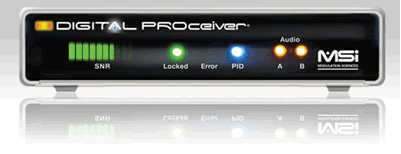
product is called "DIGITAL PROceiver" and will be
available for delivery no later than the end of the third quarter
of this year. For more information see www.modsci.com.
DEADLINE
EXTENDED FOR 63rd NAB BROADCAST ENGINEERING CONFERENCE
CALL FOR PAPERS
 NAB
Show will host the 63rd NAB Broadcast Engineering Conference
on April 18 - 23 at the Las Vegas Convention Center in Las Vegas,
Nevada. NAB
Show will host the 63rd NAB Broadcast Engineering Conference
on April 18 - 23 at the Las Vegas Convention Center in Las Vegas,
Nevada.
The NAB
Broadcast Engineering Conference is a highly technical conference
where presenters deliver technical papers ranging over a variety
of topics relevant to the broadcast and allied industries. We
invite you to submit a proposal to present a technical paper
at our conference. The deadline for submitting your proposal
is October 27, 2008.
To submit
a technical paper proposal, click
here and complete the electronic form. If you have questions
regarding the NAB Broadcast Engineering Conference, please contact
John Marino.
 
Register
Now!
Discounted Registration Rate is only available until 1 October
2008
The IEEE Broadcast Technology Society
58th ANNUAL IEEE BROADCAST SYMPOSIUM
Managing the Transitions
15 - 17 October 2008
The Westin Alexandria
Alexandria, VA, USA
Keynote
speakers to include: Richard E. Wiley, Wiley Rein, LLP and Peter
Fannon, Panasonic Corporation.
Please visit the Registration
page for additional information.
ALERT:
Action Needed for New Daylight Savings Time Change
Daylight
Savings Time (DST in the United States) ends at 2:00 a.m. local
time on November 2, 2008. In order to technically comply with
47 CFR 73.682(d), all stations, effective October 3, 2008 (between
12:00 and 12:01 a.m.) need to send DS_day_of_month set to '2'
with DS_status = '1' in their STT. The value for DS_hour normally
needs to be set to '2' (unless for programmatic reasons you
shift out of DST at another time). Please refer to A/65C, Annex
A for exactly when the DS_status changes to '0' if the STT is
provided by the network and/or more than one time zone is covered.


The
September 29, 2008 TV TechCheck is also available
in an Adobe Acrobat file.
Please click
here to read the Adobe Acrobat version of TV TechCheck.
|

