| |
Microsoft
Launches New Worldwide Platform for Broadcast TV on the PC
On September
12, 2008 at IBC2008, Microsoft Corporation announced that the
Protected Broadcast Driver Architecture (PBDA), Microsoft's new
worldwide platform for broadcast TV on the PC, has been delivered
to the marketplace. The announcement is being touted as the first
time the platform enables the PC-TV hardware ecosystem to integrate
virtually any free or premium TV service into Windows Media Center,
while also satisfying the TV industry's requirements for strong
content protection. Among the companies announcing support for
PBDA at the show were AVerMedia Inc., Buffalo, Hauppauge Computer
Works Inc., I-O Data Device Inc., NEC Electronics Corp., NXP Semiconductors
and ViXS Systems Inc.
The PBDA platform
enhances and supersedes the existing Broadcast Driver Architecture
(BDA), which has been Microsoft's standard for digital video capture.
PBDA technology was referred to as the path forward back in April
2005. The extensions to the previous Broadcast Driver Architecture
work by setting up a secure channel between the hardware tuner
device and the Windows Media Digital Rights Management (WMDRM)
system. In turn, the WMDRM system releases content to recording,
playback, and other authorized applications. Microsoft's view
then was that WMDRM is viewed as the most robust component within
the system to control conditional-access content, by holding onto
and protecting keys through a variety of ever-growing technologies.
This allows the Protected BDA device to trust the system to which
it is delivering content by getting trust directly from WMDRM.
WMDRM then enforces proper downstream behavior by entrusting components
with access to the data through a revocation and a renewability
system.
This underling
technology is used in the Media Center TV Pack, which provides
a general purpose user interface. An example of a TV setup screen
(Vista version) is shown below, showing that a diversity of delivery
and content control systems can be accommodated.
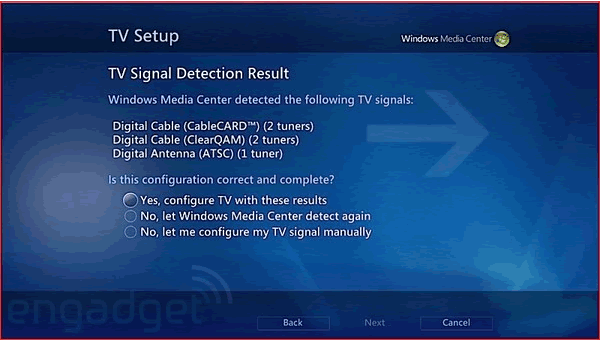
Note that
over-the-air ATSC is treated equally along with pay-service content
sources. For more screens and a review, see http://www.engadgethd.com/2008/08/06/hands-on-with-the-vista-media-center-tv-pack.
From Microsoft's
press release:
For the
first time, we're enabling those in the PC-TV community to build
tuners and integrate almost any broadcast service into Windows
Media Center themselves regardless of geographic location or
television standard - we've removed a major roadblock by delivering
one consistent platform for the industry," said Geoff Robertson,
general manager for Windows Media Center at Microsoft. "The
tremendous response we're already seeing for the platform means
PC OEMs, broadcast service providers and tuner-makers can now
collaborate and embrace the PC as a first-class citizen for
delivering more high-quality free or pay content to consumers
in their local markets. This is a major milestone for us and
our partners as we continue our efforts to deliver the highest-quality,
personalized TV-watching experiences available to people everywhere."
The momentum behind this new platform from Microsoft is already
being evidenced by the launch of PBDA-based tuner solutions
in Japan, Germany and the U.K., including Hauppauge's first-ever
Freeview-certified PC-TV tuner solution and AVerMedia's tuner
solution for protected digital terrestrial television in Japan.
In addition,
leading chipset providers NEC Electronics, NXP and ViXS Systems
are announcing that they have all completed their implementations
of PBDA and are now ready to support their PC-TV tuner partners
in taking PBDA-based solutions to multiple markets around the
world.
"We
are excited to be a launch partner for Microsoft's PBDA platform,"
said Allan Yang, Ph.D., president of AVerMedia. "PBDA has
enabled us to quickly and cost-effectively bring to market A320,
a PC-TV tuner solution for Windows Media Center that meets the
Japanese broadcasting industry's requirements for strong content
protection. The resulting system performance delivers a surprisingly
responsive user experience, and the response from our customers,
who are some of the most demanding PC OEMs in Japan, has been
phenomenal. We are looking forward to building on the very successful
launch of our PBDA-based solution beyond Japan."
Microsoft's
new digital TV software architecture, PBDA, enabled Hauppauge
to deliver the first-ever Freeview-certified TV tuner for PCs,"
said Ken Potkin, CEO of Hauppauge. "We look forward to
2009, when PBDA will allow us to deliver advanced digital PC-TV
tuner products, including PC solutions for pay TV."
"The
extended capabilities, which Microsoft's worldwide PBDA platform
for pay TV and free-to-air TV brings to Windows Media Center,
mirror NXP's commitment to power the TV-viewing experience by
enabling access to more content with ever better picture quality
anytime, anywhere, in the home and on the go," said Bert
van de Wakker, general manager, PC Systems, NXP Semiconductors.
"Specifically, PBDA support combined with our new-generation
three-in-one PCTV SOC SAA7231 product line, enables PC OEMs
to offer 30 million European households the ability to record
and view hundreds of free-to-air digital satellite channels
on their PC, complementing SAA7231DE's established DVB-T, analog
terrestrial and cable support. In addition, PBDA has enabled
us to provide a highly integrated, secure and cost-effective
solution for protected digital terrestrial television in Japan
using our secure Integrated Services Digital Broadcasting (ISDB)-analog
reception, SAA7164E SOC."
The PBDA platform
is a key component of the Windows Media Center TV Pack, an update
released to OEMs worldwide on July 16, 2008, with targeted optimizations
for Europe in particular. Some of the other features of this update
include native Windows Media Center experiences for digital terrestrial
television in Japan (based on the Integrated Services Digital
Television-Terrestrial standard), free-to-air satellites services
in Europe (based on the Digital Video Broadcasting-Satellite standard),
improved guide and playback experience, great personal video recorder
auto-extend support, and the flexibility of support for multiple
TV standards.
|
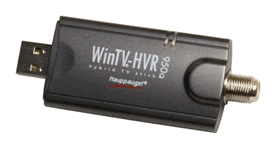 At
least one of the partners in the Microsoft announcement
also provides hardware for accessing over-the-air broadcast
TV in the computer environment. Hauppauge Computer Works
has recently announced the WinTV-HVR-950Q (see picture at
right) a USB 2.0-based receiver that supports ATSC, NTSC
and clear QAM digital cable channels. The unit allows your
computer to operate as a DVR, but a word to the wise-Hauppauge
says that recording HD programs will typically consume 5
GB of hard drive space per hour, so plan your hard disk
management carefully! At
least one of the partners in the Microsoft announcement
also provides hardware for accessing over-the-air broadcast
TV in the computer environment. Hauppauge Computer Works
has recently announced the WinTV-HVR-950Q (see picture at
right) a USB 2.0-based receiver that supports ATSC, NTSC
and clear QAM digital cable channels. The unit allows your
computer to operate as a DVR, but a word to the wise-Hauppauge
says that recording HD programs will typically consume 5
GB of hard drive space per hour, so plan your hard disk
management carefully!
|
| |
The
Hauppauge Win-TV-HVR-950Q |
For more info:
http://www.engadgethd.com/2008/08/06/hands-on-with-the-vista-media-center-tv-pack
or
http://www.consumerelectronicsnet.com/articles/viewarticle.jsp?id=505965,
http://www.microsoftmediaroom.com/#
63rd
NAB BROADCAST ENGINEERING CONFERENCE
CALL FOR PAPERS
 NAB
Show will host the 63rd NAB Broadcast Engineering Conference on
April 18 - 23 at the Las Vegas Convention Center in Las Vegas,
Nevada. NAB
Show will host the 63rd NAB Broadcast Engineering Conference on
April 18 - 23 at the Las Vegas Convention Center in Las Vegas,
Nevada.
The NAB Broadcast Engineering Conference is a highly technical
conference where presenters deliver technical papers ranging over
a variety of topics relevant to the broadcast and allied industries.
We invite you to submit a proposal to present a technical paper
at our conference. The deadline for submitting your proposal is
October 17, 2008.
To submit
a technical paper proposal, click
here and complete the electronic form. If you have questions
regarding the NAB Broadcast Engineering Conference, please contact
John Marino.
NAB365
TV Thought Leadership Series Videos
 One
of the features of NAB365 is an exclusive series of video
interviews designed to provide you with expert viewpoints
on technology's impact on digital media and the world of broadcast
content for video, radio, broadband, and more. One
of the features of NAB365 is an exclusive series of video
interviews designed to provide you with expert viewpoints
on technology's impact on digital media and the world of broadcast
content for video, radio, broadband, and more.
With technological
advancements arriving at a steady pace, it can be a challenge
understanding the creative and financial impact of each technology
on the world of content creation, content management, content
distribution & delivery, content commerce, and content consumption.
In the latest
of the NAB365 Thought Leadership series, NAB's top technical expert,
Lynn Claudy,
discusses digital media and the competitive media landscape, and
NAB's Jonathan
Collegio provides an update on the DTV transition. Enjoy and
please feel free to provide us feedback on this series through
our NAB Show
YouTube channel.
NAB
Satellite Training Offers Techniques for Keeping
Satellite Transmission Costs Reasonable for DTV
September 29 - October 2, 2008
Washington, D.C.
 If
you are concerned about keeping your satellite transmission costs
reasonable, the NAB Satellite Uplink Operators Seminar can help
you. The seminar that will be at NAB Headquarters on September
29 - October 2 can teach you techniques to give you the best performance
and keep your station's transmission costs under control. For
more information call Cheryl Coleridge at (202) 429-5346 or go
to NAB
Satellite Uplink Operators Seminar. If
you are concerned about keeping your satellite transmission costs
reasonable, the NAB Satellite Uplink Operators Seminar can help
you. The seminar that will be at NAB Headquarters on September
29 - October 2 can teach you techniques to give you the best performance
and keep your station's transmission costs under control. For
more information call Cheryl Coleridge at (202) 429-5346 or go
to NAB
Satellite Uplink Operators Seminar.
ATSC
Digital Television Transmission System 8-VSB Fundamentals Seminar
Wednesday, September 24, 2008 – KNME, Albuquerque,
N.M.
The 1-day
8-VSB Fundamentals seminar, conducted by Gary Sgrignoli, will
help you develop a fundamental understanding of the digital VSB
transmission system and its performance attributes as well as
current practical application information. The seminar includes
an optional site visit to KNME’s DTV Tx site on Sandia Crest.
For additional information contact the instructor Gary Sgrignoli,
Meintel, Sgrignoli & Wallace at 847 259 3352 or Gary.Sgrignoli@IEEE.org
or Jim Gale, KNME-DT, 505 277 2049, jgale@knme.org


The
September 15, 2008 TV TechCheck is also available
in an Adobe Acrobat file.
Please click
here to read the Adobe Acrobat version of TV TechCheck.
|
|

