|
New
Smart Antenna Shown at CEDIA
In March 2008,
NAB partnered with St. Louis-based Antennas Direct to initiate
development of a so called "Smart Antenna" based on
the CEA-909A Antenna interface. A prototype of this antenna was
shown at the Custom Electronics Design & Installation Association's
(CEDIA) fall Expo held last week in Denver.
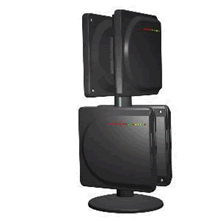 A
smart antenna is a TV receive antenna that can exchange information
such as channel number, gain, direction, polarization, etc. with
a CEA-909A-compliant receiver allowing the Smart Antenna to be
electronically steered and tuned to find the optimum setting for
each received channel. The TV set stores these settings and automatically
reconfigures the antenna as the viewer changes channels. This
allows consumers to channel surf without having to get off the
couch to adjust the antenna. A
smart antenna is a TV receive antenna that can exchange information
such as channel number, gain, direction, polarization, etc. with
a CEA-909A-compliant receiver allowing the Smart Antenna to be
electronically steered and tuned to find the optimum setting for
each received channel. The TV set stores these settings and automatically
reconfigures the antenna as the viewer changes channels. This
allows consumers to channel surf without having to get off the
couch to adjust the antenna.
CEA-909A is
a technical standard that defines the physical interface and communications
protocol between a compliant TV set and a Smart Antenna. The original
CEA-909 standard specified a 2-cable interface consisting of the
coax (for RF) and a control cable (for data and power) connected
via an offset RJ-45 connector. This standard has received some
recognition relatively recently as it is an explicitly permitted
feature for digital converter boxes certified through the NTIA
DTV coupon program. At least some of the certified models of converter
boxes from AccessHD, Alpha Digital, Apex, GE, Goodmind, Philco,
RCA and Tivax are among those that include the smart antenna interface
feature. However, no integrated DTV set has implemented the smart
antenna feature yet. At the present time, the only known commercially
available smart antenna remains the DTA-5000 antenna from DX Antenna,
available from such online retailers as www.solidsignal.com.
Audiovox is expected to release the RCA ANT2000 indoor smart antenna
later this year and potentially others will enter the market as
well. But the requirement for two wires between antenna and TV
set (or converter box) in order to implement the smart antenna
function has certainly been a factor in dampening the enthusiasm
of manufacturers for including the feature in their products..
Revised in
2007, CEA-909A added the provision for the RF, data and power
to be combined on a single wire (the coax) allowing for one simple,
less-confusing connection to the television. The antenna introduced
at CEDIA is the first implementation of a CEA-909A Smart Antenna
for digital television. The prototype antenna uses reconfigurable
elements to achieve performance on par with antennas normally
found in military applications. It is highly efficient and was
designed and optimized for the post-February 2009 digital TV frequency
plan using the CEA-909A single-wire control protocol.
The goal of
the Smart Antenna project - part of NAB's FASTROAD (Flexible Advanced
Services for Television and Radio On All Devices www.nabfastroad.org)
technology advocacy program - was to create an indoor antenna
that was easy and convenient for a consumer to use and would aid
viewers in the task of tuning in over-the-air DTV stations. While
manually re-aiming the ordinary "rabbit ear" antennas
for analog signals may not have been a big deal, re-adjusting
an indoor antenna for optimum DTV reception can be difficult sometimes
calling for precise adjustments. It is hoped that receiver manufacturers
will begin to build CEA-909A capability into their sets. CEA-909A
Smart Antenna technology can make a huge difference in the overall
consumer DTV experience, allowing access to all local television
signals without having to spend a lot of time aiming or re-aiming
antennas.
For additional
information on Antennas Direct, visit http://www.antennasdirect.com.
63rd
NAB BROADCAST ENGINEERING CONFERENCE
CALL FOR PAPERS
 NAB
Show will host the 63rd NAB Broadcast Engineering Conference on
April 18 - 23 at the Las Vegas Convention Center in Las Vegas,
Nevada. NAB
Show will host the 63rd NAB Broadcast Engineering Conference on
April 18 - 23 at the Las Vegas Convention Center in Las Vegas,
Nevada.
The NAB Broadcast Engineering Conference is a highly technical
conference where presenters deliver technical papers ranging over
a variety of topics relevant to the broadcast and allied industries.
We invite you to submit a proposal to present a technical paper
at our conference. The deadline for submitting your proposal is
October 17, 2008.
To submit
a technical paper proposal, click
here and complete the electronic form. If you have questions
regarding the NAB Broadcast Engineering Conference, please contact
John Marino.
NAB365
TV Thought Leadership Series Videos
 One
of the features of NAB365 is an exclusive series of video
interviews designed to provide you with expert viewpoints
on technology's impact on digital media and the world of broadcast
content for video, radio, broadband, and more. One
of the features of NAB365 is an exclusive series of video
interviews designed to provide you with expert viewpoints
on technology's impact on digital media and the world of broadcast
content for video, radio, broadband, and more.
With technological
advancements arriving at a steady pace, it can be a challenge
understanding the creative and financial impact of each technology
on the world of content creation, content management, content
distribution & delivery, content commerce, and content consumption.
In the latest
of the NAB365 Thought Leadership series, NAB's top technical expert,
Lynn Claudy,
discusses digital media and the competitive media landscape, and
NAB's Jonathan
Collegio provides an update on the DTV transition. Enjoy and
please feel free to provide us feedback on this series through
our NAB Show
YouTube channel.
NAB
Satellite Training Offers Techniques for Keeping
Satellite Transmission Costs Reasonable for DTV
September 29 - October 2, 2008
Washington, D.C.
 If
you are concerned about keeping your satellite transmission costs
reasonable, the NAB Satellite Uplink Operators Seminar can help
you. The seminar that will be at NAB Headquarters on September
29 - October 2 can teach you techniques to give you the best performance
and keep your station's transmission costs under control. For
more information call Cheryl Coleridge at (202) 429-5346 or go
to NAB
Satellite Uplink Operators Seminar. If
you are concerned about keeping your satellite transmission costs
reasonable, the NAB Satellite Uplink Operators Seminar can help
you. The seminar that will be at NAB Headquarters on September
29 - October 2 can teach you techniques to give you the best performance
and keep your station's transmission costs under control. For
more information call Cheryl Coleridge at (202) 429-5346 or go
to NAB
Satellite Uplink Operators Seminar.
ATSC
Digital Television Transmission System 8-VSB Fundamentals Seminar
Wednesday, September 24, 2008 – KNME, Albuquerque,
N.M.
The 1-day
8-VSB Fundamentals seminar, conducted by Gary Sgrignoli, will
help you develop a fundamental understanding of the digital VSB
transmission system and its performance attributes as well as
current practical application information. The seminar includes
an optional site visit to KNME’s DTV Tx site on Sandia Crest.
For additional information contact the instructor Gary Sgrignoli,
Meintel, Sgrignoli & Wallace at 847 259 3352 or Gary.Sgrignoli@IEEE.org
or Jim Gale, KNME-DT, 505 277 2049, jgale@knme.org


The
September 8, 2008 TV TechCheck is also available
in an Adobe Acrobat file.
Please click
here to read the Adobe Acrobat version of TV TechCheck.
|

