|
MPEG
Surround Technology for Headphones
Surround
sound audio is a very popular format since the advent of the home
theater, and the variety of platforms which support surround is
ever increasing. Video sources, such as ATSC digital TV, DVDs,
and Blu-ray discs, are perhaps the most prevalent sources of surround
material, but audio sources such as DVD-Audio and SACD support
surround, as do digital radio technologies such as the in-band/on-channel
(IBOC) HD Radio system developed by iBiquity Digital corporation.
In addition, the popular MP3 music format can also be enhanced
to support surround sound signals.
 One
of the most efficient methods of surround sound transmission and/or
storage is known as MPEG Surround (www.mpegsurround.com).
MPEG Surround captures the spatial image of a multi-channel audio
signal into a compact set of parameters which are transported
in a digital “side channel” along with a normal, one-
or two-channel perceptually-coded digital audio signal. This side
channel information is used (in the decoder) along with the digital
audio signal to synthesize a high quality multi-channel representation.
MPEG Surround is perceptual codec agnostic, that is, it is compatible
with “virtually any” coding scheme including MPEG-2,
MPEG AAC, and HDC (the perceptual codec for the iBiquity HD Radio
system). Typically the side channel information rate is very small
compared to the bit rate required by the perceptual encoder (on
the order of One
of the most efficient methods of surround sound transmission and/or
storage is known as MPEG Surround (www.mpegsurround.com).
MPEG Surround captures the spatial image of a multi-channel audio
signal into a compact set of parameters which are transported
in a digital “side channel” along with a normal, one-
or two-channel perceptually-coded digital audio signal. This side
channel information is used (in the decoder) along with the digital
audio signal to synthesize a high quality multi-channel representation.
MPEG Surround is perceptual codec agnostic, that is, it is compatible
with “virtually any” coding scheme including MPEG-2,
MPEG AAC, and HDC (the perceptual codec for the iBiquity HD Radio
system). Typically the side channel information rate is very small
compared to the bit rate required by the perceptual encoder (on
the order of
10 %). See the October
15, 2007 issue of TV TechCheck for additional information
on MPEG Surround.
 The
graph at right illustrates how the audio quality of the surround
sound signal varies with the bit rate of the surround side channel
information (also called the “surround bitstream”).
For the data shown here, a relatively high perceptual coding rate
of 160 kbps (using MPEG AAC) was used for all cases, and consequently
the differences in audio quality observed are reliably attributed
to the different side channel bit rates. “MUSHRA” stands
for “MUltiple Stimuli with Hidden Reference and Anchor,”
a widely used methodology for subjective evaluation of audio signals,
defined in ITU-R recommendation BS.1534. It is interesting to
note how good the audio quality was judged to be with relatively
low rate, 5 to 10 kbps side channels. The
graph at right illustrates how the audio quality of the surround
sound signal varies with the bit rate of the surround side channel
information (also called the “surround bitstream”).
For the data shown here, a relatively high perceptual coding rate
of 160 kbps (using MPEG AAC) was used for all cases, and consequently
the differences in audio quality observed are reliably attributed
to the different side channel bit rates. “MUSHRA” stands
for “MUltiple Stimuli with Hidden Reference and Anchor,”
a widely used methodology for subjective evaluation of audio signals,
defined in ITU-R recommendation BS.1534. It is interesting to
note how good the audio quality was judged to be with relatively
low rate, 5 to 10 kbps side channels.
A
technique included as part of the MPEG Surround standard called
“binaural rendering” (also called “MPEG Surround
binaural”) is currently generating significant interest in
the broadcasting and consumer electronics industries. It offers
simulation of a surround listening environment over standard stereo
headphones or earbuds on mobile devices or for rear seat passengers
in a vehicle. Binaural rendering relies on the fact that there
are time, level, and spectral differences between sounds arriving
at the left and right ears. Audio engineers can characterize these
differences with what is called a “head-related transfer
function” (HRTF). To generate a binaurally rendered signal,
each channel in the surround sound representation of an audio
signal is processed by HRTFs and then summed to form left and
right headphone channels.
The
block diagram below illustrates the flexibility of MPEG Surround
signals. First, a 5.1 channel audio source or a legacy stereo
source which has been upconverted to 5.1 is sent through an MPEG
Surround encoder. (In the block diagram, a technology developed
by Fraunhofer IIS called “SX Pro” is shown for the upconversion
of stereo – for additional information on SX Pro go to www.iis.fraunhofer.de/Images/SXProFlyer-web_tcm97-73219.pdf.)
The one- or two-channel audio signal is then perceptually coded
(in the diagram, an MPEG High-Efficiency Advanced Audio Coder
is shown) and the perceptually coded signal and companion side-channel
data (the “surround bitstream”) are then available for
storage or transmission.
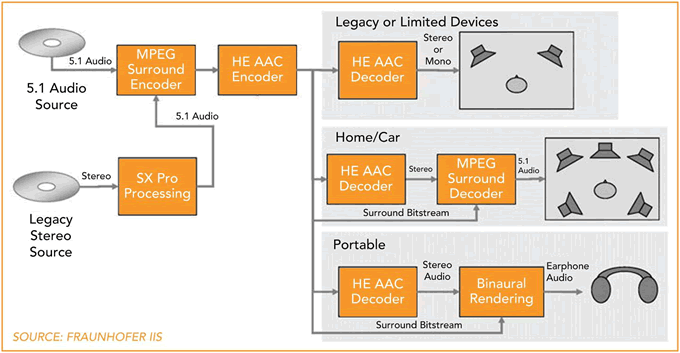 |
For
playback, the capability of the playback device (or receiver)
will determine the type of audio signal heard. A device capable
of decoding the perceptual audio, but not the surround bitstream,
will generate mono or stereo audio (depending upon what was encoded)
as shown in the “Legacy or Limited Devices” block in
the diagram. For an MPEG Surround-capable device with loudspeakers,
as shown in the “Home/Car” block, 5.1 channel surround
audio is produced. Finally, for a device capable of binaural rendering
(the “Portable” block), audio with MPEG Surround binaural
is generated for use with earphones.
A
similar set of surround sound tools is available for systems unable
to accommodate a surround side data channel. MP3 Surround enables
high-quality surround sound at bit rates comparable to those currently
used to encode stereo MP3 material. It is backwards compatible
to stereo MP3; a legacy MP3 device plays back MP3 Surround as
high quality stereo. MP3 SX is an upconverting technology which
enhances stereo MP3 files from stereo to surround without changing
the original stereo quality. MP3 3D is similar to MPEG Surround
binaural and can simulate a surround sound experience using earphones;
additional information on these MP3 technologies is available
at www.all4mp3.com/info/mp3d.html.
 SIGN
UP NOW FOR NAB'S SATELLITE SIGN
UP NOW FOR NAB'S SATELLITE
UPLINK OPERATORS TRAINING SEMINAR
September 29 - October 2, 2008
 If
you weren't able to attend the June NAB Satellite Uplink Operators
Training Seminar, you still have one more opportunity this year.
The course will be offered September 29 - October 2 at NAB's headquarters
in Washington DC. This four-day course is designed to instruct
students in the proper technical and operational practices that
will ensure safe, successful and interference free satellite transmissions. If
you weren't able to attend the June NAB Satellite Uplink Operators
Training Seminar, you still have one more opportunity this year.
The course will be offered September 29 - October 2 at NAB's headquarters
in Washington DC. This four-day course is designed to instruct
students in the proper technical and operational practices that
will ensure safe, successful and interference free satellite transmissions.
You can check out a short video piece featuring satellite seminar
instructor Sidney Skjei on the NAB365 Thought Leadership Channel
at: http://nab365.bdmetrics.com/spc-8-10720/nab365-tv.aspx.
For more information call Cheryl Coleridge at (202) 429-5346 or
go to NAB
Satellite Uplink Operators Seminar.
ATSC
Digital Television Transmission System
8-VSB Fundamentals Seminar
Wednesday, September 24, 2008 – KNME, Albuquerque, N.M.
The 1-day
8-VSB Fundamentals seminar, conducted by Gary Sgrignoli, will
help you develop a fundamental understanding of the digital VSB
transmission system and its performance attributes as well as
current practical application information. The seminar includes
an optional site visit to KNME’s DTV Tx site on Sandia Crest.
For additional information contact the instructor Gary Sgrignoli,
Meintel, Sgrignoli & Wallace at 847 259 3352 or Gary.Sgrignoli@IEEE.org
or Jim Gale, KNME-DT, 505 277 2049, jgale@knme.org
The
AFD Ready Initiative
 AFD
Ready is an initiative created by television broadcasters to insure
uniform and optimum program delivery of television broadcasts
after the analog shutdown on February 17, 2009. Through this initiative,
participants will work to increase awareness of AFD and promote
its use throughout the television industry. AFD
Ready is an initiative created by television broadcasters to insure
uniform and optimum program delivery of television broadcasts
after the analog shutdown on February 17, 2009. Through this initiative,
participants will work to increase awareness of AFD and promote
its use throughout the television industry.
More
information on the initiative including technical information
and whitepapers, industry links and a list of AFD Ready ATSC receiver/down-converter
devices is now available at www.nab.org/AFDReady.

The
July 28, 2008 TV TechCheck is also available in
an Adobe Acrobat file.
Please click
here to read the Adobe Acrobat version of TV TechCheck.
|

