| |
WiMAX
Promises True Mobile Wireless Broadband Service
 Wi-Fi
technology has revolutionized the way that people use the Internet
by allowing for a convenient and (most of the time) easy-to-use
wireless connection to laptop computers and other portable devices.
A new type of wireless service, called “WiMAX” (for
Worldwide Interoperability for Microwave Access), promises to
provide a much improved wireless Internet experience (compared
to Wi-Fi) and will even support a true mobile, in-motion connectivity
for users in automobiles as well as a true Internet-based wireless
broadcast service. A comparison of some of the key parameters
of Wi-Fi and WiMAX is shown in the table below. Wi-Fi
technology has revolutionized the way that people use the Internet
by allowing for a convenient and (most of the time) easy-to-use
wireless connection to laptop computers and other portable devices.
A new type of wireless service, called “WiMAX” (for
Worldwide Interoperability for Microwave Access), promises to
provide a much improved wireless Internet experience (compared
to Wi-Fi) and will even support a true mobile, in-motion connectivity
for users in automobiles as well as a true Internet-based wireless
broadcast service. A comparison of some of the key parameters
of Wi-Fi and WiMAX is shown in the table below.
WiMAX
comes in two “flavors,” fixed (IEEE standard 802.16-2004)
and mobile (802.16e-2005). While fixed WiMAX services offer an
alternative to wired Internet service to the home, mobile WiMAX
will provide a broadband cellular phone-like service operating
multiple times faster than so-called “3G” cellular networks
which offer connection speeds from 144 kbps to 2.4 Mbps (3G is
currently supported in the U.S. by a number of cellular service
providers including AT&T, Sprint/Nextel, TMobile and Verizon).
With embedded mobile WiMAX chipsets in laptops, phones, PDAs,
mobile Internet devices and consumer electronic equipment, mobile
WiMAX technology is expected to allow users to wirelessly access
a range of multimedia applications, such as live videoconferencing,
recorded video, games, large data files and more, anywhere within
the WiMAX network coverage area.
In
addition, the Mobile WiMAX standard includes a Multicast and Broadcast
Service (MBS) specification designed to support a broadcast (i.e.
point to multipoint) mode of operation, in contrast to the point-to-point
connectivity more typically supported by ISPs and existing cellular
networks. Some of the features of the WiMAX MBS include high data
rates and coverage using a Single Frequency Network (SFN); a flexible
allocation of RF channel resources; low mobile-station power consumption;
support for datacasting in addition to audio and video streams
and fast channel-switching. At the 2008 NAB Show, French technology
developer UDcast (Sophia-Antipolis, France, www.udcast.com)
previewed a mobile TV architecture based on the WiMAX MBS specification;
for more information, visit the UDcast Web page at www.udcast.fr/solutions/udcast_solutions_tv_wimax.htm.

Recently, Sprint Nextel announced that it will launch its first
commercial mobile WiMAX service in Baltimore in September, and
 expects to add two others cities—Chicago and Washington,
D.C.—by the end of the year. Sprint has been testing its
mobile WiMAX service (called Xohm, pronounced “Zoam,”
like “Foam” with a “Z”) with download speeds
of between 2 and 4 Mbps since the end of 2007 in Chicago and the
Washington/Baltimore area. Sprint has also recently announced
that it is spinning off its WiMAX assets and teaming with WiMAX
service provider Clearwire (Kirkland, WA, www.clearwire.com).
The new joint venture, to be called Clearwire, will be majority-owned
by Sprint with significant investments from Comcast, Time Warner
Cable, Intel and Google.
expects to add two others cities—Chicago and Washington,
D.C.—by the end of the year. Sprint has been testing its
mobile WiMAX service (called Xohm, pronounced “Zoam,”
like “Foam” with a “Z”) with download speeds
of between 2 and 4 Mbps since the end of 2007 in Chicago and the
Washington/Baltimore area. Sprint has also recently announced
that it is spinning off its WiMAX assets and teaming with WiMAX
service provider Clearwire (Kirkland, WA, www.clearwire.com).
The new joint venture, to be called Clearwire, will be majority-owned
by Sprint with significant investments from Comcast, Time Warner
Cable, Intel and Google.
Clearwire
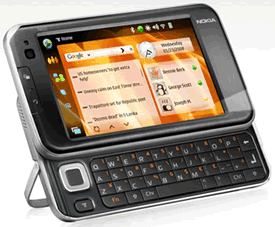
hopes to offer Xohm at a price of $40 per month, for a mobile
wireless Internet service with 2-4 Mbps download speed and 500k-1.5
Mbps upload speed. Clearwire expects that by the end of 2008 there
will be WiMAX chips in more than 20 different devices (shown here
is the Nokia 810 mobile phone, available now, which is already
WiMAX enabled).
 Some
of the functions that the Xohm service will offer include streaming
video and music, as well as the ability for users to stream camcorder
video in real time back to others (so-called “live streaming”).
Xohm contrasts the full Internet connectivity it will provide
to mobile users to the limited, “walled garden” experience
currently available to customers that connect to the Internet
over the cellular phone network. For additional information, visit
the Xohm Web site at www.xohm.com. Some
of the functions that the Xohm service will offer include streaming
video and music, as well as the ability for users to stream camcorder
video in real time back to others (so-called “live streaming”).
Xohm contrasts the full Internet connectivity it will provide
to mobile users to the limited, “walled garden” experience
currently available to customers that connect to the Internet
over the cellular phone network. For additional information, visit
the Xohm Web site at www.xohm.com.
SIGN
UP NOW FOR NAB'S SATELLITE UPLINK OPERATORS TRAINING SEMINAR
September 29 - October 2, 2008
 If
you weren't able to attend the June NAB Satellite Uplink Operators
Training Seminar, you still have one more opportunity this year.
The course will be offered September 29 - October 2 at NAB's headquarters
in Washington DC. This four-day course is designed to instruct
students in the proper technical and operational practices that
will ensure safe, successful and interference free satellite transmissions. If
you weren't able to attend the June NAB Satellite Uplink Operators
Training Seminar, you still have one more opportunity this year.
The course will be offered September 29 - October 2 at NAB's headquarters
in Washington DC. This four-day course is designed to instruct
students in the proper technical and operational practices that
will ensure safe, successful and interference free satellite transmissions.
You can check out a short video piece featuring satellite seminar
instructor Sidney Skjei on the NAB365 Thought Leadership Channel
at: http://nab365.bdmetrics.com/spc-8-10720/nab365-tv.aspx.
For more information call Cheryl Coleridge at (202) 429-5346 or
go to NAB
Satellite Uplink Operators Seminar.
ATSC
Digital Television Transmission System
8-VSB Fundamentals Seminar
Wednesday, September 24, 2008 – KNME, Albuquerque, N.M.
The 1-day
8-VSB Fundamentals seminar, conducted by Gary Sgrignoli, will
help you develop a fundamental understanding of the digital VSB
transmission system and its performance attributes as well as
current practical application information. The seminar includes
an optional site visit to KNME’s DTV Tx site on Sandia Crest.
For additional information contact the instructor Gary Sgrignoli,
Meintel, Sgrignoli & Wallace at 847 259 3352 or Gary.Sgrignoli@IEEE.org
or Jim Gale, KNME-DT, 505 277 2049, jgale@knme.org
The
AFD Ready Initiative
 AFD
Ready is an initiative created by television broadcasters to insure
uniform and optimum program delivery of television broadcasts
after the analog shutdown on February 17, 2009. Through this initiative,
participants will work to increase awareness of AFD and promote
its use throughout the television industry. AFD
Ready is an initiative created by television broadcasters to insure
uniform and optimum program delivery of television broadcasts
after the analog shutdown on February 17, 2009. Through this initiative,
participants will work to increase awareness of AFD and promote
its use throughout the television industry.
More
information on the initiative including technical information
and whitepapers, industry links and a list of AFD Ready ATSC receiver/down-converter
devices is now available at www.nab.org/AFDReady.

The
July 21, 2008 TV TechCheck is also available in
an Adobe Acrobat file. Please click
here to read the Adobe Acrobat version of TV TechCheck.
|
|

