|
NHK
Technology Open House in Tokyo Highlights Advanced Broadcast Research
 In
April,
attendees at the NAB Show in Las Vegas got a glimpse of several
of the advanced broadcast technology developments under investigation
at the NHK Science and Technical Research Laboratories. However,
the exhibits that were brought to NAB in 2006 through 2008 represent
only a small part of the ongoing research and development program
at NHK. Each May, the NHK Science and Research Laboratories opens
its doors to the public for three days and holds the NHK Technology
Open House, an exhibition showing the major research efforts underway.
The event attracts a total of approximately 20,000 people at the
NHK Science and Technical Research Labs (STRL) facility in Tokyo,
a 14-story building built in 2002. NHK STRL employs 264 personnel,
239 of which are research engineers, including 71 doctorate holders. In
April,
attendees at the NAB Show in Las Vegas got a glimpse of several
of the advanced broadcast technology developments under investigation
at the NHK Science and Technical Research Laboratories. However,
the exhibits that were brought to NAB in 2006 through 2008 represent
only a small part of the ongoing research and development program
at NHK. Each May, the NHK Science and Research Laboratories opens
its doors to the public for three days and holds the NHK Technology
Open House, an exhibition showing the major research efforts underway.
The event attracts a total of approximately 20,000 people at the
NHK Science and Technical Research Labs (STRL) facility in Tokyo,
a 14-story building built in 2002. NHK STRL employs 264 personnel,
239 of which are research engineers, including 71 doctorate holders.
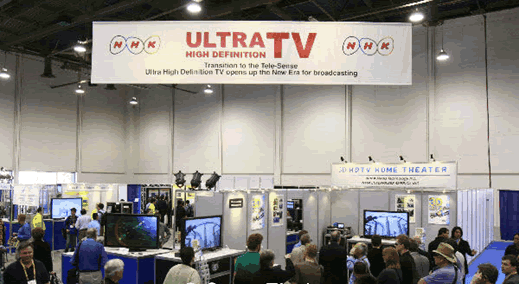
Ultra
HDTV was one of several advanced technologies demonstrated by
NHK at the 2008 NAB Show.
Nippon Hoso
Kyokai (NHK) is the sole public broadcaster in Japan, with network
headquarters in Tokyo, operating two terrestrial TV channels,
three satellite channels, main stations in eight cities in Japan
with a total of 54 stations throughout the country, and 28 overseas
network bureaus, with a full offering of news, information, entertainment
and educational program content. NHK also operates three national
radio channels. With over $6 billion in annual revenue, approximately
97% of funding comes from "receiving fees" that are
paid by every Japanese citizen with a television set (terrestrial
viewers pay about $150 per year and satellite viewers pay about
$250 per year). The first radio broadcasts by Tokyo Broadcasting
Station, the predecessor to NHK, were initiated in 1925. The NHK
Science and Technical Research Laboratories were established five
years later in 1930.
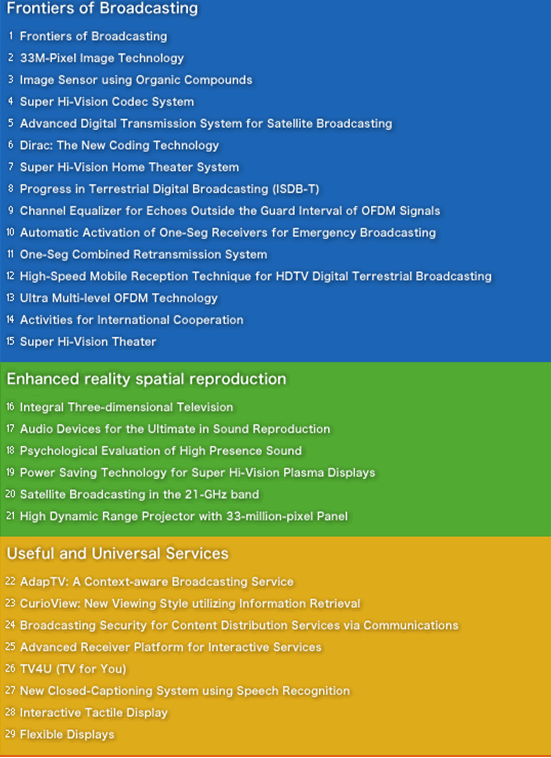
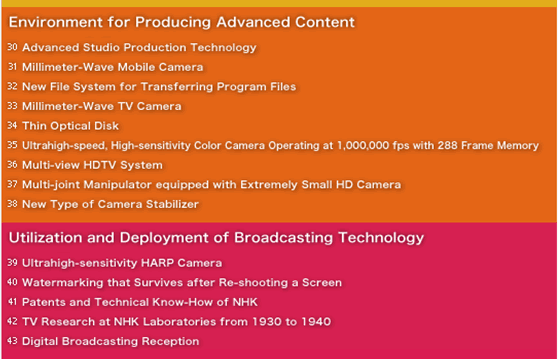
The 2008 NHK
Technology Open House, held May 22-25, encompassed 43 separate exhibits,
within five general categories as shown below:
A
particular highlight of the Open House was the progress shown
on the development of Ultra-HDTV (also referred to as Super Hi-Vision),
which is the focus of several research projects. The basic picture
resolution specification for Ultra HDTV is 7680 by 4320 pixels,
or 16 times the resolution of HDTV. As opposed to the optimized
30 degree horizontal viewing angle and viewing distance of 3 times
screen height of HDTV, Ultra HDTV is optimized for a 100 degree
viewing angle with a viewing distance of 0.75 times screen height.

The Ultra-HDTV
format and viewing environment.
The high resolution
images are accompanied by a 22.2 channel sound system, allowing
pinpoint sound localization as well as an immersive sound experience.
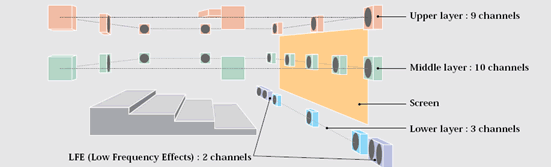
Placement
of loudspeakers in the Ultra-HDTV 22.2 channel sound specification.
Implementation
of Ultra HDTV requires breakthroughs in numerous areas, and progress
was shown in the following areas of ongoing active research: small
and highly sensitive imagers, large capacity storage devices,
efficient coding and transmission capability and compatible display
and sound systems for home use. Experimental satellite transmissions
in the 21 GHz band are being planned and live satellite transmission
of Ultra HDTV will be demonstrated at the IBC convention in Amsterdam
in the fall, in conjunction with several European partners.
For more information
on the 2008 NHK Technology Open House see http://www.nhk.or.jp/strl/open2008/english/index.html.
NAB'S
SATELLITE UPLINK OPERATORS TRAINING SEMINAR
September 29 - October 2, 2008
 If
you weren't able to attend this week's NAB Satellite Uplink Operators
Training Seminar, you still have one more opportunity this year.
The course will be offered September 29 - October 2 at NAB's headquarters
in Washington DC. This four-day course is designed to instruct
students in the proper technical and operational practices that
will ensure safe, successful and interference free satellite transmissions.
For more information call Cheryl Coleridge at (202) 429-5346 or
go to NAB
Satellite Uplink Operators Seminar. If
you weren't able to attend this week's NAB Satellite Uplink Operators
Training Seminar, you still have one more opportunity this year.
The course will be offered September 29 - October 2 at NAB's headquarters
in Washington DC. This four-day course is designed to instruct
students in the proper technical and operational practices that
will ensure safe, successful and interference free satellite transmissions.
For more information call Cheryl Coleridge at (202) 429-5346 or
go to NAB
Satellite Uplink Operators Seminar.

The
June 2, 2008 TV TechCheck is also available in
an Adobe Acrobat file. Please click
here to read the Adobe Acrobat version of TV TechCheck.
|

