| |
ICO
mim - A New Direct Broadcast Satellite Service for the U.S.
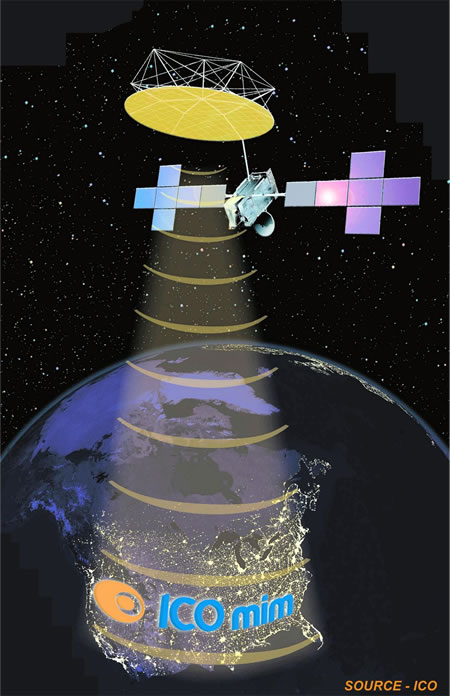 The largest commercial satellite ever built, ICO G1, was launched
into space on April 14, 2008, headed for geosynchronousorbit over
the U.S. to provide a new mobile satellite service (MSS) starting
in 2009. ICO G1 is the first commercial satellite to utilize a
ground-based beam forming system to determine the contours of
the satellite’s multiple spot beams. ICO (Reston, VA, www.ico.com)
will use this satellite to support a mobile interactive media
service, ICO mim™, feature mobile video, interactive navigation,
and emergency to communications services for consumers. According
to ICO, alpha trials for ICO mim will take place later in 2008
in Raleigh-Durham, NC, and Las Vegas, NV.
The largest commercial satellite ever built, ICO G1, was launched
into space on April 14, 2008, headed for geosynchronousorbit over
the U.S. to provide a new mobile satellite service (MSS) starting
in 2009. ICO G1 is the first commercial satellite to utilize a
ground-based beam forming system to determine the contours of
the satellite’s multiple spot beams. ICO (Reston, VA, www.ico.com)
will use this satellite to support a mobile interactive media
service, ICO mim™, feature mobile video, interactive navigation,
and emergency to communications services for consumers. According
to ICO, alpha trials for ICO mim will take place later in 2008
in Raleigh-Durham, NC, and Las Vegas, NV.
ICO’s planned system infrastructure includes the following:
- The ICO G1 satellite operating in a "bent pipe"
fashion, "reflecting" the signals between the end-user
equipment and the gateway ground station;
- A land-based transmitter network (Ancillary Terrestrial Component
or ATC) that will complement the ICO G1 satellite signals, with
the goal of providing seamless, gap-free coverage to end users
(similar to the terrestrial repeater network in use by SDARS
providers Sirius and XM);
- Ground-based beam forming (GBBF) equipment, located at the
gateway ground station North Las Vegas, NV), allowing the satellite
to dynamically form up to 250 spot beams of varying sizes throughout
the satellite’s coverage area in both the uplink and downlink
paths. This will allow ICO to dynamically accommodate traffic,
power, and coverage requirements from the ground, and represents
the first such application of this technology;
- A core switching/routing segment, consisting of equipment
used to route voice, video, and data traffic between the ICO
network and public data, telephone, Internet and mobile networks;
- End-user equipment capable of supporting both satellite-only
and dual-mode (satellite/terrestrial) services.
The FCC has
assigned 20 MHz of 2 GHz band (also known as the “S”
band) MSS spectrum to ICO (10 MHz each for uplink and downlink),
and when the spacecraft arrives at its final position at 92.85°
west longitude, it will be able to provide geographic coverage
to all 50 states as well as Puerto Rico and the U.S. Virgin Islands.
If appropriate regulatory approval is granted by other countries,
the ICO G1 satellite is also capable of providing service beyond
the U.S. to other parts of North America.
 ICO
mim will support a full set of service offerings including wireless
voice, video, data and/or Internet and telematics (vehicle tracking),
and is expected to provide multiple channels of high-quality mobile
video including 10-15 live channels of premium television content
to portable, larger-screen (4.5 to 10 inch) user devices. The
ICO G1 satellite architecture is flexible and is expected to be
compatible with existing radio protocols including W-CDMA, GSM,
DVB-SH, CDMA and OFDM, and to be able to support communications
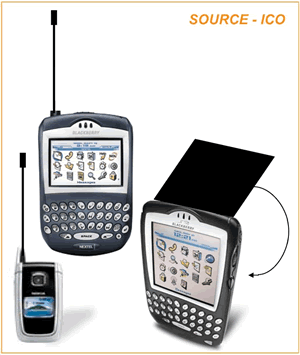
with a wide variety of user devices and handsets, many similar
in size to existing cellular phones (see photo). ICO
mim will support a full set of service offerings including wireless
voice, video, data and/or Internet and telematics (vehicle tracking),
and is expected to provide multiple channels of high-quality mobile
video including 10-15 live channels of premium television content
to portable, larger-screen (4.5 to 10 inch) user devices. The
ICO G1 satellite architecture is flexible and is expected to be
compatible with existing radio protocols including W-CDMA, GSM,
DVB-SH, CDMA and OFDM, and to be able to support communications
with a wide variety of user devices and handsets, many similar
in size to existing cellular phones (see photo).
The mobile
television component of ICO mim will use the DVB-SH standard.
Video content providers for the alpha trials to take place later
this year include Discovery Communications and NBC Universal.
The Discovery channels available for the ICO mim trials include
Discovery Channel, TLC and Discovery Kids. Navigation features
of ICO mim will include real-time traffic and weather alerts,
re-routing, and access to destination information, which will
combine with ICO mim’s unique integrated applications allowing
users to pre-program tasks and activities into their system. ICO
mim will also offer a roadside assistance and emergency messaging
capability, with satellite-connected emergency voice and text
messaging assistance,
Additional
information on ICO mim is available on the Internet at www.ico.com/_about/tech/mim.php.
FCC Updates
“The Public and Broadcasting”
 The
FCC’s Media Bureau has released an updated version of a document
entitled “The Public and Broadcasting.” This publication,
which every broadcaster is required to have a copy of in their
public inspection file, provides an overview of the FCC’s
regulation of broadcast radio and television licensees, describes
how broadcast stations are authorized, and explains the various
rules and policies relating to broadcast programming and operations
with which stations must comply, including the obligation to serve
their local communities. It also explains how members of the public
can become involved in assessing whether local broadcast stations
are complying with these requirements. The publication is also
intended to make the public aware of FCC procedures and the tools
at their disposal, in the event that they conclude that any of
their local stations do not meet these responsibilities. The
FCC’s Media Bureau has released an updated version of a document
entitled “The Public and Broadcasting.” This publication,
which every broadcaster is required to have a copy of in their
public inspection file, provides an overview of the FCC’s
regulation of broadcast radio and television licensees, describes
how broadcast stations are authorized, and explains the various
rules and policies relating to broadcast programming and operations
with which stations must comply, including the obligation to serve
their local communities. It also explains how members of the public
can become involved in assessing whether local broadcast stations
are complying with these requirements. The publication is also
intended to make the public aware of FCC procedures and the tools
at their disposal, in the event that they conclude that any of
their local stations do not meet these responsibilities.
In addition
to having this document in the public inspection file, broadcasters
must provide a copy of this publication to any member of the public
who requests one. The current version is available on the FCC’s
web page at www.fcc.gov/mb/audio/decdoc/public_and_broadcasting.html.
Also, effective
with the release of this latest version, two Broadcast Information
Specialists, one in the Media Bureau’s Audio Division and
one in its Video Division, will now serve as contact points for
the public, accessible via toll-free phone numbers, facsimile,
or e-mail. These individuals will be available to provide information
to persons interested in becoming involved in the Commission’s
processes, and will answer questions about how to do so, including
inquiries about the FCC’s complaint or petitioning procedures
or the filing and status of the license renewal, modification
or assignment or transfer application for a particular station.
The Broadcast Information Specialists can be contacted as follows:
If the inquiry
relates to a radio station:
Phone: (866) 267-7202 (Voice) or (877) 479-1433 (TTY)
Fax: (202) 418-1411
E-Mail: radioinfo@fcc.gov
If the inquiry
relates to a television station:
Phone: (866) 918-5777 (Voice) or (866) 787-6222 (TTY)
Fax: (202) 418-2827
E-Mail: tvinfo@fcc.gov.
If the inquiry
relates to both a radio and a television station, or is general
in nature, the FCC indicates that either Specialist may be contacted.
SIGN UP
NOW FOR NAB'S JUNE SATELLITE UPLINK OPERATORS TRAINING SEMINAR
 Whether
you are a satellite uplink operator, engineer or even a technical
manager who just wishes to become more familiar with satellite
communications, NAB's Satellite Uplink Operators Training Course
is for you. This four-day course is designed to instruct students
in the proper technical and operational practices that will ensure
safe, successful and interference free satellite transmissions.
The course will be offered June 2-5, 2008 at NAB's headquarters
in Washington DC. For more information call Cheryl Coleridge at
(202) 429-5346 or go to NAB
Satellite Uplink Operators Seminar.
Whether
you are a satellite uplink operator, engineer or even a technical
manager who just wishes to become more familiar with satellite
communications, NAB's Satellite Uplink Operators Training Course
is for you. This four-day course is designed to instruct students
in the proper technical and operational practices that will ensure
safe, successful and interference free satellite transmissions.
The course will be offered June 2-5, 2008 at NAB's headquarters
in Washington DC. For more information call Cheryl Coleridge at
(202) 429-5346 or go to NAB
Satellite Uplink Operators Seminar.
The
May 12, 2008 TV TechCheck is also available in
an Adobe Acrobat file. Please click
here to read the Adobe Acrobat version of TV TechCheck.

|
|

