|
Mobile
DTV, 3D TV Loom Large at 2008 NAB Show
US broadcaster's
are in hot pursuit of mobile DTV service and there was ample evidence
of this at last week's 2008 NAB Show in Las Vegas, NV (see www.nabshow.com
for more information about the show). Between all the meetings,
conference sessions, exhibits and mobile DTV demos it was clear
that the industry is fully focused on expanding terrestrial DTV
service to mobile, portable, and handheld devices.
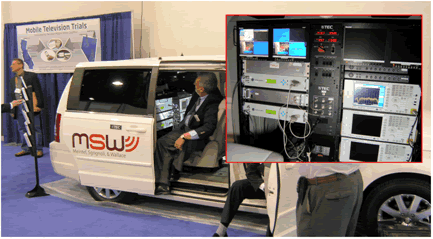 On
Monday, April 14, 2008, the Open Mobile Video Coalition (OMVC)
announced that the recent Independent Demonstration of Viability
(IDOV) trials (being undertaken by OMVC) showed that "...DTV-based
mobile video technologies are feasible." The vehicle being
used to collect the field trial data purpose-built by integration
company TEC and consulting group Meintel, Sgrignoli and Wallace
(MSW) under contract to the Association for Maximum Service Television
(MSTV) was on display in the exhibit hall (see photo at right
- inset shows equipment rack located inside of vehicle). "We
are on schedule for the 2009 rollout of commercial mobile DTV,"
said Brandon Burgess, president of the OMVC and CEO of ION Media
Networks. On
Monday, April 14, 2008, the Open Mobile Video Coalition (OMVC)
announced that the recent Independent Demonstration of Viability
(IDOV) trials (being undertaken by OMVC) showed that "...DTV-based
mobile video technologies are feasible." The vehicle being
used to collect the field trial data purpose-built by integration
company TEC and consulting group Meintel, Sgrignoli and Wallace
(MSW) under contract to the Association for Maximum Service Television
(MSTV) was on display in the exhibit hall (see photo at right
- inset shows equipment rack located inside of vehicle). "We
are on schedule for the 2009 rollout of commercial mobile DTV,"
said Brandon Burgess, president of the OMVC and CEO of ION Media
Networks.
The OMVC is
an association of commercial and public television broadcasters
representing over 800 television stations, which came together
in 2007 to accelerate the development of mobile digital television.
"We are laser-focused on finalizing a technology standard
for mobile DTV, and working with technology companies and service
operators to launch services beginning next year," said Anne
Schelle, executive director, OMVC. OMVC has been working with
MSTV, NAB, and the Advanced Television Systems Committee (ATSC)
for the past six months to conduct trials for pedestrian and mobile
digital television reception. OMVC initiated the IDOV trials at
ATSC's request to accelerate the adoption of an effective, mobile
DTV standard.
Laboratory
and field trials were conducted in March and April of 2008 in
the San Francisco Bay Area and Las Vegas. Additional lab testing
will be completed over the next several weeks. OMVC is confident
that it will complete the IDOV field and lab tests and have results
available in time to meet the mid-May timeframe established by
ATSC. The trials constitute a critical first step toward the ATSC's
adoption of a standard that will enable broadcasters to launch
mobile DTV services that will effectively serve the American public.
Preliminary and partial results of the trials have been encouraging,
and OMVC has reported the following findings:
The trials
show that both high VHF and UHF mobile reception works at pedestrian
and highway speeds;
Mobile reception
can be achieved as far as 40 miles from the transmitter;
None of the
systems interfere with normal digital broadcasting.
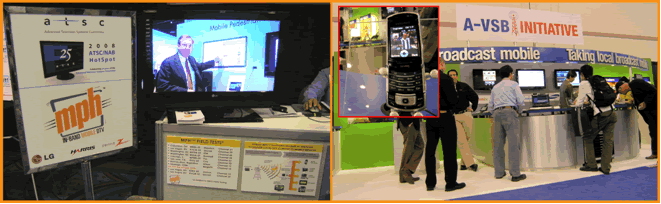
The three
systems that have been subjected to preliminary testing and
evaluation are: the MPH (Mobile Pedestrian-Handheld) system
jointly developed by LG Electronics and Harris Corporation;
the A-VSB system jointly developed by Samsung Electronics, Co.
Ltd and Rohde & Schwarz; and a third system jointly developed
by Thomson and Micronas (T/M). Harris/LG and Samsung had demonstrations
of the MPH and A-VSB systems using buses driving around Las
Vegas with fixed screens and handheld devices receiving transmissions
from two Las Vegas DTV stations. The MPH and A-VSB systems also
had exhibits on the NAB show floor (see photos above—the
inset in the A-VSB photo is a Samsung cell phone that was displaying
real-time video utilizing A-VSB). The Thomson booth had a demonstration
of their "StaggerCast" system, showing an ability
to maintain continuous video with one-second signal interruptions.
Thomson also demonstrated the use of Scalable Video Coding (SVC),
enabling enhanced quality for higher resolution receiving devices.
OMVC expects to deliver a final report to the ATSC in May. Next
steps will include consumer trials. For additional information
go to www.openmobilevideo.com.
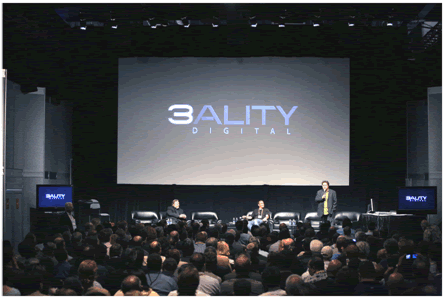 Also
on Monday at the NAB show, 3ality Digital hosted a live 3D digital
TV demonstration of a new game show with "Deal or No Deal"
host Howie Mandel and executive producer Scott St. John. Led
by 3ality Digital's Steve Schklair, John Modell and Howard Postley
(shown on the dais in the photo at right), the event was broadcast
out of 3ality's facility in Burbank from 3:15-3:45pm PDT. It
was a live 3D feed, sent in a single stream using an existing
broadcast infrastructure via satellite transmission, to the
NAB "Content Theater," a state-of-the-art digital
screening room on the exhibit floor featuring RealD's 3D technology
where top Hollywood filmmakers and executives revealed how they
used new technologies to produce their latest content. Also
on Monday at the NAB show, 3ality Digital hosted a live 3D digital
TV demonstration of a new game show with "Deal or No Deal"
host Howie Mandel and executive producer Scott St. John. Led
by 3ality Digital's Steve Schklair, John Modell and Howard Postley
(shown on the dais in the photo at right), the event was broadcast
out of 3ality's facility in Burbank from 3:15-3:45pm PDT. It
was a live 3D feed, sent in a single stream using an existing
broadcast infrastructure via satellite transmission, to the
NAB "Content Theater," a state-of-the-art digital
screening room on the exhibit floor featuring RealD's 3D technology
where top Hollywood filmmakers and executives revealed how they
used new technologies to produce their latest content.
The demonstration
highlighted the advanced camera technology created and utilized
by 3ality Digital and showed the ease with which production
can be accomplished. One of these advancements is in the camera's
zoom lenses, which can compensate for the differences in the
two lenses used for 3D imaging as they zoom in and out. 3ality
Digital says that the immersive 3D effects "...heighten
the stakes for the viewers and makes them feel in the moment."
For this live demo, there was audience interaction with a vote
as to a choice the game show contestant had to make (between
kissing a 90-year old toothless woman or hugging a large brown
bear that was in the studio!).
"We
are thrilled to have partnered with 3ality Digital and to share
their excitement and enthusiasm for the 3D format that will
change how home entertainment is experienced," said Mandel
and St. John in a joint statement. "3ality Digital is taking
3D to another dimension and it's changed all the things I used
to believe about 3D," continued Mandel. St. John added:
"As a producer I'm completely blown away by the cameras'
ability to change depth while shooting. Today's event totally
broke through a wall and now allows viewers to be in the game,
not just watching it."
"The
debut of our groundbreaking technology today displayed the rapid
development of 3ality's advanced image capture and transmission
capabilities for live 3D entertainment and sports," stated
3ality Digital CEO Sandy Climan. "This takes fans into
a zone where they get to feel what the contestants are feeling.
Whether it's game shows, reality television, or sports, this
is the technology of the future, and it's available today. We
look forward to continuing to deliver this kind of quality 3D
content to the public." For more information see www.3alitydigital.com.
The
April 21, 2008 TV TechCheck is also available
in an Adobe Acrobat file.
Please click
here to read the Adobe Acrobat version of TV TechCheck.
|

