 |
HD-ENG Field Test Report
Television
broadcasters are transitioning to digital electronic newsgathering
(ENG) technology which operates in the 2 GHz frequency band (see
the December
10, 2007 issue of TV TechCheck for the latest regulatory
information on this transition). A session at the upcoming NAB
Broadcast Engineering Conference (BEC, April 12-17, 2008, Las
Vegas, NV - see below for additional information) called "TV
News and Live Production" includes a paper by Walter Sidas,
Gregory Coppa, and Robert Seidel of CBS describing the results
of HD-ENG field tests performed by CBS in the New York City area,
which is excerpted here.
INTRODUCTION
- this paper presents the results of HD-ENG field tests performed
by CBS. It describes the objectives, methodology, and field tests
performed in an urban environment using compressed HD signals
at bit rates from 18 to 28 Mbps. The microwave signals were transmitted
using the new, FCC-mandated 2 GHz, 12 MHz channel plan and employed
Coded Orthogonal Frequency Division Multiplexed (COFDM) modulation.
The tests were performed using a typical ENG vehicle, modified
to incorporate an HD encoder and the COFDM modulation equipment.
Six COFDM configurations were tested to determine the maximum
bit rate that could be reliably delivered.
DESCRIPTION
OF TEST PROGRAM - the test program's primary objective was
to determine the optimal operating parameters of digital microwave
transmission and reception using the new 2 GHz, 12 MHz channel
plan in an urban environment using compressed HD signals at bit
rates from 18 to 28 Mbps. A series of tests were performed to
determine operational parameters required to achieve the highest
bit rate possible for reliable HDTV transmission. These tests
used one ENG van and recorded parameters for quasi-error free
HDTV transmission. The tests concentrated on collecting reception
data from "difficult" transmit sites that required a
"bounce." A variety of line-of-sight (LOS) locations,
considered "easy" transmit sites with increasing distances
from the Empire State Building, were measured for all data rates
to determine the relationship between data rate and transmit distance.
SYSTEM
DESCRIPTION - the DVB-T transmission system utilizes COFDM
made up of 2,000 carriers that are spaced a few KHz apart across
the operating signal bandwidth of 8, 7 or 6 MHz. The modulation
format of all carriers is operator  selectable
as QPSK, 16-QAM or 64-QAM. The different modulation systems have
different minimum Carrier-to-Noise (C/N) ratios that must be taken
into consideration when analyzing the data. The minimum C/N is
also different for the type of channel model. A Gaussian channel,
where the direct receive signal is only impaired by white noise,
will have the lowest C/N requirement. A Ricean channel, where
the signal path is impaired by a number of echoes of varying levels
and phases, will have a slightly higher C/N for the same modulation.
A Rayleigh channel, which has no direct line of sight and has
multiple echoes similar to the Ricean channel, has the highest
C/N requirement of the channel models and is closest to actual
field conditions. For Quasi-Error-Free (QEF) reception, a bit
error rate of 2x10⁻⁴, after FEC is applied, is required. Shown
in the table are the C/N ratios required to achieve QEF for the
Gaussian, Ricean, and Rayleigh channels. selectable
as QPSK, 16-QAM or 64-QAM. The different modulation systems have
different minimum Carrier-to-Noise (C/N) ratios that must be taken
into consideration when analyzing the data. The minimum C/N is
also different for the type of channel model. A Gaussian channel,
where the direct receive signal is only impaired by white noise,
will have the lowest C/N requirement. A Ricean channel, where
the signal path is impaired by a number of echoes of varying levels
and phases, will have a slightly higher C/N for the same modulation.
A Rayleigh channel, which has no direct line of sight and has
multiple echoes similar to the Ricean channel, has the highest
C/N requirement of the channel models and is closest to actual
field conditions. For Quasi-Error-Free (QEF) reception, a bit
error rate of 2x10⁻⁴, after FEC is applied, is required. Shown
in the table are the C/N ratios required to achieve QEF for the
Gaussian, Ricean, and Rayleigh channels.
HDTV DATA
RATE TESTING - HDTV data rate testing was undertaken to determine
the maximum data rate that could be transmitted using a DVB-T
8 MHz pedestal in a 12 MHz channel. It should be noted that the
9.68 Mbps MPEG-2 data rate was only used for antenna sighting
and is insufficient to provide "broadcast quality" HDTV
transmissions, since the HD-ENG signal will be concatenated with
the ATSC compression process when it is broadcast to the home.
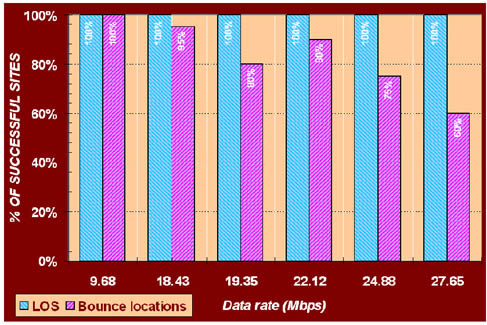
Shown in the bar chart below are the percentage of successful
sites for LOS and "bounce" locations within a 35-mile
radius for the 6 data rates under test. For the LOS sites, a 100%
success rate was achieved for all 6 data rates with only 1 watt
of transmitted power. The bounce locations were those that required
a bounce of the transmitted signal off adjacent buildings to reach
the Empire State Building. The maximum transmission distance for
any bounce site was 27.5 miles. The baseline data rate of 9.68
Mbps, which was used for sighting the antenna, had a 100% success
rate for all bounce locations. The 18.43 and 22.12 Mbps signals
had comparable success rates of 95% and 90% respectively. This
is expected since these two modulation schemes have the same minimum
C/N requirement of 19.3 dB for a Rayleigh channel (as shown in
the table). The 19.35 Mbps signal had a receive success rate of
80%. This lower success rate is attributed to the higher C/N noise
requirement of 22.8 db for a Rayleigh channel.
 RESULTS
- many of the most difficult ENG locations in the canyons of New
York City; such as Gracie Mansion, United Nations, City Hall,
Lincoln Center, Wall Street Area, World Trade Center provided
reliable HD-ENG transmission paths using a variety of data rates.
The success rate of these tests indicates the HD-ENG using an
8 MHz DVB-T pedestal can provide reliable transmission paths for
both line of sight and bounce locations. Because high definition
signal quality is of paramount importance, all six of these data
rates should be loaded as pre-sets in the transmission encoders
and modulators. This will afford the broadcaster the greatest
flexibility and the highest quality for ENG. RESULTS
- many of the most difficult ENG locations in the canyons of New
York City; such as Gracie Mansion, United Nations, City Hall,
Lincoln Center, Wall Street Area, World Trade Center provided
reliable HD-ENG transmission paths using a variety of data rates.
The success rate of these tests indicates the HD-ENG using an
8 MHz DVB-T pedestal can provide reliable transmission paths for
both line of sight and bounce locations. Because high definition
signal quality is of paramount importance, all six of these data
rates should be loaded as pre-sets in the transmission encoders
and modulators. This will afford the broadcaster the greatest
flexibility and the highest quality for ENG.
This paper
will be presented on Monday, April 14, 2008 starting at 4PM in
room S226/227 of the Las Vegas Convention Center. It will also
be included in its entirety in the 2008 NAB BEC Proceedings,
on sale at the 2008 NAB Show. For additional conference information
visit the NAB Show Web page at www.nabshow.com.
ATSC Digital
VSB Measurements Seminar
Monday, March 10, 2008
Great Lakes Broadcasting Conference
Grand Rapids, Mich.
A one-day
seminar on the ATSC's digital television (DTV) vestigial sideband
(VSB) transmission system measurement methodologies will be presented
on March 10 in Grand Rapids, Mich. Presented by DTV transmission
engineer, Gary Sgrignoli, the seminar identifies and describes
the pieces of test equipment needed for VSB testing in the laboratory,
at transmitter sites and at remote field sites.
For additional
information contact Gary Sgrignoli, Meintel, Sgrignoli & Wallace
at (847) 259-3352 or Gary.Sgrignoli@IEEE.org.
2008
NAB Broadcast Engineering Conference Summary of Presentations
Check out the papers
that will be presented at the 2008 NAB Broadcast Engineering
Conference in Las Vegas, April 12 -17, 2008. Find registration,
housing or additional information on the NAB Show at http://www.nabshow.com/.

The
March 3, 2008 TV TechCheck is also available in
an Adobe Acrobat file.
Please click
here to read the Adobe Acrobat version of TV TechCheck.
|
|
