Smart
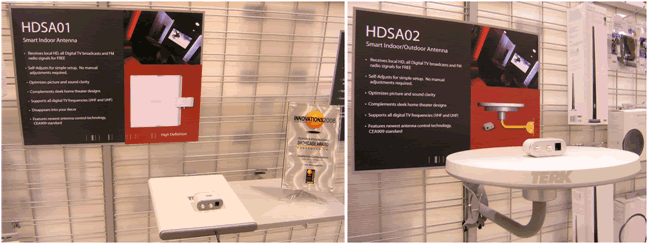
antennas - Terk (now a division of Audiovox, www.audiovox.com)
received a "CEA Innovation Award" for its HDSA01 Omni-Directional
Indoor Smart Antenna. Shown in the photo is the indoor HDSA01
(at left below) along with an outdoor smart antenna HDSA02 (at
right below). These antennas comply with the CEA 909 smart antenna
standard - for more information on that standard go to the CEA
Web page at http://www.ce.org/print/Standards/browseByCommittee_2784.asp.
The CEA Innovation Award program recognizes technologies, applications,
products, and services judged to be the most unique in design
and engineering and beneficial to the consumer electronics industry.
The winning products are selected by a panel of independent
industrial designers, engineers and trade press editors based
on "engineering and design qualities, uniqueness, user
value, contributions to consumers' quality of life and the impact
on the manufacturer's business." A list of all the Innovation
Award winners for 2008 may be found online at http://www.cesweb.org/attendees/awards/innovations/rd_2008honorees.asp.
Coupon-eligible
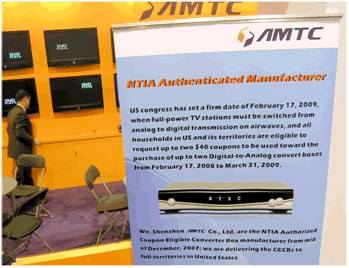
converter boxes - A number of companies showed ATSC DTV-to-NTSC
converter boxes, including the one shown below from Chinese
manufacturer Shenzen AMTC Co. (http://www.szmtc.com.cn/en/).
The current list of NTIA certified coupon-eligible converter
boxes is located on the NTIA's DTV Web page at http://www.ntiadtv.gov/cecb_list.cfm.
Display technology - many display vendors were offering
similar innovations at this year's show including 120 Hz refresh
rates, "ultra-thin" LCD displays (though none were
as thin as the Organic LED displays, see below) and LED backlighting
of LCD panels. Panasonic unveiled a 150-inch plasma display
(see photo) which was characterized as an "engineering
prototype" but which the Panasonic representative in the
photo says is headed for production (he also said the biggest
problem is figuring out "how to get it in the house").
It has a resolution of 2,000-by-4,000 pixels resolution and
is 11 feet wide (equivalent to nine 50-inch plasma screens).
Previously Panasonic has manufactured a 103-inch plasma set
and reportedly sold 3,000 units (retail price of the 103-inch
model is $70,000).

Also on
display was an example of Texas Instrument's "Dual View"
technology which uses a TI DLP device for two-player gaming
applications and provides each player independent full screen
views on the same display. According to TI, all 3D ready DLP
HDTVs are capable of DualView and can simultaneously display
two content sources, including DVD movies, video games and TV
programming. TI says that this has been achieved by the combination
of advancements on the DLP chipset and compatible eyewear. DLP
Products collaborated with ColorLink/RealD (www.colorlink.com)
and others for these suppliers to develop a customized DualView
eye-wear control solution. The key to a ghost-free picture quality
of DualView is the coordination of the DLP chip's extremely
fast 8 microsecond switching speed with high-contrast shutter
glass operation. The DLP prototype eye-wear controller synchronizes
the glasses' shutters by decoding a proprietary signal embedded
in the 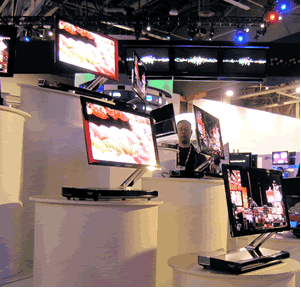 DLP
image stream. The result is a view for each gamer that is independent
from the other and allows for a more competitive, enjoyable
game experience by eliminating the ability to cheat at the other
players screen, which currently is a limitation of split screen
two-player game displays. To use DualView, the DLP HDTV is connected
to a compatible source and each gamer wears compatible DualView
glasses. Select Samsung and Mitsubishi DLP HDTVs are shipping
with 3-D ready and DualView capabilities. A press release from
TI on DualView can be seen here.
DLP
image stream. The result is a view for each gamer that is independent
from the other and allows for a more competitive, enjoyable
game experience by eliminating the ability to cheat at the other
players screen, which currently is a limitation of split screen
two-player game displays. To use DualView, the DLP HDTV is connected
to a compatible source and each gamer wears compatible DualView
glasses. Select Samsung and Mitsubishi DLP HDTVs are shipping
with 3-D ready and DualView capabilities. A press release from
TI on DualView can be seen here.
The XEL-1
Organic Light Emitting Diode (OLED) TV was being shown in the
Sony booth, and is the first commercialized, with an 11-inch
display and integrated ATSC tuner OLED TV (see photo). Sony
indicated that the XEL-1 is now available for about $2,500.
Initially, it will be in limited supply at Sony Style® retail
stores nationwide. Additional information is available here.
Sony also showed a 27" OLED prototype and Samsung showed
a 31" OLED prototype.
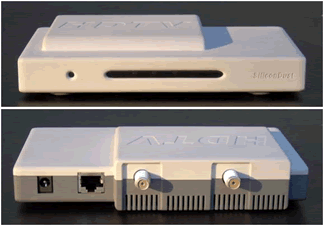
HD HomeRun - this device (see photo at left), which
is available on-line for about $170, includes two ATSC DTV tuners
and plugs into an Ethernet network, allowing the user to watch
one channel while recording another. For more information go
to www.silicondust.com/.
Wireless
HD - in the opening keynote address at last week's show,
Panasonic AVC Networks Company President Toshihiro Sakamoto
unveiled a new a wireless 1080p full HD transmission system.
WirelessHD or WiHD™, is a wireless high definition digital
interface standard operating in the unlicensed (and globally
available) 60 GHz frequency band. Involved in the development
of this technology are Intel Corporation, LG Electronics, Panasonic,
NEC, Samsung, SiBeam, Sony and Toshiba. The WirelessHD specification
defines a wireless protocol that enables consumer devices to
create a wireless video area network (WVAN) with the following
characteristics: stream uncompressed audio and video at up to
1080p resolution, 24 bit color at 60 Hz refresh rates; deliver
compressed A/V streams and data; advanced A/V and device control
protocol; unlicensed operation at 60 GHz with a typical range
of at least 10 m and data rates up to 4 Gbps. For more information
go to www.wirelesshd.org.

 The
eyes of the consumer electronics world were on Las Vegas last week
as the 2008 International Consumer Electronics Show(CES) drew over
130,000 attendees with exhibits from over 2,700 companies spanning
1.85 million net square feet of exhibit space. As usual, broadcasting-related
technologies, in particular HDTV and HD Radio, were very much a
part of the show; given below are some of the highlights as noted
by NAB staff who were in attendance:
The
eyes of the consumer electronics world were on Las Vegas last week
as the 2008 International Consumer Electronics Show(CES) drew over
130,000 attendees with exhibits from over 2,700 companies spanning
1.85 million net square feet of exhibit space. As usual, broadcasting-related
technologies, in particular HDTV and HD Radio, were very much a
part of the show; given below are some of the highlights as noted
by NAB staff who were in attendance: