|
Comments
Filed on Request for FM Digital Power Increase
Comments were
filed on December 5 responding to the FCC’s Public Notice on
the proposed FM IBOC digital power increase (http://hraunfoss.fcc.gov/edocs_public/attachmatch/DA-08-2340A1.pdf).
This proposal was made in June 2008 by a group consisting of 18
broadcasters and the 4 largest manufacturers of broadcast transmission
equipment (identifying themselves as “Joint Parties”).
Specifically, the Joint Parties requested that the Commission increase
the maximum permissible digital 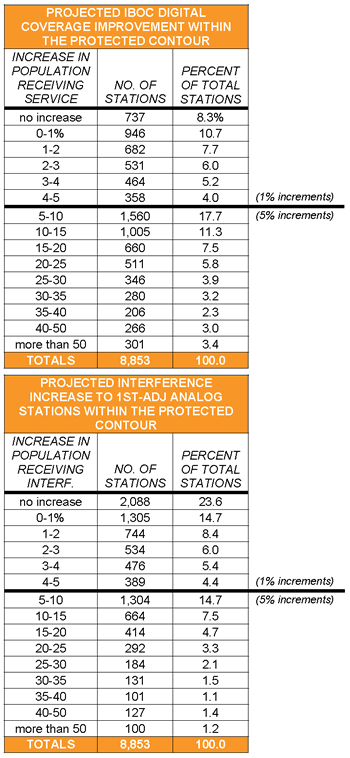 operating
power of FM stations from the current level of 1 percent of a station’s
authorized analog power (-20 dBc, referenced to the unmodulated
analog FM carrier power) to a maximum of 10 percent of a station’s
authorized analog power (-10 dBc). The results of technical studies
conducted by iBiquity Digital and CBS Radio in support of this proposal
were submitted to the Commission, as well. operating
power of FM stations from the current level of 1 percent of a station’s
authorized analog power (-20 dBc, referenced to the unmodulated
analog FM carrier power) to a maximum of 10 percent of a station’s
authorized analog power (-10 dBc). The results of technical studies
conducted by iBiquity Digital and CBS Radio in support of this proposal
were submitted to the Commission, as well.
NAB’s comments
noted that the benefits of permitting FM broadcasters to optionally
increase the power in their digital signal which include increased
digital coverage and penetration of IBOC signals into buildings)
are compelling, and that the iBiquity and CBS Radio studies are
sound and provide a sufficient and strong basis for the FCC to authorize
the proposal of the Joint Parties. Included with NAB’s filing
is an engineering study, conducted for NAB by the broadcast consulting
engineering firm of Hammett & Edison (H&E, San Francisco,
CA, www.h-e.com). In addition to
reviewing the iBiquity study, H&E conducted a detailed computer
analysis of the impact of the proposed power increase on digital
coverage and 1st-adjacent channel analog interference nationwide.
Their analysis generally confirms the conclusions of the iBiquity
report and offers additional insight into the impact of the proposed
power increase.
H&E conclude
that a 10 dB power increase would improve digital population coverage
within stations’ protected contours by a significant amount.
A summary of their analysis is presented in the tables which detail
both the estimated digital coverage improvement and 1st-adjacent
channel interference increase (to analog FM signals), within a station’s
protected contour, if all stations in the U.S. were broadcasting
digitally at the higher (-10dBc) level. These increases are expressed
as a percentage of the listener populations within a station’s
protected contour based upon existing IBOC transmission levels of
-20 dBc. Note that, since the study limits its area of consideration
to within a station’s protected contour, those stations that
already cover their contour would be listed as having 0% coverage
improvement. The 10 dB power increase would however, result in more
coverage outside the contour, more reliable service within the contour
and better reception indoors.
In practice,
the potential interference would actually be much lower than the
Hammett & Edison results suggest. This is because the Hammett
& Edison analysis assumes that all FM stations are broadcasting
digitally, whereas presently only 12% of FM stations are on air
in digital. Further, it assumes that all stations are operating
with the maximum proposed power increase of 10 dB, and it is very
unlikely, for a variety of reasons, that this would ever be the
case.
The Joint Parties’
comments, filed on behalf of over 1,200 broadcast stations (as well
as the four largest broadcast manufacturers) first note that their
power increase request is based on extensive real-world studies
conducted by several broadcasters and iBiquity Digital. They further
note that the iBiquity study found, in the majority of instances,
listeners to 1st-adjacent analog stations did not hear meaningful
impact from the increase in digital power, and that although the
test program was conducted over a significant period of time, not
one interference complaint was received by any of the test stations,
or, to the Joint Parties' knowledge, were any complaints filed with
the FCC. Thus, the test program indicates that the power increase
may, at most, have a tolerable potential for interference in limited
first adjacent analog situations.
Regarding the
NPR Labs digital interference study (which was also a subject of
the FCC’s Public Notice), the Joint Parties observe that the
NPR work is based on multiple laboratory assumptions and predictions,
with no real-world test component involving stations operating at
elevated digital levels. Moreover, while the real-world studies
associated with the Joint Parties’ request were designed to
calculate and evaluate the impact that a discretionary digital FM
power increase would actually have on analog and digital listeners
(so that the Commission would have a substantive basis for acting
on the HD Power Increase Request), the NPR Study is premised on
a "worst case" scenario which "assumes that all existing
stations affecting the subject facility have increased their IBOC
power by a full 10%.” The Joint Commenters believe that by
adopting a worst case scenario, the NPR Study produced an unrealistic
prediction of the impact that the requested digital power increase
would have on analog operations.
Ford Motor Company
and BMW also filed comments supporting the proposed power increase.
Both automakers expressed their concern that the benefits of HD
Radio technology will not be accepted by the public unless HD Radio
technology is able to replicate analog coverage in a greater number
of cases, and note that these coverage problems are particularly
problematic in a car environment. They note that mobile reception
is inherently more susceptible to multipath interference and other
impairments that can vary considerable in very short time frames
as a car drives into and out of areas of interference. Both Ford
and BMW believe the tests iBiquity Digital conducted demonstrate
a 10 dB power increase will deliver a more complete replication
of digital coverage in a variety of terrain environments.
The full text
of all comments may be obtained using the FCC’s Electronic
Comment Filing System (ECFS) at www.fcc.gov/cgb/ecfs/.
Select the “Search for Filed Comments” link on the right
side of this Web page, then enter “99-325” (no quotes)
in box #1 and click on the “Retrieve Document List” button
at the bottom of the page. Broadcasters interested in filing replies
in this matter (due January 12, 2009) may do so electronically by
accessing the ECFS. Filers should follow the instructions provided
on the Web site for submitting comments, and should include their
full name, U.S. Postal service mailing address, and the applicable
docket number: MM Docket No. 99-325. Parties may also submit an
electronic comment by email—to get filing instructions, send
an e-mail to ecfs@fcc.gov, and
include the words “get form” in the body of the message.
A sample form and instructions will be sent in response.
Another Radio Receiver
for the Holidays…
 A
number of exciting radio-based consumer products were featured in
the December
8, 2008 issue of Radio TechCheck. Here's another new product
that would make a great holiday gift: A
number of exciting radio-based consumer products were featured in
the December
8, 2008 issue of Radio TechCheck. Here's another new product
that would make a great holiday gift:
Broadcast
Traffic Consortium-enabled navigation - brought to you by the
efforts of the Broadcaster Traffic Consortium (BTC) and Navteq is
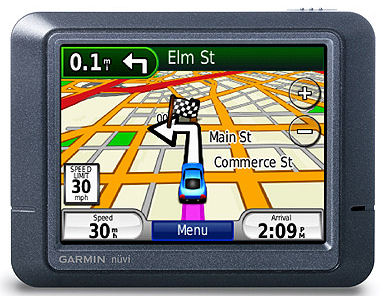
the new Garmin Nuvi 265T Portable Automotive GPS with free lifetime
traffic. All Garmin units that end in "T" provide ad-supported
lifetime traffic. The Nuvi 265T unit can be purchased from Walmart
for $240 and is available on Walmart's web site at www.walmart.com/catalog/product.do?
product_id=10543584&sourceid=18453967783684869578.
View Real-time
traffic and a vibrant 4.3" color, touch screen display with
Garmin's Nuvi. This mapping device has the entire US, Canada and
Puerto Rico pre-loaded in to the unit along with up 6 million points
of interest. The free traffic service, provided by Navteq, uses
the Nuvi 265WT or 755T's integrated traffic receiver for up to the
minute alerts about traffic delays or road construction that lie
ahead on your route. The Garmin 265T can then prompt you to route
around these delays to save you valuable time and fuel.
The December
15, 2008 Radio TechCheck is also available in an
Adobe Acrobat file.
Please
click
here to read the Adobe Acrobat version of Radio TechCheck.
|
