|
FM
Digital Power Increase Shown to Improve Indoor Reception
Testing
done by CBS Radio has shown that increasing the digital power
of an FM IBOC signal by 10 dB significantly improves indoor HD
Radio reception. This study was done in conjunction with the digital
coverage and analog interference study done by iBiquity on the
impact of an FM digital power increase (see the June
16, 2008 issue of Radio TechCheck for information on
the iBiquity test program).
Together,
the results from these studies offer compelling evidence that
the FM digital power increase proposed by a group of broadcasters
and equipment manufacturers, and recently put out on Public Notice
by the FCC, would provide significantly improved digital radio
coverage and not meaningfully increase potential interference
to analog. The CBS Radio indoor reception study was reported on
at the 2008 NAB Broadcast Engineering Conference in April of this
year, and in addition was submitted into the FCC’s terrestrial
digital radio proceeding (Media Bureau Docket No. 99-325) on June
10, 2008.
Station
KROQ-FM, a Class B FM commercial radio station operating on 106.7
MHz in Pasadena, CA, was used for these indoor reception tests,
operating under an Experimental Authorization from the FCC. A
“common amplification” IBOC configuration is used at
KROQ, and the transmitter is connected to a 3-bay antenna, generating
5.6 kW of analog effective radiated power (ERP) and a digital
ERP of either 56 W at -20 dBc (nominal IBOC operation), or 560
W at -10 dBc (operation with proposed 10 dB power increase).
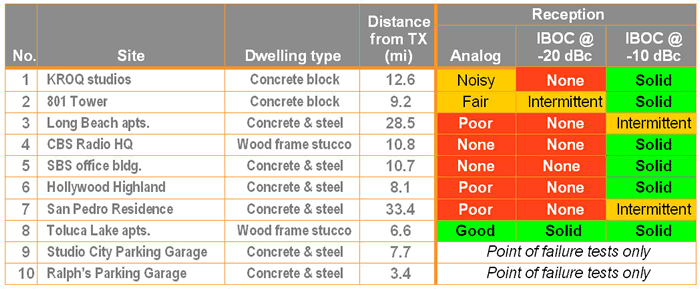
Ten
test structures were selected so as to provide a variety of construction
types and usage (see table). At each site the following test procedure
was followed:
- Receive
antenna was placed outside the structure at a point where
visual observation indicated that the signal was being received
with minimal multipath. Spectrum analyzer data and signal
level was then recorded to establish the unattenuated RF signal
level for this site;
- The antenna,
HD Radio receiver and spectrum analyzer were moved to an indoor
location near a window where an attempt
 was
made to receive the digital signal with the sidebands at -20
dBc. Analyzer data and signal level were recorded at this
point (the “window location”); was
made to receive the digital signal with the sidebands at -20
dBc. Analyzer data and signal level were recorded at this
point (the “window location”);
- Measurements
were made at a more interior point within the building in
an attempt to determine where the (-20 dBc) digital signal
failed (point-of-failure or POF);
- The digital
power at the transmitter was increased to -10 dBc and the
antenna was then moved further into the interior of the building
to establish the new POF.
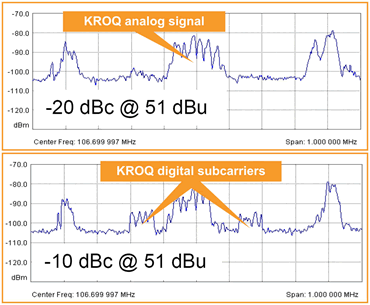
Some
example spectrum analyzer plots obtained during these tests are
shown in the figures. These plots were taken at test site #6 (Hollywood
Highland entertainment complex). At this site, the digital signal
was lost as soon as the test setup was brought inside (upper plot),
and the analog reception was found to be poor. When the digital
signal power was increased to -10 dBc (lower plot), there was
good digital reception, however the analog reception was still
poor since increasing the digital signal power does not change
the quality or reception of the analog signal.
The results from these tests are summarized in the table. In 75%
of the buildings tested the analog reception was described as
nonexistent, noisy or poor and there was no digital reception
when the digital power level was at -20 dBc. With the digital
power level elevated to -10 dBc, the digital radio signal could
be received reliably in 75% of the buildings and at selected locations
in the remaining 25% of the buildings. For the parking garage
tests, the distance within the structure for which the digital
signal was receivable increased from 30 feet (with -20 dBc) to
165 feet (with -10 dBc) for site #10; for site #9, the digital
signal at -20 dBc failed at the bottom of the entrance ramp to
the garage, but was receivable throughout the parking structure
when the digital power was increased to -10 dBc.
A
copy of the CBS Radio test report (entitled “FM IBOC Building
Penetration Tests at Elevated Carrier Levels”), as well as
a copy of the iBiquity digital coverage and analog interference
study, can be downloaded from the iBiquity Web page at: www.ibiquity.com/i/pdfs/10db%20HD%20Radio%20Increase.zip.
Broadcasters
interested in filing comments in response to the FCC’s Public
Notice on the proposed FM digital power increase may obtain a
copy of the Public Notice from the FCC’s Web site at: http://hraunfoss.fcc.gov/edocs_public/attachmatch/DA-08-2340A1.pdf.
Comments are due on November 28, 2008 and replies are due on January
4, 2009. Comments and replies may be filed electronically by accessing
the Electronic Comment Filing System (ECFS) at www.fcc.gov/cgb/ecfs/.
Filers should follow the instructions provided on the Web site
for submitting comments, and should include their full name, U.S.
Postal service mailing address, and the applicable docket number:
MM Docket No. 99-325. Parties may also submit an electronic comment
by email—to get filing instructions, send an e-mail to ecfs@fcc.gov,
and include the words “get form” in the body of the
message. A sample form and instructions will be sent in response.
 The
FCC Adopted Computer Modeling for The
FCC Adopted Computer Modeling for
AM Antenna Proof of Performance on September 24, 2008
Attend NAB's AM Antenna Computer Modeling Seminar and Learn How
It's Done
Computer
modeling for AM Antenna proof of performance was adopted by the
FCC on September 24. To learn the basics needed to utilize modeling
software, such as MININEC and nodal analysis – used for designing
performance-optimized AM directional antenna phasing and coupling
systems and proving the performance of directional antenna patterns
–- plan on attending NAB’s AM Antenna Computer Modeling
Seminar in Washington, D.C. November 20 and 21.
You
will learn about:
Moment
Method Modeling Basics
DA
Proofing Using Moment Method Modeling
Overcoming
Limitations of Using Field Strength Measurements for DA Proofs
State
of the Art in Phasing System Design Nodal Analysis of AM DA
Phasing and Coupling Systems
Pattern
Design Considerations for Optimum Performance
 AM
antenna experts Ron Rackley and Ben Dawson, along with antenna
modeling software specialist Jerry Westberg, will lead the seminar
demonstrating how moment method modeling makes analysis of actual
tower current distributions possible and how a model can be used
to proof an array provided the proper criteria are considered.
All instructors are well known in the radio industry as experts
in the field of directional antenna design and maintenance. Their
decades of experience offer station engineers an opportunity to
learn techniques, tips and tricks that can be immediately useful. AM
antenna experts Ron Rackley and Ben Dawson, along with antenna
modeling software specialist Jerry Westberg, will lead the seminar
demonstrating how moment method modeling makes analysis of actual
tower current distributions possible and how a model can be used
to proof an array provided the proper criteria are considered.
All instructors are well known in the radio industry as experts
in the field of directional antenna design and maintenance. Their
decades of experience offer station engineers an opportunity to
learn techniques, tips and tricks that can be immediately useful.
Seminar
fee: $395.00 (NAB members) and $495.00 (non-members). For
more information on the curriculum, how to register or housing
go to AM
DA Seminar on the NAB Web site or call Sharon Devine at (202)-429-5338.
Register now for the NAB AM Antenna Computer Modeling Seminar!
The November 3, 2008 Radio TechCheck is also available
in an Adobe Acrobat file.
Please
click
here to read the Adobe Acrobat version of Radio TechCheck.
|
