|
AM
Directional Antenna Modeling – a Case Study
AM
broadcasters will soon be allowed to use computer modeling (in
conjunction with sampling system verification) for performance
verification of AM directional antennas (DAs; see the October
6, 2008 issue of Radio TechCheck for additional information
on the new rules recently adopted by the FCC). An interesting
case study comparing computer modeling to actual measurements
was included in a paper given at the IEEE Broadcast Symposium,
held earlier this month in Alexandria, Va. Entitled “Review
and Analysis of Medium Wave Directional Antenna Sample Systems,”
this paper was co-authored by Steven S. Lockwood, P.E., Carl T.
Jones, Jr., P.E., and Matthew W. Folkert.
Mr.
Lockwood and Mr. Jones co-presented this material to the Symposium
attendees. Mr. Lockwood focused on Medium Wave (MW) directional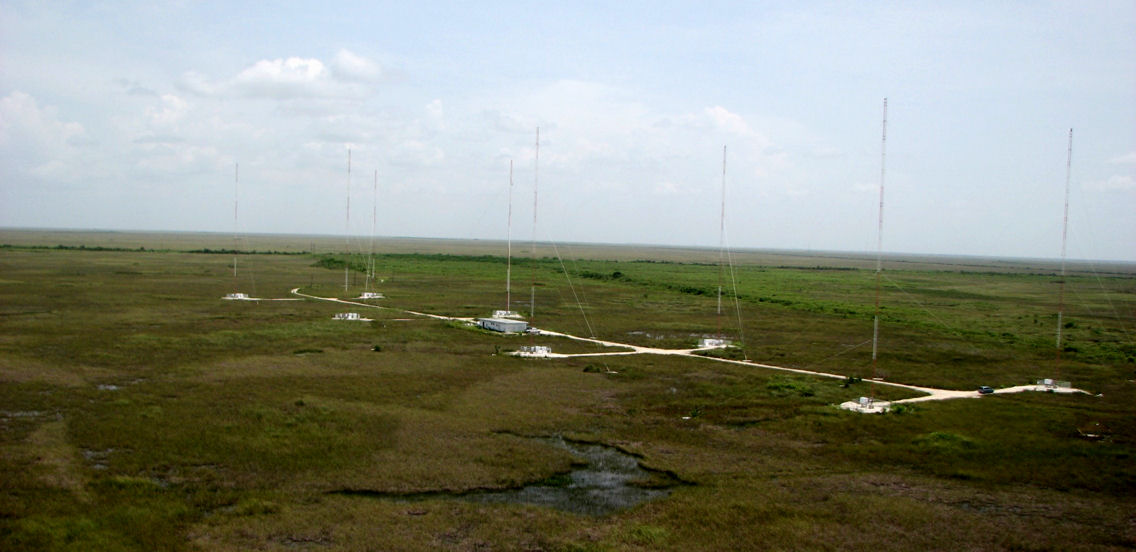 antenna sample systems, while Mr. Jones discussed the modeling
of an eight-tower AM directional array (see photo) which utilizes
toroidal current transformers (TCTs) for sampling. This array
is located adjacent to the Florida Everglades, far away from any
significant re-radiating structures that could potentially distort
the directional pattern, and as such represents a nearly-ideal
opportunity to do a comparison of computer modeling and measured
performance values. These towers are of equal height, uniform
cross-section, base insulated, and supported by non-conducting,
Phillystran guy cables. According to Mr. Jones, since the tower
(electrical) heights at the station’s operating frequency
are 73.4 degrees, they are well within the tower height range
where TCT-based sampling works extremely well.
antenna sample systems, while Mr. Jones discussed the modeling
of an eight-tower AM directional array (see photo) which utilizes
toroidal current transformers (TCTs) for sampling. This array
is located adjacent to the Florida Everglades, far away from any
significant re-radiating structures that could potentially distort
the directional pattern, and as such represents a nearly-ideal
opportunity to do a comparison of computer modeling and measured
performance values. These towers are of equal height, uniform
cross-section, base insulated, and supported by non-conducting,
Phillystran guy cables. According to Mr. Jones, since the tower
(electrical) heights at the station’s operating frequency
are 73.4 degrees, they are well within the tower height range
where TCT-based sampling works extremely well.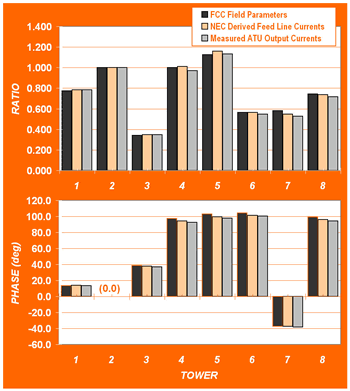
For
this study, an antenna system model was developed using NEC-4
computer code that had been specially modified to incorporate
an algorithm that derives base drive voltages from radiated field
parameters. Once all construction was completed at the site, impedance
measurements were performed at the base of each tower with all
other towers shorted at their base. Iterative changes to the modeled
towers were made until the resulting model-derived base impedance
of each tower matched the measured base impedance for the case
where all other towers were shorted at their base. The directional
model was then re-run with the modified towers to establish the
relative magnitude and phase of the base currents required to
produce the directional pattern.
The
charts at right contains a comparison of the relative magnitude
(ratio, normalized to tower 2 values, shown in upper chart) and
phase (lower chart, also normalized to tower 2) of the radiated
fields (FCC field parameters), the NEC derived feed line currents,
and the corresponding TCT measured currents at the output of the
antenna tuning unit (ATU) network. Comparison of the measured
relative ATU output currents with the corresponding feed line
currents demonstrates the impact of stray capacitance associated
with diplexing filters used in this installation. Comparison of
the NEC derived feed line parameters with the FCC field parameters
indicates that the TCT-based sampling system provides a good approximation
of the field parameters for the tower height of 73.4 degrees.
 Next,
field strength measurements were performed in accordance with
FCC Rules. Non-directional and directional measurements were made
along twelve radial bearings including the bearings of the six
pattern minima. A helicopter outfitted with a specially mounted
and calibrated receive antenna and GPS receiver was used for these
measurements. The results are shown in the polar plot at left,
which compares the measured pattern with the FCC authorized “standard
pattern” (an interesting historical paper on the standard
pattern was referenced in the IEEE paper and is available on the
Internet at www.dlr.com/pdfs/StandardPattern.pdf). Next,
field strength measurements were performed in accordance with
FCC Rules. Non-directional and directional measurements were made
along twelve radial bearings including the bearings of the six
pattern minima. A helicopter outfitted with a specially mounted
and calibrated receive antenna and GPS receiver was used for these
measurements. The results are shown in the polar plot at left,
which compares the measured pattern with the FCC authorized “standard
pattern” (an interesting historical paper on the standard
pattern was referenced in the IEEE paper and is available on the
Internet at www.dlr.com/pdfs/StandardPattern.pdf).
This
plot shows that the measured pattern shape, even in the highly
suppressed null directions of the pattern, is in excellent agreement
with the authorized pattern shape. Further, the measured radiated
fields are within the authorized maximum radiation values (standard
pattern fields) for all radial bearings except for the pattern
minimum at 224.5 degrees, where the measured radiation exceeds
the standard pattern radiation by approximately 16%. Mr. Jones
believes that even this small perturbation is the result of re-radiation
from sources external to the antenna array rather than the result
of an error in the set-up procedure or in the TCT-based current
samples.
Mr.
Jones believes this example case shows that TCT-based sampling
systems can be used to set up and verify complicated directional
antenna systems when moment method modeling techniques are used
to establish accurate estimates of the required feed line currents.
For additional information or for a copy of this paper, contact
Mr. Jones by email at ctjones@ctjc.com
or Stephen Lockwood by email at lockwood@hatdaw.com.
Both
of the topics discussed in this IEEE paper (antenna modeling and
sampling systems) will be covered in detail at the upcoming NAB
AM Antenna Computer Modeling Seminar, to be held on November 20-21,
2008 in Washington, D.C. (additional information below).
FCC
Releases Public Notice on Proposed FM Digital Power Increase
The
Federal Communications Commission is seeking public input on a
proposal to allow FM in-band/on-channel (IBOC) digital radio broadcasters
to increase the power of the digital portion of their signal by
up to 10 dB.
As
discussed in the Public Notice, in June 2008 a group consisting
of 18 broadcasters and the 4 largest manufacturers of broadcast
transmission equipment (identifying themselves as “Joint
Parties”) filed a request asking the Commission to revise
the current technical specifications for FM IBOC digital radio
(available on the Internet at http://gullfoss2.fcc.gov/prod/ecfs/retrieve.cgi?native_or_pdf=pdf&id_document=6520027716).
Specifically, the Joint Parties request that the Commission increase
the maximum permissible digital operating power of FM stations
from the current level of 1 percent of a station’s authorized
analog power (-20 dBc, referenced to the unmodulated analog FM
carrier power) to a maximum of 10 percent of a station’s
authorized analog power (-10 dBc).
Additionally,
technical reports have been filed by iBiquity Digital Corporation
and NPR Labs on studies which relate to this matter. The FCC is
seeking comment on the Joint Parties request, the iBiquity study,
and the NPR study. A copy of the Public Notice is available from
the FCC’s Web site at http://hraunfoss.fcc.gov/edocs_public/attachmatch/DA-08-2340A1.pdf.
Comments are due on November 28, 2008 and replies are due on January
4, 2009. Comments and replies may be filed electronically by accessing
the Electronic Comment Filing System (ECFS) at www.fcc.gov/cgb/ecfs/.
Filers should follow the instructions provided on the Web site
for submitting comments, and should include their full name, U.S.
Postal service mailing address, and the applicable docket number:
MM Docket No. 99-325. Parties may also submit an electronic comment
by email—to get filing instructions, send an e-mail to ecfs@fcc.gov,
and include the words “get form” in the body of the
message. A sample form and instructions will be sent in response.
 The
FCC Adopted Computer Modeling for The
FCC Adopted Computer Modeling for
AM Antenna Proof of Performance on September 24, 2008
Attend NAB's AM Antenna Computer Modeling Seminar and Learn How
It's Done
Computer
modeling for AM Antenna proof of performance was adopted by the
FCC on September 24. To learn the basics needed to utilize modeling
software, such as MININEC and nodal analysis – used for designing
performance-optimized AM directional antenna phasing and coupling
systems and proving the performance of directional antenna patterns
–- plan on attending NAB’s AM Antenna Computer Modeling
Seminar in Washington, D.C. November 20 and 21.
You
will learn about:
Moment
Method Modeling Basics
DA
Proofing Using Moment Method Modeling
Overcoming
Limitations of Using Field Strength Measurements for DA Proofs
State
of the Art in Phasing System Design Nodal Analysis of AM DA
Phasing and Coupling Systems
Pattern
Design Considerations for Optimum Performance
AM
antenna experts Ron Rackley and Ben Dawson, along with antenna
modeling software specialist Jerry Westberg, will lead the seminar
demonstrating how moment method modeling makes analysis of actual
tower current distributions possible and how a model can be used
to proof an array provided the proper criteria are considered.
All instructors are well known in the radio industry as experts
in the field of directional antenna design and maintenance. Their
decades of experience offer station engineers an opportunity to
learn techniques, tips and tricks that can be immediately useful.
Seminar
fee: $395.00 (NAB members) and $495.00 (non-members). For
more information on the curriculum, how to register or housing
go to AM
DA Seminar on the NAB Web site or call Sharon Devine at (202)-429-5338.
Register now for the NAB AM Antenna Computer Modeling Seminar!
Share
Your Expertise with Your Fellow Engineers
Last Call for 63rd NAB Broadcast Engineering Conference Proposals
 The
NAB Show will host the 63rd NAB Broadcast Engineering Conference
(BEC) on April 18 - 23 at the Las Vegas Convention Center in Las
Vegas, Nev. This world-class conference addresses the most recent
developments in broadcast technology and focuses on the opportunities
and challenges that face broadcast engineering professionals around
the world. The BEC is a highly technical conference where presenters
deliver technical papers ranging over a variety of topics relevant
to the broadcast and allied industries. We invite you to submit
a proposal to present a technical paper at our conference. The
deadline for submitting your proposal is October 27, 2008. The
NAB Show will host the 63rd NAB Broadcast Engineering Conference
(BEC) on April 18 - 23 at the Las Vegas Convention Center in Las
Vegas, Nev. This world-class conference addresses the most recent
developments in broadcast technology and focuses on the opportunities
and challenges that face broadcast engineering professionals around
the world. The BEC is a highly technical conference where presenters
deliver technical papers ranging over a variety of topics relevant
to the broadcast and allied industries. We invite you to submit
a proposal to present a technical paper at our conference. The
deadline for submitting your proposal is October 27, 2008.
To
submit a technical paper proposal, click
here and complete the electronic form. If you have questions
regarding the NAB Broadcast Engineering Conference, please contact
John Marino.

The October 27, 2008 Radio TechCheck is also available
in an Adobe Acrobat file.
Please
click
here to read the Adobe Acrobat version of Radio TechCheck.
|
