|
Graceful
Degradation in Digital Radio Systems
 While
digital broadcasting systems are a significant improvement over
analog in almost every regard, one aspect which is often seen
as less than desirable is the so-called “cliff effect”
manner by which digital system performance degrades. This refers
to the behavior whereby the digital system (be it digital radio
or TV) works perfectly up to a certain point (for example, to
a threshold level of interference or receivable signal level),
but just beyond that point, the picture freezes or the audio mutes.
A paper presented at the 125th Audio Engineering Society (AES)
convention (October 2-5, 2008, in San Francisco, Calif., www.aes.org)
describes a method of graceful degradation recently developed
for the Digital Radio Mondiale (DRM) digital radio system, and
includes some interesting test data indicating how graceful degradation
is perceived by listeners. While
digital broadcasting systems are a significant improvement over
analog in almost every regard, one aspect which is often seen
as less than desirable is the so-called “cliff effect”
manner by which digital system performance degrades. This refers
to the behavior whereby the digital system (be it digital radio
or TV) works perfectly up to a certain point (for example, to
a threshold level of interference or receivable signal level),
but just beyond that point, the picture freezes or the audio mutes.
A paper presented at the 125th Audio Engineering Society (AES)
convention (October 2-5, 2008, in San Francisco, Calif., www.aes.org)
describes a method of graceful degradation recently developed
for the Digital Radio Mondiale (DRM) digital radio system, and
includes some interesting test data indicating how graceful degradation
is perceived by listeners.
Graceful
degradation has been one of the hallmarks of the iBiquity HD Radio
digital radio system (developed by iBiquity Digital Corporation,
Columbia, Md, www.ibiquity.com)
and perhaps one of its most distinguishing features. For both
the AM and FM hybrid HD Radio systems (these are the systems currently
authorized for use in the U.S. by the FCC), the main channel audio
signal is simulcast on both the analog and digital portions of
the signal. At the point of digital signal degradation, these
systems “blend” from the digital to the analog version
of the audio signal and consequently the listener continues to
hear the audio programming instead of silence as would happen
with other (non-HD Radio) digital radio systems under similar
circumstances.
The
HD Radio system design also provides for graceful degradation
when operating in an “all-digital” mode that is not
yet authorized by the FCC but which may some day be allowed when
the HD Radio receiver penetration in the marketplace is sufficiently
high. The all-digital mode offers additional benefits including
expanded digital coverage and increased digital payload capacity.
In all-digital mode, the main channel audio signal is sent in
separate parts, as “core” and “enhanced” bit
streams, with the core part being the more robust of the two,
that is, better able to survive impairments due to noise and/or
interference, or weak signal strength. As the signal degrades,
the receiver will first lose the enhanced portion of the audio
but continue to receive the core portion, providing for a graceful
degradation under impaired or low signal level conditions.
In
the graceful degradation method being proposed for DRM, a separate,
redundant audio stream with a very low bit rate is sent along
with the full rate digital audio signal. According to the AES
paper, this method was chosen over more sophisticated hierarchical
coding and modulation schemes (such as the one used in the all-digital
HD Radio systems) because it requires a lesser amount of change
to the DRM standard to be accommodated. This very low bit rate
redundant stream is sent with a time delay (with respect to the
full rate stream), creating “time diversity” in the
audio transmission such that short duration impairments will affect
each of these streams at different points in the audio material.
When degradation is detected in the full rate stream, the receiver
will attempt to replace the degraded portion with the corresponding
(and presumably undegraded) portion from the low rate stream.
For impairments (or low signal level conditions) of very long
duration, both streams will ultimately be impaired and in this
case the system will end up in a muted condition, but for short
duration events, muting can be avoided.
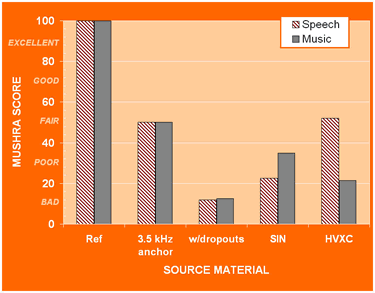 Two
different audio coding methods were tested for use with the DRM
low bit rate redundant audio stream, one optimized for speech
(Harmonic Vector Excitation Coding or HCVX), and the other for
music (a sinusoidal audio codec, denoted SIN, developed especially
for this project). The results of some subjective audio testing
using these two methods are presented in the graph. For these
tests the “Multi Stimulus Test with Hidden Reference and
Anchor” (MUSHRA) methodology was used; listeners rated the
audio quality of a series of audio cuts on a scale of 0 (bad)
to 100 (excellent). Two
different audio coding methods were tested for use with the DRM
low bit rate redundant audio stream, one optimized for speech
(Harmonic Vector Excitation Coding or HCVX), and the other for
music (a sinusoidal audio codec, denoted SIN, developed especially
for this project). The results of some subjective audio testing
using these two methods are presented in the graph. For these
tests the “Multi Stimulus Test with Hidden Reference and
Anchor” (MUSHRA) methodology was used; listeners rated the
audio quality of a series of audio cuts on a scale of 0 (bad)
to 100 (excellent).
By
design (in a MUSHRA test), the reference signal (“Ref”)
and anchor signal (“3.5 kHz anchor) are set to full- and
mid-scale, respectively. As seen in the graph, the results for
the impaired audio samples without graceful degradation (“w/dropouts”)
are “BAD” for both speech and music. With the graceful
degradation scheme enabled, the audio quality is improved, with
the speech material experiencing more improvement when the HVCX
codec is used, and likewise for the music material with the SIN
codec.
The
AES paper is entitled “Graceful Degradation for Digital Radio
Mondiale (DRM)” and is co-authored by Ferenc Kraemer and
Gerald Schuller, both of Fraunhofer IDMT, Ilmenau, Germany. A
copy of the complete AES paper will soon be available for purchase
on the AES Web page. Go to www.aes.org/publications/preprints/
and look for the link to the AES 125th Convention, San Francisco,
Calif.
 The
FCC Adopted Computer Modeling for The
FCC Adopted Computer Modeling for
AM Antenna Proof of Performance on September 24, 2008
Attend NAB's AM Antenna Computer Modeling Seminar and Learn How
Computer
modeling for AM Antenna proof of performance was adopted by the
FCC on September 24. To learn the basics needed to utilize modeling
software, such as MININEC and nodal analysis – used for designing
performance-optimized AM directional antenna phasing and coupling
systems and proving the performance of directional antenna patterns
–- plan on attending NAB’s AM Antenna Computer Modeling
Seminar in Washington, D.C. November 20 and 21.
You
will learn about:
Moment
Method Modeling Basics
DA
Proofing Using Moment Method Modeling
Overcoming
Limitations of Using Field Strength Measurements for DA Proofs
State
of the Art in Phasing System Design Nodal Analysis of AM DA
Phasing and Coupling Systems
Pattern
Design Considerations for Optimum Performance
AM
antenna experts Ron Rackley and Ben Dawson, along with antenna
modeling software specialist Jerry Westberg, will lead the seminar
demonstrating how moment method modeling makes analysis of actual
tower current distributions possible and how a model can be used
to proof an array provided the proper criteria are considered.
All instructors are well known in the radio industry as experts
in the field of directional antenna design and maintenance. Their
decades of experience offer station engineers an opportunity to
learn techniques, tips and tricks that can be immediately useful.
Seminar
fee: $395.00 (NAB members) and $495.00 (non-members). For
more information on the curriculum, how to register or housing
go to AM
DA Seminar on the NAB Web site or call Sharon Devine at (202)-429-5338.
Register now for the NAB AM Antenna Computer Modeling Seminar!
DEADLINE
EXTENDED FOR 63rd NAB BROADCAST ENGINEERING CONFERENCE
CALL FOR PAPERS
 NAB
Show will host the 63rd NAB Broadcast Engineering Conference on
April 18 – 23 at the Las Vegas Convention Center in Las Vegas,
Nevada. NAB
Show will host the 63rd NAB Broadcast Engineering Conference on
April 18 – 23 at the Las Vegas Convention Center in Las Vegas,
Nevada.
The
NAB Broadcast Engineering Conference is a highly technical conference
where presenters deliver technical papers ranging over a variety
of topics relevant to the broadcast and allied industries. We
invite you to submit a proposal to present a technical paper at
our conference. The deadline for submitting your proposal is October
27, 2008.
To
submit a technical paper proposal, click
here and complete the electronic form. If you have questions
regarding the NAB Broadcast Engineering Conference, please contact
John Marino.
 
The IEEE Broadcast Technology Society
58th ANNUAL IEEE BROADCAST SYMPOSIUM
Managing
the Transitions
15 - 17 October 2008
The Westin Alexandria
Alexandria, Va.
Keynote
Speakers to include: Richard E. Wiley, Wiley Rein, LLP and Peter
Fannon, Panasonic Corporation.
Please visit the Registration
page for additional information.


The October 13, 2008 Radio TechCheck is also available
in an Adobe Acrobat file.
Please
click
here to read the Adobe Acrobat version of Radio TechCheck.
|
