|
Computer
Modeling with Sampling System Verification Now Allowed for AM
DAs
In
a long-awaited move, on September 24, the FCC issued a 2nd
Report & Order (R&O) and 2nd Further Notice of
Proposed  Rulemaking
(FNPRM) which for the first time will allow AM broadcasters to
use computer modeling (in conjunction with sampling system verification)
for performance verification of AM directional antennas (DAs).
This action is taken as part of the FCC’s proceeding in MM
Docket No. 93-177, An Inquiry into the Commission's Policies
and Rules Regarding AM Radio Service Directional Antenna Performance
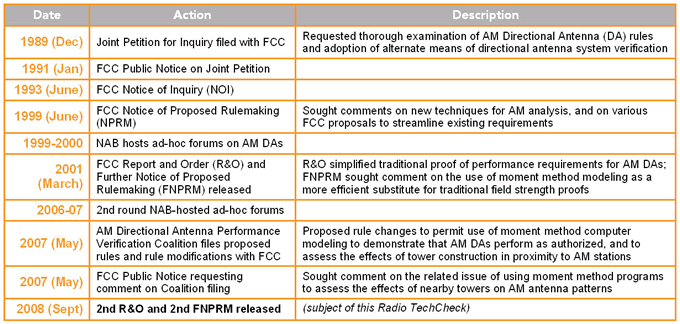
Verification. A brief history of this proceeding is provided
in the table below (see also the July
30, 2007 issue of Radio TechCheck for additional information). Rulemaking
(FNPRM) which for the first time will allow AM broadcasters to
use computer modeling (in conjunction with sampling system verification)
for performance verification of AM directional antennas (DAs).
This action is taken as part of the FCC’s proceeding in MM
Docket No. 93-177, An Inquiry into the Commission's Policies
and Rules Regarding AM Radio Service Directional Antenna Performance
Verification. A brief history of this proceeding is provided
in the table below (see also the July
30, 2007 issue of Radio TechCheck for additional information).
These new rules are essentially those proposed in May 2007 by
the AM Directional Antenna Verification Coalition, a self-described
group of “...broadcasters, broadcast engineering consultants
and broadcast equipment manufacturers, all of whom are experts
in the science of AM DA design and have extensive experience in
the adjustment and maintenance of AM DAs.” Throughout this
proceeding, the goal has been to allow broadcasters to take advantage
of advances in antenna analysis methods, resulting in simpler,
less expensive means of verifying AM DA performance. Some commenters
maintain that as many as half of the approximately 1,900 AM DAs
in service are in need of adjustment, and consequently the adoption
of these modeling techniques will provide an overall benefit to
the AM service by substantially reducing the cost of a proof of
performance, and thereby encouraging AM licensees to properly
maintain their directional arrays.
Some
of the details of the now-modified §73.151, Directional Antenna
Performance Verification, include the following:
- The performance
of a DA may be verified either by field strength measurement
or by computer modeling and sampling system verification;
- Each
element of the directional array shall be modeled by use of
a method of moments computer program. Only arrays consisting
of series-fed elements may have their performance verified
by computer modeling and sample system verification;
- A matrix
of impedance measurements at the base and/or feed point of
each element in the array, with all other elements shorted
and/or open circuited at their respective measurement locations,
shall be made. The physical model of the individual antenna
elements used in the computer program may be varied to match
the measured impedance matrix, but the actual spacings and
orientations of the array elements must be used;
- The
samples used to drive the antenna monitor may be current transformers
or voltage sampling devices at the outputs of the antenna
matching networks or sampling loops located on the towers.
A complete description of the sampling system, including the
results of the required measurements, shall be submitted with
the application for license.
In
the 2nd R&O, the FCC noted comments expressing concerns
about differences between computer simulations and field measurements
of antenna performance, but said that “...minor differences
in pattern adjustment are [not] sufficient to disqualify moment
method techniques,” adding that “[t]he uncertainties
in the AM assignment process, including short- and long-term variations
in directional antenna performance, seasonal changes in ground
conductivities, and variations in nighttime propagation caused
by sunspot activity, are large enough to obscure any differences
between two reasonable methods of directional antenna adjustment.”
The 2nd FNPRM
portion of the document deals with issues raised in the FCC’s
May 2007 Public Notice, responding to comments from the AM
Directional Antenna Verification Coalition on the use of moment
method programs to assess the effects of nearby towers on AM antenna
patterns. The Commission is requesting comment on rules proposed
by the Coalition which are attached to the 2nd FNPRM as Appendix
E. Some of the specific questions being asked include the following:
-
Should
the proposed rules apply to construction of all communications
towers above a specified height, not just towers requiring
notice to the Federal Aviation Administration and tower registration
under Part 17?
-
Should
the Commission apply the proposed rules to the owners of structures
that are not otherwise subject to Commission licensing processes,
i.e., with regard to structures such as towers that do not
require registration and which no Commission licensee or applicant
uses or proposes to use?
- Should
the Commission prohibit applicants from proposing and licensees
from using a tower when the owner has not complied with notice
and detuning requirements?
- Regarding
the proposed rule’s exclusion of short towers from consideration,
should the Commission reduce the proposed threshold height
of 45 electrical degrees to 36 degrees (this based on a technical
filing provided by the Association of Federal Communications
Consulting Engineers)?
- Comments
are sought on the types of structures, such as buildings,
that should be categorically excluded from the proposed rules;
- Should
any final rule on this issue, if adopted, include a provision
requiring tower proponents to protect the AM station upon
submission of a credible demonstration that the tower affects
the AM pattern?
The
new AM DA rules established in the 2nd R&O will not become
effective until they are published in the Federal Register. The
full text of the 2nd R&O and 2nd FNPRM are available on the
FCC Web site at http://hraunfoss.fcc.gov/edocs_public/attachmatch/FCC-08-228A1.pdf.
Comments and Reply Comments for the 2nd FNPRM will be due 30 days
and 60 days after publication in the Federal Register, respectively.
 NAB
AM Antenna Computer Modeling Seminar NAB
AM Antenna Computer Modeling Seminar
November 20-21, 2008
NAB Headquarters
Washington D.C.
Computer
modeling for AM Antenna proof of performance was adopted by the
FCC on September 24. To learn the basics needed to utilize modeling
software, such as MININEC and nodal analysis – used for designing
performance-optimized AM directional antenna phasing and coupling
systems and proving the performance of directional antenna patterns
–- plan on attending NAB’s AM Antenna Computer Modeling
Seminar in Washington, D.C. November 20 and 21.
You
will learn about:
Moment
Method Modeling Basics
DA
Proofing Using Moment Method Modeling
Overcoming
Limitations of Using Field Strength Measurements for DA Proofs
State
of the Art in Phasing System Design Nodal Analysis of AM DA
Phasing and Coupling Systems
Pattern
Design Considerations for Optimum Performance
AM
antenna experts Ron Rackley and Ben Dawson, along with antenna
modeling software specialist Jerry Westberg, will lead the seminar
demonstrating how moment method modeling makes analysis of actual
tower current distributions possible and how a model can be used
to proof an array provided the proper criteria are considered.
All instructors are well known in the radio industry as experts
in the field of directional antenna design and maintenance. Their
decades of experience offer station engineers an opportunity to
learn techniques, tips and tricks that can be immediately useful.
Seminar
fee: $395.00 (NAB members) and $495.00 (non-members). For
more information on the curriculum, how to register or housing
go to AM
DA Seminar on the NAB Web site or call Sharon Devine at (202)-429-5338.
Register now for the NAB AM Antenna Computer Modeling Seminar!
DEADLINE
EXTENDED FOR 63rd NAB BROADCAST ENGINEERING CONFERENCE
CALL FOR PAPERS
 NAB
Show will host the 63rd NAB Broadcast Engineering Conference on
April 18 – 23 at the Las Vegas Convention Center in Las Vegas,
Nevada. NAB
Show will host the 63rd NAB Broadcast Engineering Conference on
April 18 – 23 at the Las Vegas Convention Center in Las Vegas,
Nevada.
The
NAB Broadcast Engineering Conference is a highly technical conference
where presenters deliver technical papers ranging over a variety
of topics relevant to the broadcast and allied industries. We
invite you to submit a proposal to present a technical paper at
our conference. The deadline for submitting your proposal is October
27, 2008.
To
submit a technical paper proposal, click
here and complete the electronic form. If you have questions
regarding the NAB Broadcast Engineering Conference, please contact
John Marino.
 
The IEEE Broadcast Technology Society
58th ANNUAL IEEE BROADCAST SYMPOSIUM
Managing
the Transitions
15 - 17 October 2008
The Westin Alexandria
Alexandria, VA, USA
Keynote
Speakers to include: Richard E. Wiley, Wiley Rein, LLP and Peter
Fannon, Panasonic Corporation.
Please visit the Registration
page for additional information.


The October 6, 2008 Radio TechCheck is also available
in an Adobe Acrobat file.
Please
click
here to read the Adobe Acrobat version of Radio TechCheck.
|
