|
NAB
FASTROAD Releases HD Radio EPG Report
NAB's
technology advocacy program, NAB FASTROAD, released a report on
September 17, 2008 that describes the key business requirements
and consumer-use scenarios for various HD Radio-based Electronic
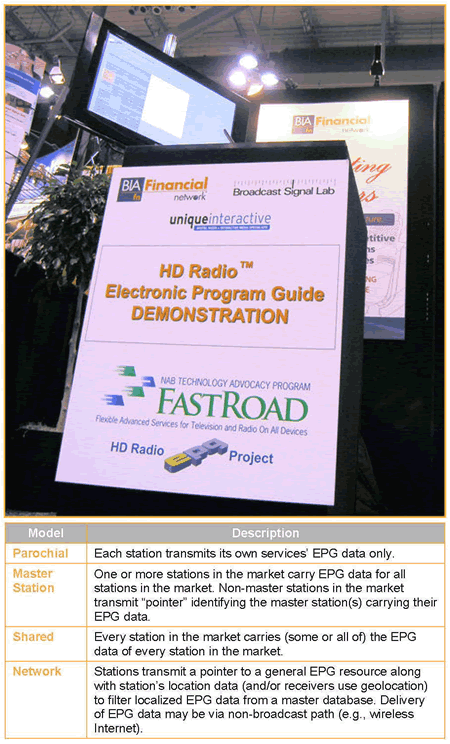
Program Guide (EPG) system designs. This release was done in conjunction
with the demonstration of a prototype EPG authoring system, on
display in the BIA Financial Network (BIAfn) booth during The
NAB Radio Show in Austin, Texas (www.nabradioshow.com).
The system, an interactive on-screen guide that displays scheduled
broadcast programming, is suited to serve the needs of local HD
Radio stations.
 EPG
is seen as many in the radio industry as not just a simple feature
extension, but rather as having the potential to fundamentally
affect the radio industry and how listeners discover new music
and new stations. It can provide significant incentive for digital
conversion of stations that have not yet done so, and it can drive
substantial new consumer adoption of HD Radio technology. EPG
service can also help the radio broadcast medium remain competitive,
by satisfying listeners who are becoming more sophisticated in
their expectations of the services that accompany their digital
media. EPG
is seen as many in the radio industry as not just a simple feature
extension, but rather as having the potential to fundamentally
affect the radio industry and how listeners discover new music
and new stations. It can provide significant incentive for digital
conversion of stations that have not yet done so, and it can drive
substantial new consumer adoption of HD Radio technology. EPG
service can also help the radio broadcast medium remain competitive,
by satisfying listeners who are becoming more sophisticated in
their expectations of the services that accompany their digital
media.
The
overall goals of this NAB FASTROAD project are to develop the
business requirements, system architecture and specifications
for an HD Radio-based EPG. The project team–BIAfn, Broadcast
Signal Lab (BSL) and Unique Interactive, which has developed similar
EPG services for the digital audio broadcast market in Europe–has
worked in close cooperation with iBiquity Digital Corporation,
developers of HD Radio technology (see the September
8, 2008 issue of Radio TechCheck for additional information
on this project).
Implementing
an EPG for radio is inherently more difficult than for TV due
to a variety of factors, including the mobile nature of radio
listening, the lack of an established EPG content-aggregation
infrastructure, the wide variation in receiver displays, and the
fact that there are so many stations to manage in any given market.
Taking these challenges into account, this report presents what
the authors believe to be a workable design for a U.S. radio EPG
system utilizing HD Radio technology.
Four
possible delivery architectures are presented in the report, accommodating
a range of station needs, from each station carrying its own EPG
data, to various methods of cross-carriage via cooperation among
station groups, or even an entire radio market (see table). Also
noted is the expectation that some stations will use EPG data
more than others, and that receivers’ EPG capabilities will
vary widely, from the earliest and most basic EPG-capable designs,
to more advanced models and those expected during the period of
EPG service’s ultimate maturity (currently available HD Radio
hardware does not support EPG transmission or reception).
In
addition, the report addresses the issues of EPG parity between
AM and FM stations, and how to accommodate stations that are not
yet transmitting HD Radio signals (given that HD Radio receivers
also pick up analog-only radio signals).
Of
particular interest is an Appendix to the report describing a
field survey, conducted by Broadcast Signal Lab, which explores
the variability of stations that can be received at any given
location within and around a radio market. This is a dynamic situation,
because there will be different sets of receivable stations in
different parts of the same radio market. Indeed, radio stations
from adjacent markets often will be added to the list of currently
receivable stations at any given location.
For
this survey, the Boston market was selected in part because of
the proximity of two close adjacent markets (Providence and Worcester).
The survey results (included in the Appendix) compare the stations
receivable at a reference point (in the center of the Boston market)
with the stations receivable at 25 test sites within a 40-mile
radius of the reference point. For FM, it was found that on average,
17 of the stations received at the test sites matched those receivable
at the reference location; that 10 stations (on average) available
at the reference location were not receivable at the test sites;
and, that an average of 14 stations were receivable at the test
sites that were not receivable at the reference point. These results
highlight the difficulties to be dealt with in trying to develop
an EPG system that is market-based.
The
full text of the HD Radio EPG report and information on the NAB
FASTROAD technology advocacy program are available at www.NABFASTROAD.org.
FCC Streamlines Rules for AM Directional Antenna
Proof of Performance
On
Friday, September 26, 2008 the FCC released a Second Report
and Order and Second Further Notice of Proposed Rulemaking
regarding the Rules for verifying the performance of AM directional
antenna (DA) systems. The Report and Order part of the document
substantially reduces the regulatory burdens on AM broadcasters
by, among other things, permitting the use of computer-based Method
of Moments modeling techniques to verify AM directional antenna
performance. It also streamlined the Rules with respect to conventional
requirements for directional AM stations, reduced the scope of
work required for a directional AM proof of performance, and eliminated
other obsolete Rules. The Further Notice portion seeks comment
on a number of issues regarding restrictions that should be placed
on construction of towers near existing AM directional facilities
that could distort the DA's pattern.
For
more information you can view the complete Second
Report and Order and Second Further Notice of Proposed Rulemaking.
DEADLINE
EXTENDED FOR 63rd NAB BROADCAST ENGINEERING CONFERENCE
CALL FOR PAPERS
 NAB
Show will host the 63rd NAB Broadcast Engineering Conference on
April 18 – 23 at the Las Vegas Convention Center in Las Vegas,
Nevada. NAB
Show will host the 63rd NAB Broadcast Engineering Conference on
April 18 – 23 at the Las Vegas Convention Center in Las Vegas,
Nevada.
The
NAB Broadcast Engineering Conference is a highly technical conference
where presenters deliver technical papers ranging over a variety
of topics relevant to the broadcast and allied industries. We
invite you to submit a proposal to present a technical paper at
our conference. The deadline for submitting your proposal is October
27, 2008.
To
submit a technical paper proposal, click
here and complete the electronic form. If you have questions
regarding the NAB Broadcast Engineering Conference, please contact
John Marino.
 
Register Now!
Discounted Registration Rate is only available until 1 October
2008
The IEEE Broadcast Technology Society
58th ANNUAL IEEE BROADCAST SYMPOSIUM
Managing the Transitions
15 - 17 October 2008
The Westin Alexandria
Alexandria, VA, USA
Keynote
Speakers to include: Richard E. Wiley, Wiley Rein, LLP and Peter
Fannon, Panasonic Corporation.
Please visit the Registration
page for additional information.
 NAB
AM Antenna NAB
AM Antenna
Computer Modeling Seminar
November 20-21, 2008
NAB Headquarters
Washington, DC
Computer modeling for AM Antenna proof of performance was adopted
by the FCC last week. To learn the basics needed to utilize modeling
software, such as MININEC and nodal analysis — used for designing
performance-optimized AM directional antenna phasing and coupling
systems and proving the performance of directional antenna patterns
— plan on attending NAB's AM Antenna Computer Modeling Seminar
in Washington, D.C. November 20 and 21.
You
will learn about:
- Moment
Method Modeling Basics
- DA Proofing
Using Moment Method Modeling
- Overcoming
Limitations of Using Field Strength Measurements for DA Proofs
- State
of the Art in Phasing System Design Nodal Analysis of AM DA
Phasing and Coupling Systems
- Pattern
Design Considerations for Optimum Performance
AM
antenna experts Ron Rackley and Ben Dawson, along with antenna
modeling software specialist Jerry Westberg, will lead the seminar
demonstrating how moment method modeling makes analysis of actual
tower current distributions possible and how a model can be used
to proof an array provided the proper criteria are considered.
All instructors are well known in the radio industry as experts
in the field of directional antenna design and maintenance. Their
decades of experience offer station engineers an opportunity to
learn techniques, tips and tricks that can be immediately useful.
Seminar
fee: $395.00 (NAB members) and $495.00 (non-members). For
more information on the curriculum, how to register or housing
go to AM
Antenna Computer Modeling Seminar on the NAB Web site or call
Sharon Devine at (202)-429-5338. Register now for the NAB AM Antenna
Computer
Modeling Seminar!


The September 29, 2008 Radio TechCheck is also
available in an Adobe Acrobat file.
Please
click
here to read the Adobe Acrobat version of Radio TechCheck.
|
